Glimmer of Hope for Gold’s Rebound
09 November 2022
Read Time 9 MIN
Support signs for gold
While interest rates trended higher and 10-year treasury yields rose above 4% for the first time since 2008, the dollar was unable to make new highs in October. Markets started wondering if rates are reaching a peak, allowing gold prices to stabilize above $1,600 per ounce. Gold reached a monthly high of $1,729 on October 4 amid jitters over Credit Suisse’s finances and continued fallout from UK property funds affected by the Liability Driven Investment (LDI) crisis. Gold then trended lower to end the month with a $27.05 (1.63%) loss at $1,633.56.
Historically, physical demand for gold picks up in Asia and the Middle East when the gold price is weak. The current low gold price is no exception, as buyers in China, India, and UAE sense a bargain. According to Bloomberg, gold in Dubai, Istanbul and Shanghai is trading at a premium to spot prices in London. Over 527 tonnes has been moved out of New York and London vaults since April, while Chinese imports reached a four-year high in August. Central Bank demand is also strong, as the World Gold Council reports the banks bought 399 tonnes in the third quarter, the strongest quarter on record. This physical demand may enable gold to find a floor around current levels.
Miners move the needle on “green”
Gold stocks eked out small gains in October, with the NYSE Gold Miners Index (GDMNTR) advancing 0.9% and the MVIS Global Junior Gold Index (MVGDXJTR) increasing 0.8%. There was some interesting news on the miners’ efforts to lower greenhouse gas emissions. Most mines run diesel equipment to load and haul rock. Underground gold mines use trucks that haul up to 65 tonnes, while open pit trucks can haul up to 300 tonnes. This is often a company’s largest source of greenhouse gas emissions, making the development of non-diesel equipment the key to a green mining industry. Australian Mining writes that mining manufacturer Sandvik will begin testing the largest battery electric truck for underground mining at the Sunrise Dam gold mine in Western Australia in December, with hopes of bringing it to market in 2023. Inadequate charging time and battery life have been the main impediments to adopting underground electric haul trucks. Hopefully this truck will meet the miners’ needs.
On the open pit front, Bloomberg reports members of the International Council on Mining and Metals (ICMM) plan to begin testing hydrogen and other zero-emission technologies at 50 sites by year-end. The CEO of ICMM expects mass availability of hydrogen and electric trucks in 2027, compared with an earlier projection of 2040.
Wars, inflation and recession: risks are still rising
Geopolitical risks continue to escalate. In its 2023 index of U.S. Military Strength, the Heritage Foundation downgraded the U.S. military from marginal to weak, citing shrinking shipbuilding, maintenance delays and backlogs, aging aircraft, pilot shortages, very poor pilot training, low munitions inventories and a lack of recruits. The U.S. is spending about 3% of GDP on defense, compared to 5%-6% in the 1980’s. Meanwhile, China reiterated its intentions to become a major military power and unify Taiwan Region at its Communist Party Congress.
Several recent measures indicate macro risks are also growing. Both CPI and PPI inflation were again ahead of expectations. The CPI was up 8.5% YOY in September. A study by Deutsche Bank using 126 observations around the globe since 1970 shows that when inflation exceeds 8%, it has always remained above 2% (U.S. Federal Reserve’s (Fed’s) target) for at least four years.
In a recent Wall Street Journal article the IMF Managing Director said “a global recession is very possible”. Economists, on average, put the probability of a U.S. recession in the next twelve months at 63%, up from 49% in July.
Debt may be the most overlooked danger
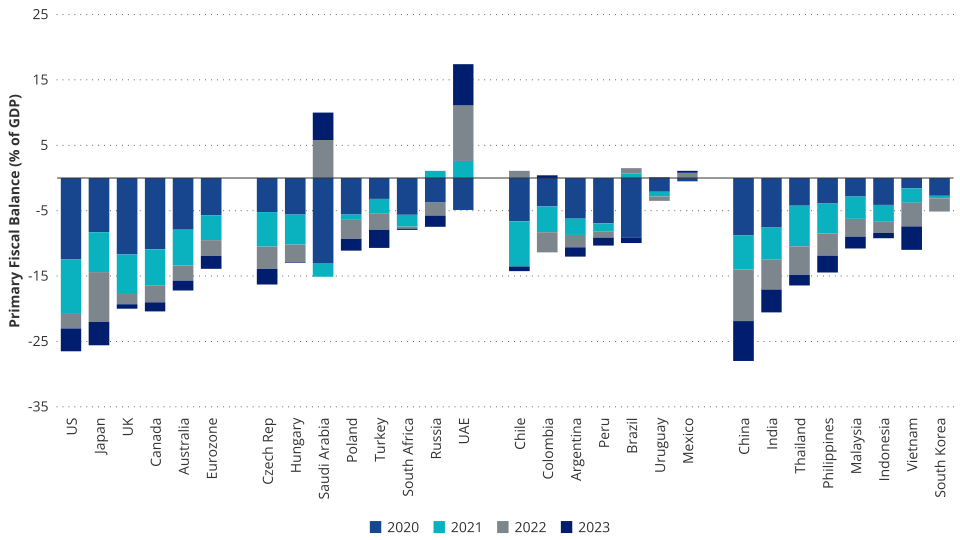
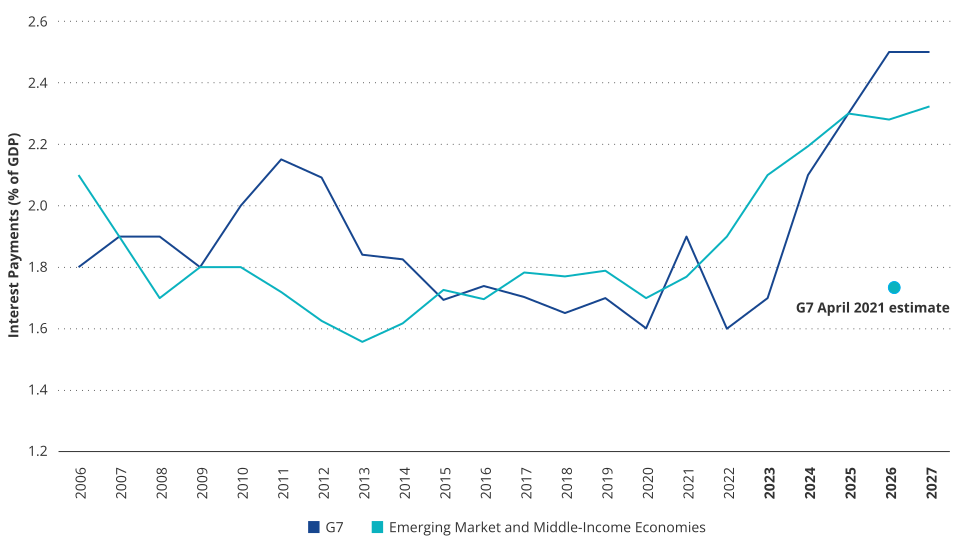
Two areas of risk that we believe are being ignored in the markets are debt and international currencies. Last month we mentioned that higher rates are setting U.S. debt service on a path to become the largest item in the federal budget. Natalia Gurushina, VanEck’s Chief Economist for Emerging Markets Fixed Income, provides two charts that illustrate that the problem is not limited to the U.S. The first chart shows many countries around the world have been piling on more debt, led by the two largest, the U.S. and China. The second chart indicates that, as existing debt is rolled into higher rates, debt service is set to consume a much larger portion of global GDP. The April 2021 estimate of 2026 G7 interest payments shows that few (if any) have anticipated this increase in debt service. Debt risks will likely rise as economies succumb to tighter central bank policies.
Piling on the debt: Primary fiscal balances as a % of GDP
Source: IMF Fiscal Monitor. Data as of October 2022.
Bills, bills, bills: Interest payments as % of GDP
Source: VanEck Research, IMF Fiscal Monitor. Data as of October 2022.
Historic mismatch in local gold prices
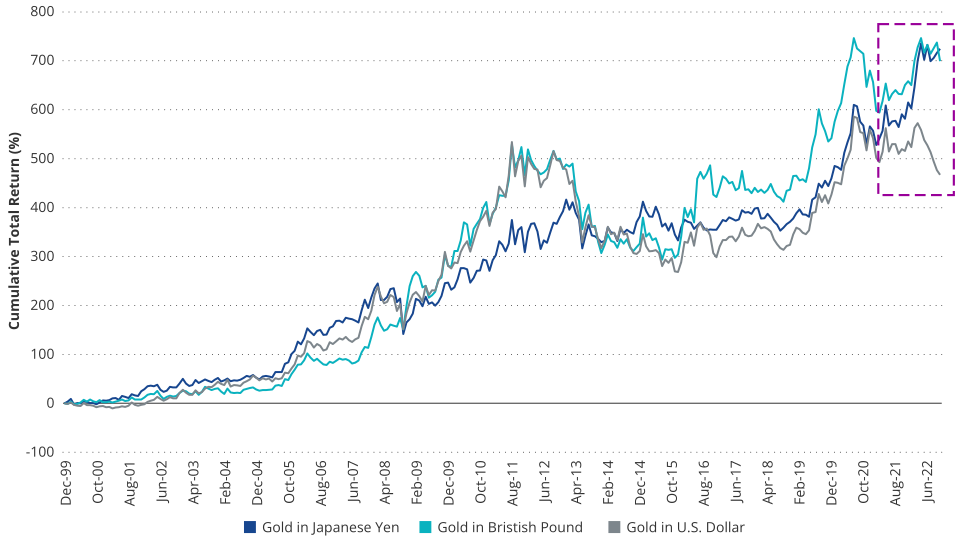
On the currency front, many have been tracking the dizzying rise in the dollar and the relentless declines in many other currencies around the globe. The chart below looks at gold prices in local currencies. The gray line is gold in U.S. dollars, while the teal and blue lines are gold in pound sterling and yen respectively. Gold in local currencies periodically outperforms or underperforms, but historically all three plots tend to move in tandem. The rectangle highlights the remarkable divergence recently between gold in U.S. dollars and the other two currencies. If fact, we looked at this chart back to 1972 and there has never been such a divergence. These are not rogue nations run by a despotic dictator, they are G7 countries with major reserve currencies. These currency dislocations reflect the extraordinary risks faced by the world today. While the U.S. has problems with inflation, debt, divisive politics, crime and a weakening military, other countries have problems that outweigh those in the U.S., allowing gold to trend higher as a local safe haven. How much longer can the U.S. be relatively insulated from the crises that increasingly afflict the rest of the world?
Mind the gap: Gold returns in dollar, yen and pound terms
Source: Bloomberg. Data as of October 2022.
Related Insights
IMPORTANT DEFINITIONS & DISCLOSURES
This material may only be used outside of the United States.
This is not an offer to buy or sell, or a recommendation of any offer to buy or sell any of the securities mentioned herein. Fund holdings will vary. For a complete list of holdings in VanEck Mutual Funds and VanEck ETFs, please visit our website at www.vaneck.com.
The information presented does not involve the rendering of personalized investment, financial, legal, or tax advice. Certain statements contained herein may constitute projections, forecasts and other forward looking statements, which do not reflect actual results. Information provided by third-party sources are believed to be reliable and have not been independently verified for accuracy or completeness and cannot be guaranteed. Any opinions, projections, forecasts, and forward-looking statements presented herein are valid as of the date of this communication and are subject to change without notice. The information herein represents the opinion of the author(s), but not necessarily those of VanEck.
The views contained herein are not to be taken as advice or a recommendation to buy or sell any investment in any jurisdiction, nor is it a commitment from Van Eck Associates Corporation or its subsidiaries to participate in any transactions in any companies mentioned herein. This content is published in the United States. Investors are subject to securities and tax regulations within their applicable jurisdictions that are not addressed herein.
All investing is subject to risk, including the possible loss of the money you invest. As with any investment strategy, there is no guarantee that investment objectives will be met and investors may lose money. Diversification does not ensure a profit or protect against a loss in a declining market. Past performance is no guarantee of future results.