Defi Tokens Rebound Amid Wide Valuation Dispersion
13 January 2022
Bitcoin's share of the total crypto market fell below 40% in January for the first time since 2018.1 Three years ago, Bitcoin's underperformance heralded a year-long crypto bear market as the ICO (initial coin offering) boom succumbed to a regulatory crackdown and global equities ended the year down for the only time in the last six years. Recall that the MSCI All-Country World Index fell 11% in 2018.2
Today, the situation appears very different. While crypto generally and Bitcoin more specifically remain positively correlated to risk assets such as stocks (fig 1), recently rising inflation expectations appear to be providing some support to digital assets (figs 2 and 3). Indeed, layer 1 smart contract platforms, of which Ethereum is the largest, now comprise $600B+ in market cap with 2022 revenues expected to surpass $30B.3 Meanwhile, as venture capitalists pumped $30B+ into blockchain and crypto startups in 2021 vs. a total of $10B in 2017 and 2018 combined4, crypto entrepreneurs have used those funds to build new open-source products that are now driving further adoption: total addresses on the Ethereum blockchain rose 2.6% m/m in December to 141M, while Bitcoin addresses grew 1.4% m/m to 923M. This is as total transactions on Ethereum now surpass Bitcoin by a multiple of 4.5x (1.2M daily for ETH vs 261K daily for BTC).5 Clearly, the on-chain data continue to indicate strong demand for the rules-based monetary policies of open-source blockchain protocols with smart contract capabilities.
Bitcoin/Nasdaq Correlation
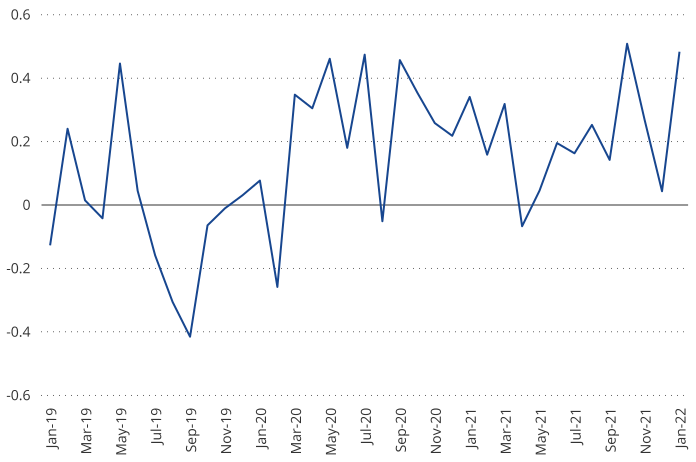
Source: Bloomberg as of 4/1/2022.
Bitcoin/20+ Year Treasury Bond Correlation
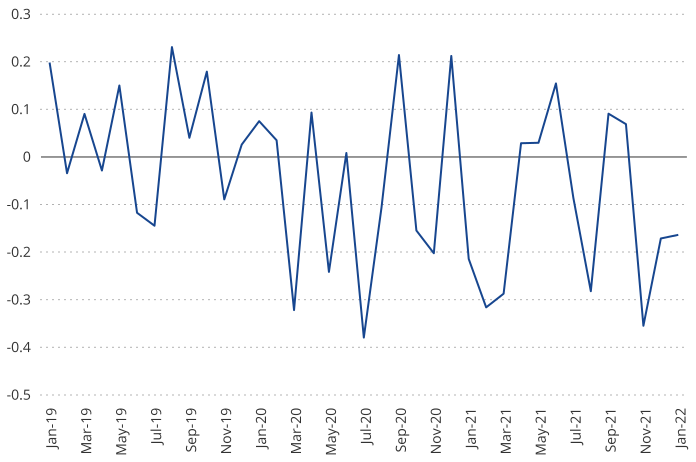
Source: Bloomberg as of 4/1/2022.
Ethereum vs. 10-Year Breakeven Rates
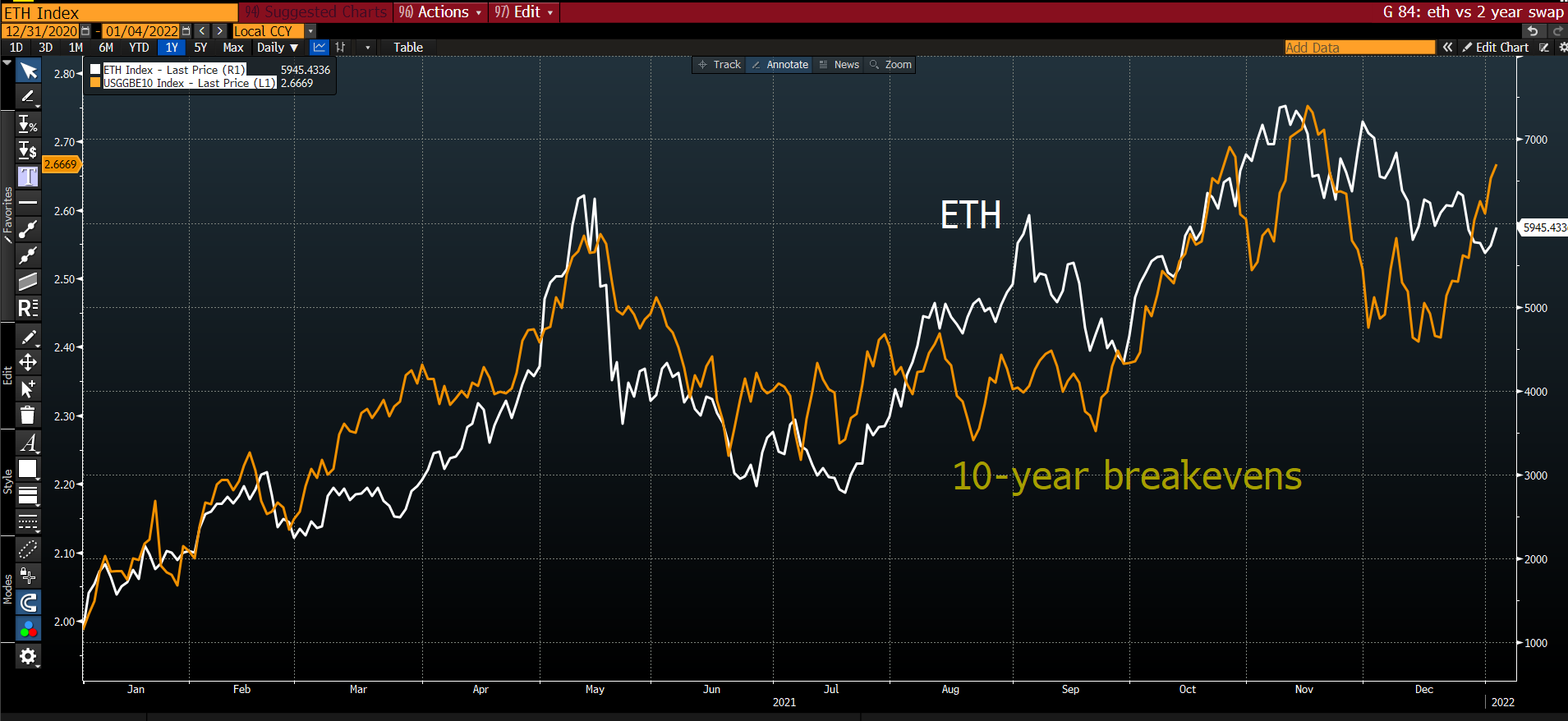
Source: Bloomberg as of 4/1/2022. 10-Year Breakeven Inflation Rate is a measure of expected inflation based on the difference between 10-Year Bond and Treasury Inflation Protected Securities.
But while 2021 saw massive outperformance from smart contract platforms, DeFi protocols struggled mightily as competitive pressures drove multiple forks of popular automated market makers (AMMs), such as Uniswap, with the result being fee pressure and commoditization leading to underperformance. Thus, the MVIS CryptoCompare Smart Contract Leaders Index rose 294% in 2021 vs. a 13% decline for the MVIS CryptoCompare Decentralized Finance Leaders Index6, opening up an enormous discrepancy between token valuations. Indeed, six of the top smart contract platforms trade at an average of 5,450x protocol sales, while six of the top DeFi platforms trade at an average of 9x sales (figs 4 & 5).7
Smart Contract Protocols (Layer 1): Price-to-Sales Ratio
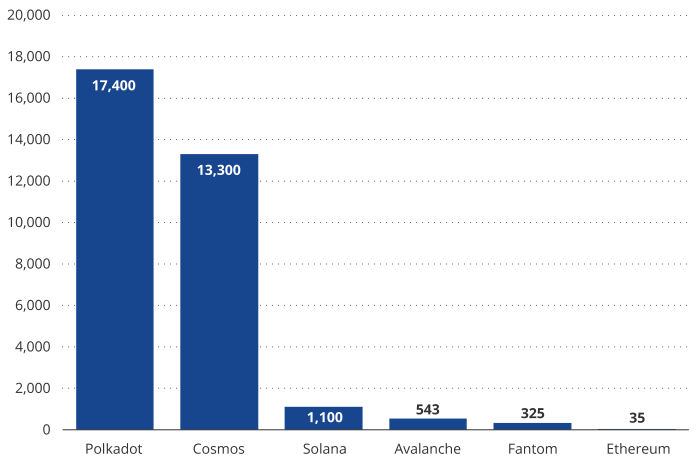
Source: TokenTerminal, as of 4/1/2022.
DeFi Protocols: Price-to-Sales Ratio
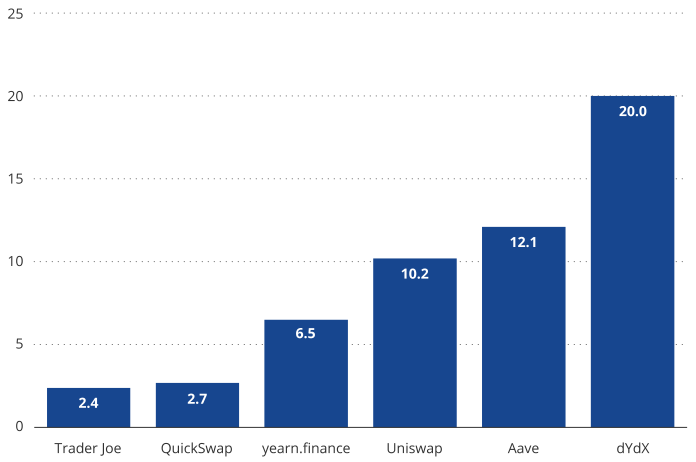
Source: TokenTerminal, as of 4/1/2022.
Markets often exhibit mean reversion tendencies around year-end, and the snap-back in DeFi performance since late November has been substantial, with the MVIS CryptoCompare Decentralized Finance Leaders Index returning 25% in the last 30 days vs. the MVIS CryptoCompare Smart Contract Leaders Index and MVIS CryptoCompare Media & Entertainment Leaders Index, both flat.8 The catalyst for the re-rating appears to be a number of protocol-specific restructuring and M&A actions, including xDai’s hostile bid for Gnosis, a $2B TVL (total value locked) merger between Rari Capital and Fei, and the likely restructuring of Uniswap fork SushiSwap at the request of institutional investors Arca and Frog Nation. With valuations so low in DeFi, investors should expect additional event-driven catalysts in the sector, though making money from them can be quite labor intensive given the lack of standardized information dissemination processes in crypto. Over the last 30-days, some notable DeFi returns include Curve +74%, yearn.finance +61%, Sushiswap +53% and Aave +37%. Contrast these positive marks to the negative returns from some notable smart contract platform tokens: Solana -13%, Ethereum -9%, and Algorand -3%. For perspective, Bitcoin fell 9%.9
On the topic of uneven information dissemination, we should highlight one important method for evaluating blockchain protocols, in addition to measuring on-chain activity such as address and transaction growth. That is, to track the number and commitment of software developers working on any given blockchain. Github, the cloud-based repository that helps developers store and manage their code, serves as a convenient measuring stick, given its ~85% market share in source-code management.10 Evaluating projects based on the number of Github software commits in the last 30 days, we notice that Solana and Bitcoin have fallen out of the top 5, replaced by Fei (an algorithmic stablecoin governed by the TRIBE governance token, which recently announced a merger with DeFi lending/borrowing pool operator Rari Capital), and NEAR Protocol, a $10B market cap smart contract protocol whose non-profit foundation announced an $800M global funding initiative in October aimed at fostering the development of its DeFi ecosystem and incentivizing developers to build new product.11, 12 Since the announcement of that fund, daily transactions on the NEAR protocol have risen from 300k/day to 500k/day and NEAR’s Github commits have outperformed sharply. Meanwhile the NEAR token has doubled over the same period.13 Catching these inflections in Github commits will be an important element in VanEck’s fund management process as we seek to launch active liquid token strategies in 2022.
3 Month Github Commits by Crypto Project
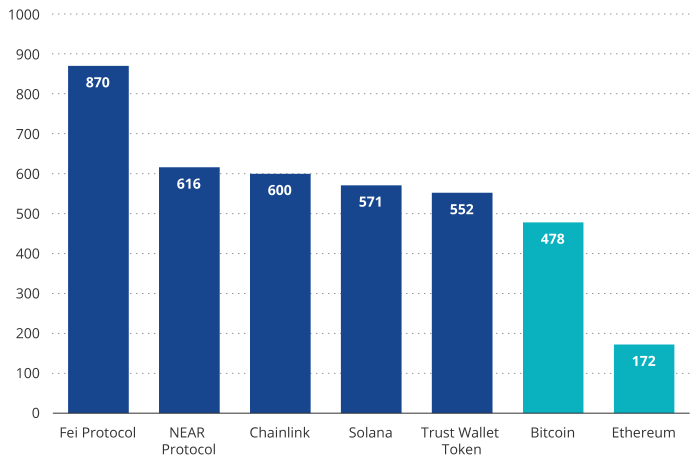
Source: Cryptomiso.
The MVIS CryptoCompare Media and Entertainment Leaders Index (MVMELE) is designed to track the performance of the largest and most liquid media & entertainment assets, and is an investable subset of MVIS CryptoCompare Media & Entertainment Index.
MVIS CryptoCompare Media and Entertainment Leaders Index is the exclusive property of MV Index Solutions GmbH (a wholly owned subsidiary of the Adviser), which has contracted with Solactive AG to maintain and calculate the Index. Solactive AG uses its best efforts to ensure that the Index is calculated correctly. Irrespective of its obligations towards MV Index Solutions GmbH, Solactive AG has no obligation to point out errors in the Index to third parties.
1 TradingView, 4/1/22.
2 Bloomberg.
3 Messari, VanEck research as of 4/1/22.
4 Pitchbook, “Venture Capital Funding for Crypto Companies is Surging,” NYTimes, 12/1/2021.
5 Glassnode, 4/1/22.
6 MVIS, as of 4/1/22.
7 TokenTerminal, VanEck, as of 4/1/22.
8 MVIS, as of 4/1/22.
9 Messari, as of 4/1/22.
10 Slintel, https://www.slintel.com/tech/source-code-management/github-market-share#alternatives-and-competitors.
11 “Near announces $800M in funding initiatives to support ecosystem growth,” 25/10/21, https://near.org/blog/near-announces-800-million-in-funding-initiatives-to-support-ecosystem-growth/.
12 Cryptomiso.
13 Messari, NEAR Protocol Blockchain explorer, as of 4/1/22.
Informations importantes
À des fins d’information et de publicité uniquement.
Ces informations proviennent de VanEck (Europe) GmbH qui a été désignée comme distributeur des produits VanEck en Europe par la société de gestion VanEck Asset Management B.V., de droit néerlandais et enregistrée auprès de l’Autorité néerlandaise des marchés financiers (AFM). VanEck (Europe) GmbH, dont le siège social est situé Kreuznacher Str. 30, 60486 Francfort, Allemagne, est un prestataire de services financiers réglementé par l’Autorité fédérale de surveillance financière en Allemagne (BaFin). Les informations sont uniquement destinées à fournir des informations générales et préliminaires aux investisseurs et ne doivent pas être interprétées comme des conseils d’investissement, juridiques ou fiscaux. VanEck (Europe) GmbH et ses sociétés associées et affiliées (ensemble « VanEck ») n’assument aucune responsabilité en ce qui concerne toute décision d’investissement, de cession ou de rétention prise par l’investisseur sur la base de ces informations. Les points de vue et opinions exprimés sont ceux du ou des auteurs, mais pas nécessairement ceux de VanEck. Les avis sont à jour à la date de publication et sont susceptibles d’être modifiés en fonction des conditions du marché. Certains énoncés contenus dans les présentes peuvent constituer des projections, des prévisions et d’autres énoncés prospectifs qui ne reflètent pas les résultats réels. Les informations fournies par des sources tierces sont considérées comme fiables et n’ont pas été vérifiées de manière indépendante pour leur exactitude ou leur exhaustivité et ne peuvent être garanties. Tous les indices mentionnés sont des mesures des secteurs et des performances du marché commun. Il n’est pas possible d’investir directement dans un indice.
Toutes les informations sur le rendement sont historiques et ne garantissent pas les résultats futurs. L’investissement est soumis à des risques, y compris la perte possible du capital. Vous devez lire le Prospectus et le DICI avant d’investir.
Aucune partie de ce matériel ne peut être reproduite sous quelque forme que ce soit, ou mentionnée dans toute autre publication, sans l’autorisation écrite expresse de VanEck.
© VanEck (Europe) GmbH
Related Insights


Related Insights
17 janvier 2025


17 janvier 2025