Stagflation Or Not… Yet?
01 June 2022
Read Time 2 MIN
The stagflation narrative was on full display in EMEA, but the picture in other EM regions is mixed - Brazil’s stagflation “escape velocity” looks more and more convincing these days.
EMEA Persistent Stagflation Drumbeat
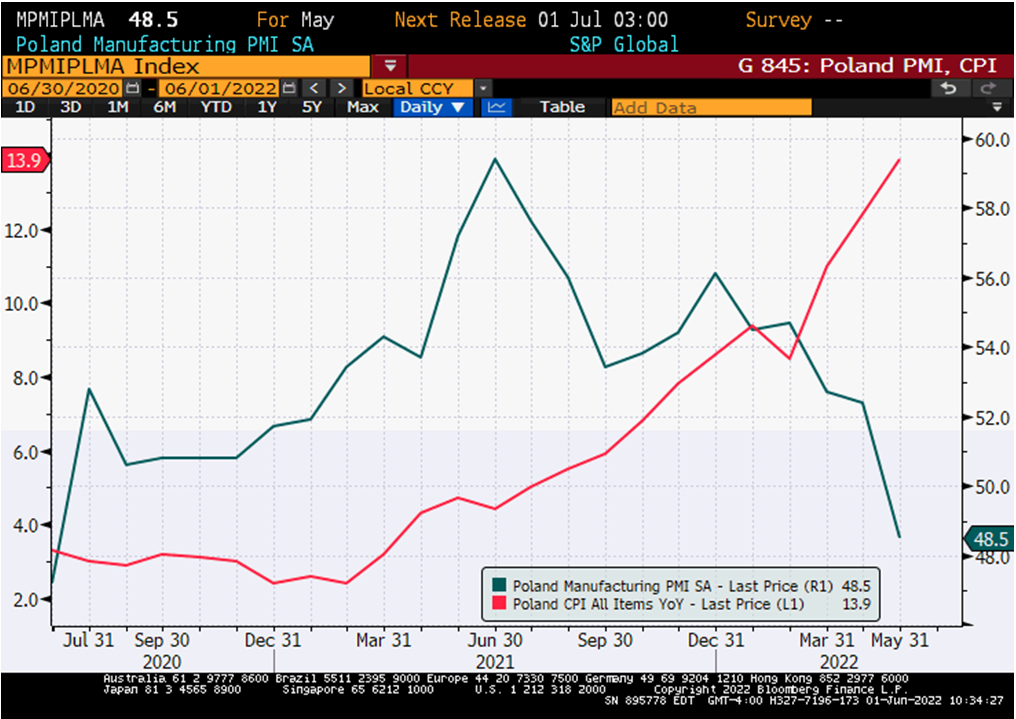
Emerging Markets (EM) activity gauges come in all shapes and forms these days – some agreeing with the stagflation narrative, and some saying “maybe not”. The stagflationary signal is currently the most persistent in EMEA. Turkey’s PMI (Purchasing Managers Index) stayed in contraction zone in May (49.2), with annual headline inflation surging to 70%. Poland’s inflation accelerated to nearly 14% year-on-year, but the manufacturing PMI unexpectedly dropped from healthy 52.4 into contraction zone (48.5 – see chart below). Hungary’s PMI managed to stay above 50.0, but it moderated much more than expected – against the backdrop of rapidly rising prices (9.5% year-on-year in May). Trends like these pose additional policy challenges for authorities – the Hungarian central bank decided to slow the pace of rate hikes, and the government’s 2023 fiscal plans are now gaining in importance (especially for bond investors).
EM Asia – Much More Than Stagflation
EM Asia is also attracting a lot of attention – as a latecomer to the EM hiking cycle – but the regional dynamics are mixed. Very solid PMIs in India (54.6) and the Philippines (54.1) show that domestic demand is strong, and the central banks were absolutely right to raise policy rates in order to bring inflation back to target. By contrast, China’s Caixin PMI (a higher representation of private firms vs. the official PMI) was not only contractionary but also weaker than expected. China’s continuing reliance on the supply-side stimulus is likely to keep inflation pressures under control in the foreseeable future (=no stagflation in sight). Malaysia’s combo of barely-expansionary PMI and 2.3% annual inflation also does not look very stagflationary – and it also tells us that the central bank can easily afford to take a pause after the surprising liftoff in May. Thailand’s PMI was stable and decent (51.9) – but would this be enough to force the central bank shift to gears and hike on June 8? An upside inflation surprise later this week can be a catalyst.
Brazil - Stronger Growth/Lower Inflation Pattern Emerging
Finally, a nice rise in Brazil’s PMI (54.2) gives more credence to the latest growth upgrades – it also makes a dent in Brazil’s stagflation storyline. Yes, headline inflation is still “double-digit” high, but the consensus believes it had peaked in April, and this should allow the central bank to end its very aggressive tightening cycle in the next several months. Stay tuned!
Chart at a Glance: “Warsaw, We Have A Problem”, A Stagflation Problem
Source: Bloomberg LP
Related Insights

Related Insights
07 April 2025
06 March 2025
20 February 2025
10 February 2026
Debasement is back in focus. Here’s what’s driving it, what could reverse it and how we’re positioning portfolios for both scenarios.
07 April 2025
Trump’s tariffs spark trade war fears, fueling market volatility, inflation risk, and recession threats. With global retaliation likely, near-term growth is clearly at risk.
06 March 2025
Trump’s tariffs, AI’s next phase, and a potential U.S. gold revaluation could shake markets—investors who stay ahead of these transitions will be best positioned.
20 February 2025
China's AI breakthrough, persistent inflation, gold’s outperformance, and rising energy demand underscore a shifting investment landscape.
16 January 2025
In 2025, navigating turbulence means balancing tech innovation, inflation hedges, energy shifts, and risks from spending cuts and inflation.