Muni CEF Discounts: A Timing Framework for XMPT
02 July 2026
Read Time 7 MIN
Key Takeaways:
- Wide underlying CEF discounts (~-7.9% or wider) have historically been associated with stronger 12-month returns for XMPT.
- Geopolitical shocks and liquidity events, not Fed rate cuts, have tended to create the widest discount opportunities.
- Today's narrower discount has historically corresponded with more modest forward returns; patience may be warranted.
What Are Muni CEF Discounts and Why Do They Matter?
Closed-end fund (CEF) discounts are one of the more honest signals in muni-land. When the funds an ETF holds trade below the value of their own portfolios, that gap tells you something about supply, demand, leverage, and investor sentiment. For the muni CEFs inside the VanEck CEF Muni Income ETF (XMPT), that discount has been more than a mood ring. Historically, how wide it was when you bought has lined up closely with what you earned over the next year. This piece lays out that framework first, then uses the past year of forces that push the discount around as evidence and ends with how to read it from here. The short version up front: a wide discount has been a strong entry point, and today's is not wide.
A quick clarification, because it's a common point of confusion. This is not XMPT's own premium or discount to its NAV. It's the weighted-average premium/discount of the underlying CEFs that XMPT owns, meaning how cheap or rich the fund's holdings are relative to their portfolios. It's a read on the muni-CEF market itself, viewed through XMPT's book.
When Has XMPT Historically Been a Good Buy?
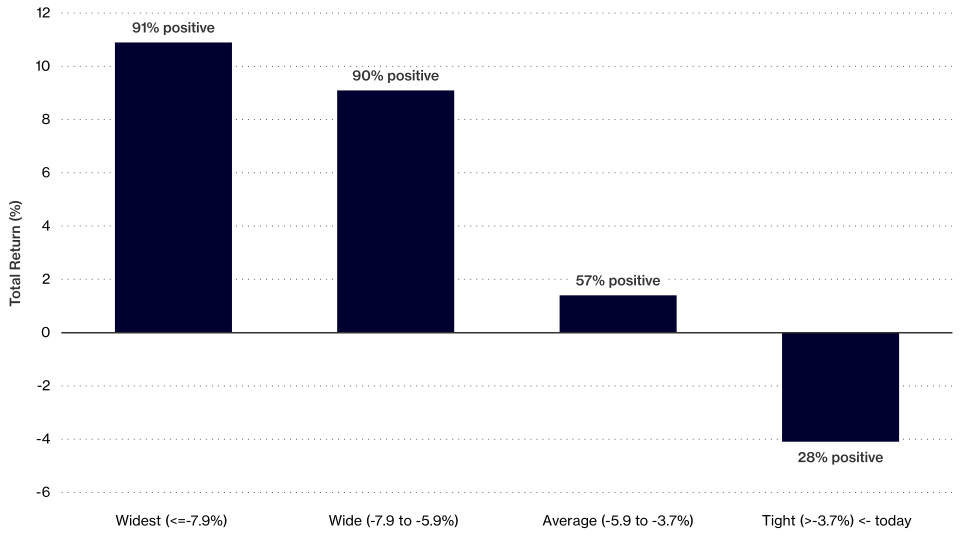
The discount isn't just a description of sentiment. Historically it has been a usable entry signal. We sorted every month since inception (July 2011) by how wide the underlying-CEF discount was at the time, then measured XMPT's actual total return over the following 12 months.
Source: VanEck. Performance current to the most recent month end is available by calling 800.826.2333
Performance quoted is past performance, which doesn't guarantee future results. Investment return and principal value fluctuate; shares when sold may be worth more or less than cost. Current performance may be lower or higher. Returns reflect fee/expense waivers (lower without them) and include dividends and capital gains.
Click here for XMPT Fee Information
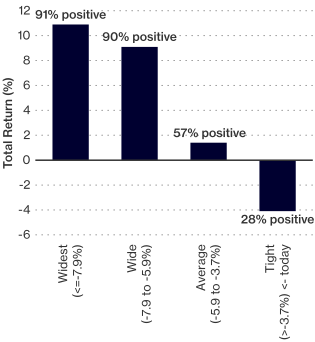
The pattern is strong. Buying when the discount sat in its widest quartile (roughly −7.9% or wider) returned about +11% over the next year, positive 91% of the time. The second-widest quartile returned +9% (90% positive). The average band gave you little: +1.4%, a coin flip at 57%. And buying in the tightest quartile (tighter than −3.7%) was a net loser: −4% on average, positive only 28% of the time. The six-month horizon shows the same staircase. The mechanism is intuitive: a wide discount pairs a depressed price with an elevated distribution yield, and the discount tends to mean-revert, so you get paid to wait while the gap closes.
So, the framework is simple. The discount level is the single most useful number for timing an entry. Which raises the obvious question: what makes the discount move in the first place, and can you see the good entry points coming?
What Drives Muni CEF Discount Widening and Tightening?
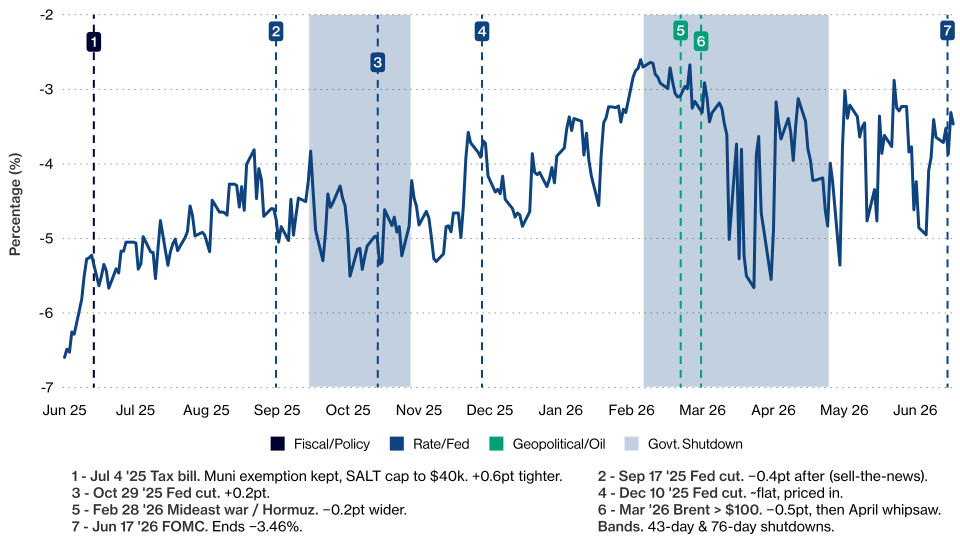
The past year is a clean illustration, because it ran the discount across most of its range, from historically wide to nearly the tightest in years and back toward the middle.
Source: VanEck.
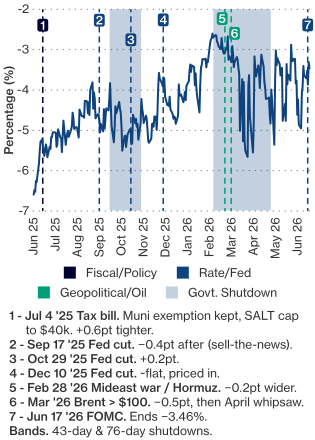
The discount started near −6.6% in late June 2025, in that rewarding wide zone, and spent the second half of the year grinding tighter, reaching −2.6% in late February 2026 before the picture cracked open.
The cleanest single catalyst on the way in was fiscal, not monetary. When the July tax bill (1) preserved the municipal interest exemption and raised the SALT cap, it removed a genuine overhang for the asset class. The discount tightened about 0.6 points over the following two weeks, the largest clean move in the dataset. Tax policy hits muni demand directly, with no "already priced in" offset.
The three Federal Reserve rate cuts (2, 3, 4) are more interesting for what they didn't do. Each was largely anticipated, and the discount tended to tighten into the meeting and then drift sideways or slightly wider afterward, a textbook "sell the news" pattern. The December cut barely registered at all.
Then the spring. A Middle East conflict and a Strait of Hormuz scare (5) broke late in February, and the oil spike that followed (6), with Brent vaulting past $100 on its way to roughly $126, coincided with the discount rolling over from its February peak and whipsawing through April. Single days swung from around −3.2% to −5.7% and back. That jaggedness is the signature of a liquidity-driven move: holders selling the liquid CEF shares into a risk-off tape faster than the underlying muni NAVs reprice. The two shaded bands mark government shutdowns, which added background uncertainty but produced little direct move on their own.
Step back and the year maps neatly onto the framework. The discount widens on stress and policy threats and tightens on demand catalysts and calm. The wide-discount entry points that history rewards tend to appear in exactly the messy moments: the shutdowns, the oil shocks, the risk-off scrambles. The tight readings, like today's, tend to arrive after a long stretch of good news.
Do Fed Rate Cuts Actually Move Muni CEF Discounts?
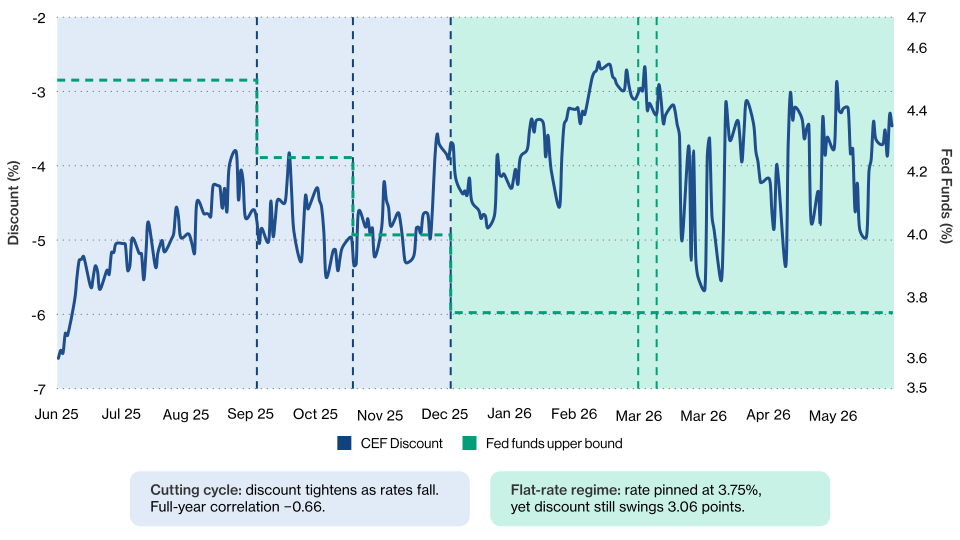
One force deserves a closer look, because it's the one most investors assume is in charge: the Fed. The intuitive story is the rate channel. Most muni CEFs use leverage, they pay a floating short-term rate to fund it, and when the Fed cuts, that financing gets cheaper, distribution coverage improves, and prices (and therefore discounts) should firm up. It's a real mechanism. The question is how much of the past year it actually explains. To test it, we plotted the discount against the federal funds upper bound, a clean proxy for the funds' floating leverage cost.
Source: VanEck.
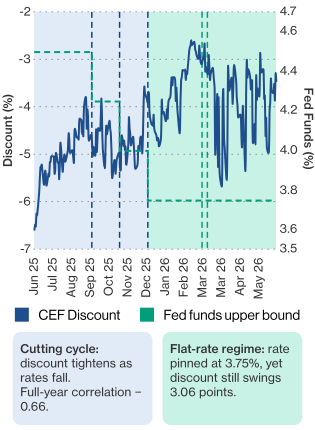
Two things stand out. First, across the full year the discount and the policy rate are negatively correlated at about −0.66. As the Fed cut from 4.50% to 3.75%, the discount re-rated from roughly −5% toward −3%. So, the rate channel does leave a fingerprint, on the slow-moving level of the discount. Second, and more telling: from the December 10 cut onward, the policy rate didn't move at all. It sat at 3.75% for more than six months. Yet over that same flat-rate stretch, the discount still swung 3.06 points, from −2.6% to −5.7%. A driver that is perfectly constant cannot explain a three-point move. The biggest volatility of the year happened with rates pinned in place, which points back at the geopolitical and liquidity forces rather than the Fed.
The lesson for the framework: rates set the backdrop, but they rarely hand you the entry point. The wide-discount opportunities come from the shocks the Fed isn't causing.
How to Use the XMPT Discount Framework Going Forward
The practical takeaway is to keep XMPT on a watch list and let the discount come to you. The income accrues either way. But the asymmetry is clear in the record: when the headlines are bad and the gap is wide, that has been the time to get interested in allocating more.
XMPT Total Expense Ratio: 1.97%. Van Eck Associates Corporation (the “Adviser”) will pay all expenses of the Fund, except for the fee payment under the investment management agreement, acquired fund fees and expenses, interest expense, offering costs, trading expenses, taxes and extraordinary expenses. Notwithstanding the foregoing, the Adviser has agreed to pay the offering costs until at least September 1, 2026.
Related Insights


Related Insights

11 August 2026
Many investors need more than traditional bonds can deliver. VanEck provides access to a range of higher-yielding asset classes built for today's income environment.
14 July 2026
After a volatile Q1, fallen angels bounced back sharply in Q2 2026, outperforming broad high yield by 1.23%, as geopolitical de-escalation and tighter spreads drove strong returns.
16 June 2026
Publicly traded BDCs offer 12.6% yields and stable credit quality, a very different story than the private credit headlines suggest.
13 April 2026
Q1 2026 threw a lot at investors: geopolitical tension, rate volatility, and macro uncertainty. Here’s why municipal bonds held up, and why the setup heading into Q2 may be even more compelling.