
Welcome to VanEck
Select Investor Type
04 March 2024
Read Time 10+ MIN
In January, the VanEck Emerging Markets Bond UCITS Fund was down 0.84% in January, compared to -1.27% for its benchmark, the 50% J.P. Morgan Government Bond Index-Emerging Markets (GBI-EM) Global Diversified and 50% J.P. Morgan Emerging Markets Bond Index (EMBI). China was by far the biggest outperformer for the Fund, with Chile the largest underperformer. We increased exposure to Mexico and Poland local currency, covering an underweight exposure, and reduced our South Africa local exposure (where we now have zero exposure). We ended January with carry of 7.0%, yield to worst of 8.7%, duration of 5.8, and 52.7% of the Fund in local currency. Our biggest exposures are Mexico (local and hard), Brazil (primarily local), China (primarily hard), Colombia (primarily local), and Indonesia (primarily local).
| Average Annual Total Returns* (%) as of 31 January 2024 | |||||||
| 1 Month | 3 Month | YTD | 1 Year | 3 Year | 5 Year | 10 Year | |
| Class A: NAV (Inception 07/09/12) | -1.03 | 8.81 | -1.03 | 4.51 | -0.88 | 2.91 | 1.90 |
| Class A: Maximum 5.75% load | -6.72 | 2.55 | -6.72 | -1.50 | -2.82 | 1.70 | 1.29 |
| Class I: NAV (Inception 07/09/12) | -0.84 | 8.88 | -0.84 | 5.01 | -0.53 | 3.21 | 2.22 |
| Class Y: NAV (Inception 07/09/12) | -1.02 | 8.65 | -1.02 | 4.66 | -0.67 | 3.13 | 2.13 |
| 50% GBI-EM/50% EMBI | -1.27 | 8.27 | -1.27 | 6.56 | -3.37 | 0.23 | 1.85 |
| Average Annual Total Returns* (%) as of 31 December 2023 | |||||||
| 1 Month | 3 Month | YTD | 1 Year | 3 Year | 5 Year | 10 Year | |
| Class A: NAV (Inception 07/09/12) | 3.88 | 8.36 | 10.91 | 10.91 | -0.79 | 4.14 | 1.80 |
| Class A: Maximum 5.75% load | -2.09 | 2.13 | 4.53 | 4.53 | -2.73 | 2.92 | 1.20 |
| Class I: NAV (Inception 07/09/12) | 3.81 | 8.43 | 10.97 | 10.97 | -0.49 | 4.46 | 2.10 |
| Class Y: NAV (Inception 07/09/12) | 3.80 | 8.40 | 11.03 | 11.03 | -0.57 | 4.39 | 2.03 |
| 50% GBI-EM/50% EMBI | 3.97 | 8.63 | 11.95 | 11.95 | -3.31 | 1.46 | 1.71 |
* Returns less than one year are not annualized.
Expenses: Class A: Gross 2.55%, Net 1.22%; Class I: Gross 2.51%, Net 0.87%; Class Y: Gross 2.91%, Net 0.97%. Expenses are capped contractually until 05/01/24 at 1.25% for Class A, 0.95% for Class I, 1.00% for Class Y. Caps excluding acquired fund fees and expenses, interest, trading, dividends, and interest payments of securities sold short, taxes, and extraordinary expenses.
The performance data quoted represents past performance. Past performance is not a guarantee of future results. Investment return and principal value of an investment will fluctuate so that an investor’s shares, when redeemed, may be worth more or less than their original cost. Performance may be lower or higher than performance data quoted.
The “Net Asset Value” (NAV) of a Fund is determined at the close of each business day, and represents the dollar value of one share of the fund; it is calculated by taking the total assets of the fund, subtracting total liabilities, and dividing by the total number of shares outstanding. The NAV is not necessarily the same as the ETF’s intraday trading value. Investors should not expect to buy or sell shares at NAV.
There are four unpriced risks to the bulk of investor portfolios, and each of these risks hurts developed markets (DM) bonds and currencies while helping emerging markets (EM) bonds and currencies. The four risks are the Fed/global rates, fiscal policy, geopolitics, and US politics. Markets historically tend to ignore three of these risks – fiscal, geopolitics, and US politics. Fiscal concerns (our “fiscal dominance” thesis, for example) are considered an almost heterodox worry. Geopolitics are considered unanalyzable. And analyzing US politics as having risky implications for the world is just not done (at most the investment conclusion redounds to defense stocks versus health care stocks). Our key conclusion is that emerging markets are on the winning side of these risks, as EM clearly has already-high real policy rates, good fiscal policy, is globalizing geopolitically (not de-globalizing), and is home to some of the most popular governments in the world (China, India, Mexico, Indonesia are a few examples of popular governments implementing orthodox policies).
Risk 1: Global interest rates (“the Fed”, if you will). Either way, EM wins and DM loses. When and if the Fed starts cutting its policy rate, EM bonds should perform better than most bond categories. In local-currency EM bonds (one half of our benchmark), this is because EM central banks raised their policy rates earlier and by more than the US. And also because the US dollar should start to decline as the Fed cuts rates, supporting EM currencies (i.e., not just their bonds). In hard-currency EM bonds, especially high yield sovereigns (the other half of our benchmark), the carry is so superior that it absorbs “sideways” or even weakness in risk-free rates. Put simply, if the Fed cuts don’t materialize, EM carry wins the day, and if they do materialize, EM will see bigger rates rallies than those in risk-free bonds.
Risk 2: Fiscal risks in developed markets – DM is highly indebted, while EM is not. Our recent white paper, Fiscal Dominance: The Clarifying Lens for EM (and DM) Bonds goes through the full argument. In short, low debt levels in EM governments allow their central banks to solely focus on inflation, while high debt levels in DM governments force their central banks to focus on multiple objectives (not just inflation). This is no longer a theoretical point as popular media now regularly focus on US debt sustainability and the US’s rating by Fitch was cut to below AAA late in 2023 (S&P already had the US below AAA), and Moody’s has a negative credit outlook on its only AAA rating. Exhibit 1 shows the returns of two bond market, EM sovereign bonds (local- and hard-currency) versus DM sovereign bonds. This chart goes back 20 years. We also showed how the best within EM on fiscal metrics – Asian EM – actually became a flight-to-quality asset class during the past three years. The exhibit simply shows how superior EM government bond returns were compared to DM government bond returns. The argument we make in our white paper on the topic of “fiscal dominance” is that persistently good EM fiscal policy compared to persistently bad DM fiscal policy is the root of this big performance divergence. There are no indications that this is changing, if anything fiscal policy and anchored inflation expectations seem more labile than they’ve ever been. In any case, the premia in EM bonds more than reflects the real or perceived risks.
Bonds Performance EM Sovereign vs. DM Sovereign (total return, %)
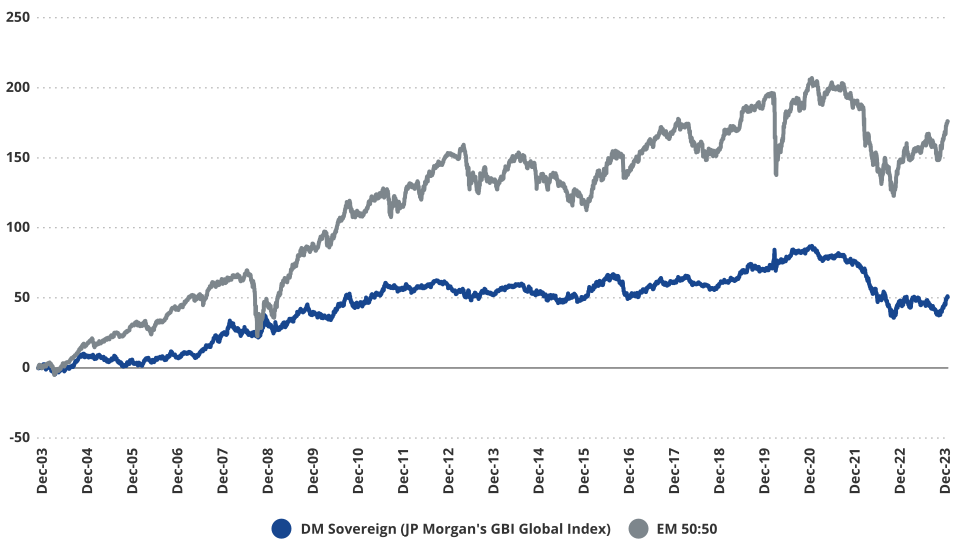
Source: VanEck Research, JP Morgan As of December 2023.
Risk 3: Geopolitics favor an EM that is deepening globalization and a DM that is isolating. We also touched on this in our fiscal dominance white paper. Geopolitics have economic implications for EM and DM, and economics (in particular fiscal dominance) has implications for geopolitics. We’ve discussed particular phenomena in our previous monthlies. In general, the implications are:
These implications will take many years to play out, but they represent a long-term tailwind for EM local-currency bonds. As we showed at the outset, it is the deficit-producing DMs that need financing from the surplus-producing EMs, whether the situation is understood that way yet, or not. The fact that EM and DM are increasingly in geopolitical disagreement represents an obvious global market risk. It is risky to depend on adversaries for one’s financing is a sentence that shouldn’t need to be written, but here we are. EM central banks will increasingly want reserve assets backed by high real yields and debt sustainability, with zero sanctions risk. Central bank purchases of gold are by now well-reported and known, especially the fact that now both EM and now DM central banks are buyers. Gold is the easiest first-reaction from central banks. But, bonds with yield and currencies with use in trade are the ultimate desire for reserve managers and they will find these in EM local-currency bonds. As noted earlier, this is a long-term tailwind, not translating into a straight line. In particular, the USD has a key structural support – most global debt is denominated in USD. This means that “risk-off” translates into USD-up1. This is less-and-less the case, as we show above with Asian EM local currencies rallying during the U.S.’s fiscal and banking issues in 2023, for example. There, countries that proved their fiscal and monetary rectitude over decades rallied as DM bond markets suffered. Put differently, the USD-up is increasingly only up against the other DM currencies and the riskiest EM currencies, not against the best EM currencies. Anyway, our general point is that even geopolitical developments that are getting increased attention support our fiscal dominance thesis.
Foreign Exchange Holdings in U.S. Dollars, % of allocated reserves

Risk 4: US politics. Market participants are especially loath to discuss politics given obvious fractiousness in DM societies. And this is on top of the normal bias in DM markets that politics simply don’t matter. We saw glaring examples of this in Brexit and President Trump’s election in 2016, both of which the “cool kids” said would never happen. The key takeaway here is that US (and European, for that matter) politics are becoming important market drivers for DM. Former UK Prime Minister Truss lost her job after 90 days due to a fiscal/bond market crisis created by the UK’s fiscal dominance (and her policies’ inability to comfort the market) less than two years ago! Ignoring things you don’t like or don’t want to talk about is unacceptable in risk management, of course. The flip side is that politics have normalized in most of EM, with voters more-or-less seeking to optimize economic outcomes in a disciplined policy context. This is arguably the case in large countries including Indonesia and most of Asia, Mexico, Colombia, China, Poland and many others. This is quite different from the constraint-free policy environment in the US where “deficits don’t matter”. With sanctions against countries’ holdings of US treasuries a policy tool, it should not be hard to imagine what happens after sanctioning one’s lenders, especially when one runs big deficits (see Exhibit 2).
The changes to our top positions are summarized below. Our largest positions in January were Mexico, Brazil, Colombia, Indonesia, and Poland:
1 “USD-up” means a scenario under which USD appreciates against other currencies
This is a marketing communication. Please refer to the prospectus of the UCITS and to the KID before making any final investment decisions.
This information originates from VanEck (Europe) GmbH, which has been appointed as distributor of VanEck products in Europe by the Management Company VanEck Asset Management B.V., incorporated under Dutch law and registered with the Dutch Authority for the Financial Markets (AFM). VanEck (Europe) GmbH with registered address at Kreuznacher Str. 30, 60486 Frankfurt, Germany, is a financial services provider regulated by the Federal Financial Supervisory Authority in Germany (BaFin).
The information is intended only to provide general and preliminary information to investors and shall not be construed as investment, legal or tax advice VanEck (Europe) GmbH, VanEck Switzerland AG, VanEck Securities UK Limited and their associated and affiliated companies (together “VanEck”) assume no liability with regards to any investment, divestment or retention decision taken by the investor on the basis of this information. The views and opinions expressed are those of the author(s) but not necessarily those of VanEck. Opinions are current as of the publication date and are subject to change with market conditions. Certain statements contained herein may constitute projections, forecasts and other forward-looking statements, which do not reflect actual results. Information provided by third party sources is believed to be reliable and have not been independently verified for accuracy or completeness and cannot be guaranteed. Brokerage or transaction fees may apply.
All performance information is based on historical data and does not predict future returns. Investing is subject to risk, including the possible loss of principal.
No part of this material may be reproduced in any form, or referred to in any other publication, without express written permission of VanEck.
© VanEck (Europe) GmbH / VanEck Asset Management B.V.