Welcome to VanEck
Select Investor Type
12 April 2021
Emerging markets bonds historically do well in a rising interest rate environment. If interest rates are rising due to higher growth prospects—as opposed to a “taper tantrum1”—emerging markets bonds may do particularly well. This makes sense, given that rising U.S. growth tends to lead to higher imports from emerging market countries, higher capital flows, and generally “risk-on2” conditions. GDP is, after all, the denominator under which everything from corporate debt service to individual consumer consumption is based. Credit quality should improve during periods of rising economic growth, and we believe the U.S. looks set for a lot of growth. In fact, the U.S. is on track to potentially grow faster than China in 2021, in our view! The only reason to worry, traditionally, would be a Federal Reserve (Fed) looking to take the punchbowl away too quickly, and we don’t expect to see that.
Of course, the month or two during which U.S. interest rates first rise to accommodate this higher growth—as is happening now—is painful for all bonds. This is the simple math of duration3 multiplied by yield change. The year so far has followed that math, as emerging markets bonds have gone down in line with their duration times the U.S. yield. Spreads haven’t widened, in other words. But what will happen once the bonds have absorbed this initial price rise? What is the longer-term effect of the higher yields that they pay and the improving economic conditions?
Emerging markets bonds have historically done well! Look at the two charts below, which show emerging markets debt performance during the past two reflationary periods (2004-2007 and 2015-2019). Both of these show what happened through a bunch of interest rate hikes by the Fed (which you can see in the light blue staircase line). In the 2004-2007 reflation, emerging markets local currency was up 60% and emerging markets hard currency was up 30%; in the 2015-2019 reflation, both were up 30%.

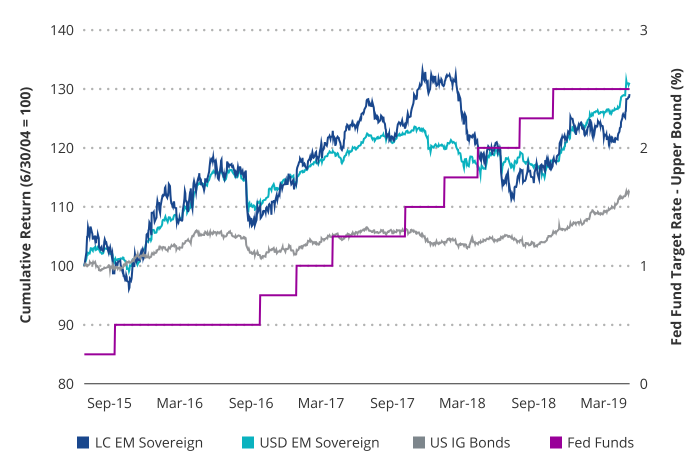
Source: VanEck Research; Bloomberg, J.P. Morgan. Data as of 10/3/2021. USD EM Sovereign represented by J.P. Morgan EMBI Global Diversified Index. LC EM Sovereign represented by J.P Morgan GBI-EM Global Diversified Index. US IG Bonds represented by J.P. Morgan GABI US IG Index.
Emerging markets local currency can be particularly attractive during these periods, as you can see from how well it did during the first reflation example (Note: Risks can occur). Emerging markets economies tend to benefit from U.S. twin deficits (fiscal deficits plus current account deficit)—the U.S. demands more goods from the emerging markets, particularly commodities. This historically benefits emerging markets currencies and weakens the U.S. dollar, which kind of makes sense. If we’re sending U.S. dollars into these economies to buy flat glass or auto components, that obviously bids up their own currencies. The chart below shows a sense of what can happen to the U.S. dollar when the U.S. engages in extremely stimulative policy, which it is doing today. The dollar falters! This is another example of how rising rates, if they are a function of better growth, can be fantastic for emerging markets bonds.
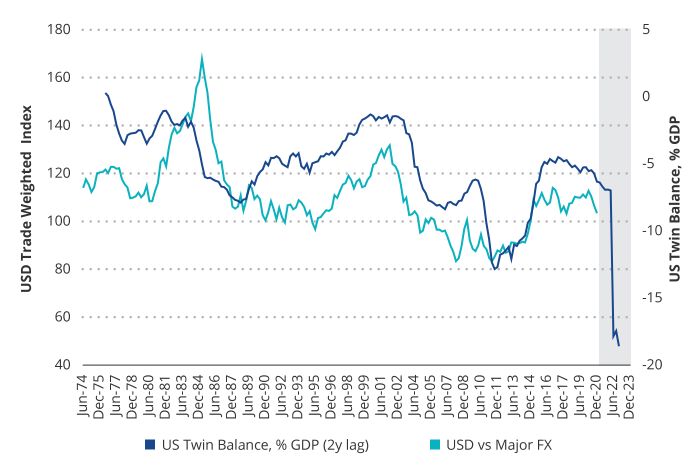
Source: VanEck Research, Bloomberg. Data as of 31/12/2020.
1 Taper tantrum refers to the 2013 spike in U.S. Treasury yields, after investors learned that the Federal Reserve was slowly halting its quantitative easing program.
2 An investment environment in which investors have a higher risk appetite and increased demand for exposure to higher risk assets.
3 Duration measures a bond's sensitivity to interest rate changes.
This is a marketing communication. Please refer to the prospectus of the UCITS and to the KID before making any final investment decisions.
This information originates from VanEck (Europe) GmbH, which has been appointed as distributor of VanEck products in Europe by the Management Company VanEck Asset Management B.V., incorporated under Dutch law and registered with the Dutch Authority for the Financial Markets (AFM). VanEck (Europe) GmbH with registered address at Kreuznacher Str. 30, 60486 Frankfurt, Germany, is a financial services provider regulated by the Federal Financial Supervisory Authority in Germany (BaFin).
The information is intended only to provide general and preliminary information to investors and shall not be construed as investment, legal or tax advice VanEck (Europe) GmbH, VanEck Switzerland AG, VanEck Securities UK Limited and their associated and affiliated companies (together “VanEck”) assume no liability with regards to any investment, divestment or retention decision taken by the investor on the basis of this information. The views and opinions expressed are those of the author(s) but not necessarily those of VanEck. Opinions are current as of the publication date and are subject to change with market conditions. Certain statements contained herein may constitute projections, forecasts and other forward-looking statements, which do not reflect actual results. Information provided by third party sources is believed to be reliable and have not been independently verified for accuracy or completeness and cannot be guaranteed. Brokerage or transaction fees may apply.
All performance information is based on historical data and does not predict future returns. Investing is subject to risk, including the possible loss of principal.
No part of this material may be reproduced in any form, or referred to in any other publication, without express written permission of VanEck.
© VanEck (Europe) GmbH / VanEck Asset Management B.V.

11 December 2025
11 December 2025