Semiconductors Drive New Tech Advances
22 December 2020
Semiconductors, also referred to as semis or chips, are used in an extensive range of products in computing, telecommunications, gaming, transportation, clean energy and healthcare. They are the brains of modern electronics and the drivers of technological innovation. Over the past decade, semis have also been the drivers of the broader technology sector’s upside and the beneficiaries of evolving sources of demand. As future technologies arise, such as the cloud, the internet of things (IoT), artificial intelligence (AI), virtual reality (VR), autonomous driving, wearables, smart technology, drones and advanced wireless networks (5G), we are bullish on the future of the semiconductor industry.
In a risk-off market, indiscriminate selling often fuels share price volatility. Semis were among the stocks hit hardest during the COVID-19 selloff this past March; however, most chip stocks have made a resilient comeback. This is potentially good news for semiconductor stocks and investors seeking outsized returns in what many anticipate to be a challenging and unpredictable market over the near-term.
The global pandemic and ensuing stay-at-home trends have been boosting the demand in the past and adoption of products that use chips. For example, certain semiconductor companies, such as Advanced Micro Devices, Inc. (AMD) and Nvidia Corp. (NVDA), are significant players in the booming global video gaming and eSports industry, too.1 These chip makers develop and manufacture semiconductor chips that define the graphic experience of the player and are crucial to the gameplay experience.
Global Semiconductor Industry Revenue Growth
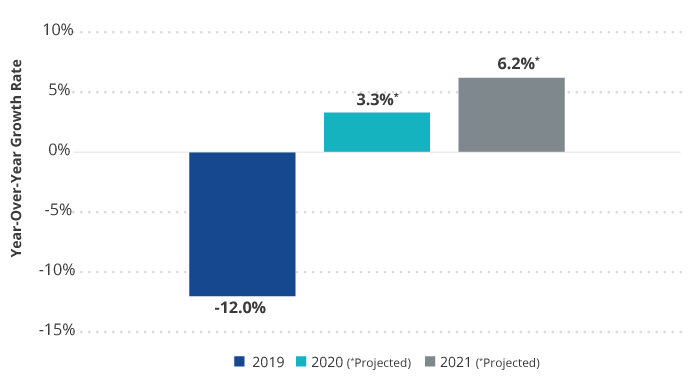
Source: World Semiconductor Trade Statistics. As of 9/6/2020. Past performance is not a guarantee of future results. Actual performance can differ from projected performance. *Indicates World Semiconductor Trade Statistics’ forecasted growth.
During periods of high demand, upturns occur and tight supply, or even shortages, generally lead to higher prices and revenue growth. According to the World Semiconductor Trade Statistics, it is expected that worldwide semiconductor sales will grow by 3.3% this year, totaling $426 billion dollars, and by 6.2% in 2021.
While actual results can hardly be predicted, we expect this dynamic industry to continue to grow and innovate as technology becomes more and more pervasive in everyday life. Investors seeking to benefit from this technological acceleration and proliferation can gain exposure to this space through semiconductor exchange-traded funds (ETFs). ETFs can help reduce individual stock risk by providing broad access to a basket of companies, but investors should pay attention to how these baskets are constructed.
VanEck Semiconductor UCITS ETF (SMH) seeks to replicate the performance of the MVIS® US Listed Semiconductor 10% Capped Index, which is comprised of the 25 largest and highly liquid U.S. listed semiconductor companies. SMH is a pure-play semiconductor industry ETF, meaning that each company must generate at least 50% of their revenues from the production of semiconductors and/or semiconductor equipment.
1As of 11 December 2020, VanEck Semiconductor UCITS ETF (SMH) holds AMD at 5.88% of total Fund net assets and NVDA at 8.38% of total Fund net assets.
Informations importantes
À des fins d’information et de publicité uniquement.
Ces informations proviennent de VanEck (Europe) GmbH qui a été désignée comme distributeur des produits VanEck en Europe par la société de gestion VanEck Asset Management B.V., de droit néerlandais et enregistrée auprès de l’Autorité néerlandaise des marchés financiers (AFM). VanEck (Europe) GmbH, dont le siège social est situé Kreuznacher Str. 30, 60486 Francfort, Allemagne, est un prestataire de services financiers réglementé par l’Autorité fédérale de surveillance financière en Allemagne (BaFin). Les informations sont uniquement destinées à fournir des informations générales et préliminaires aux investisseurs et ne doivent pas être interprétées comme des conseils d’investissement, juridiques ou fiscaux. VanEck (Europe) GmbH et ses sociétés associées et affiliées (ensemble « VanEck ») n’assument aucune responsabilité en ce qui concerne toute décision d’investissement, de cession ou de rétention prise par l’investisseur sur la base de ces informations. Les points de vue et opinions exprimés sont ceux du ou des auteurs, mais pas nécessairement ceux de VanEck. Les avis sont à jour à la date de publication et sont susceptibles d’être modifiés en fonction des conditions du marché. Certains énoncés contenus dans les présentes peuvent constituer des projections, des prévisions et d’autres énoncés prospectifs qui ne reflètent pas les résultats réels. Les informations fournies par des sources tierces sont considérées comme fiables et n’ont pas été vérifiées de manière indépendante pour leur exactitude ou leur exhaustivité et ne peuvent être garanties. Tous les indices mentionnés sont des mesures des secteurs et des performances du marché commun. Il n’est pas possible d’investir directement dans un indice.
Toutes les informations sur le rendement sont historiques et ne garantissent pas les résultats futurs. L’investissement est soumis à des risques, y compris la perte possible du capital. Vous devez lire le Prospectus et le DICI avant d’investir.
Aucune partie de ce matériel ne peut être reproduite sous quelque forme que ce soit, ou mentionnée dans toute autre publication, sans l’autorisation écrite expresse de VanEck.
© VanEck (Europe) GmbH
Related Insights

Related Insights

15 décembre 2025

18 novembre 2025

17 novembre 2025

15 décembre 2025
18 novembre 2025
17 novembre 2025