The Race to Secure Rare Earths
26 August 2025
Read Time 3 MIN
Rare earth elements and strategic metals may sound like niche materials reserved for scientists and engineers. In reality, they are the hidden backbone of modern technology—powering everything from the phone in your pocket to fighter jets, wind turbines, and electric vehicles. And as the geopolitical landscape shifts, so too does the investment opportunity.
In a recent webinar, VanEck’s Andrew Musgraves and Kendall Duncan highlight growing public and private sector alignment to build a secure, U.S.-based rare earth supply chain.
Key takeaways from the webinar include:
- Rare earths and strategic metals are vital to current and emerging technologies
- Security of supply is a growing concern
- Nations – predominately led by the U.S. – are focused on reviving their supply chains
- VanEck offers liquid exposure to the opportunity set through the VanEck Rare Earth and Strategic Metals ETF (REMX)
Why Rare Earths Matter
Rare earth elements possess unique properties like magnetic strength, heat resistance, and light transmission. These are not easily substituted, making them essential in sectors where performance is critical.
Strategic metals broaden the scope to include materials like lithium, cobalt, tungsten, and titanium, which are resources governments deem critical to economic stability and national security. Together, they are foundational to three fast-growing sectors:
- Clean energy: Rare earth magnets power wind turbines, EV motors, grid-scale batteries, and even next-gen nuclear systems.
- Defense: F-35 fighter jets, Navy destroyers, and submarines are examples of defense-related items that require large amounts of rare earth materials to produce. Without these metals, modern defense systems lose their edge.
- Consumer tech and healthcare: Smartphones, headphones, flat-screen TVs, MRI machines, and precision surgical equipment all depend on rare earths.
In short: without these materials, much of the 21st-century economy doesn’t work.
Rare Earths and Strategic Metals: Defined

Source as of May 2025: MarketVector Indexes GmbH
The Supply Chain Challenge
Extracting and refining rare earths is difficult, costly, and environmentally sensitive. Many rare earths and strategic metals are primarily produced and refined in China, posing a potential threat to supply security and prompting numerous countries to reassess their sourcing strategies and invest in domestic mining efforts. As the chart below highlights, China controls over 90% of production and refining capacity, with a similar dominance in strategic metals like lithium and cobalt.
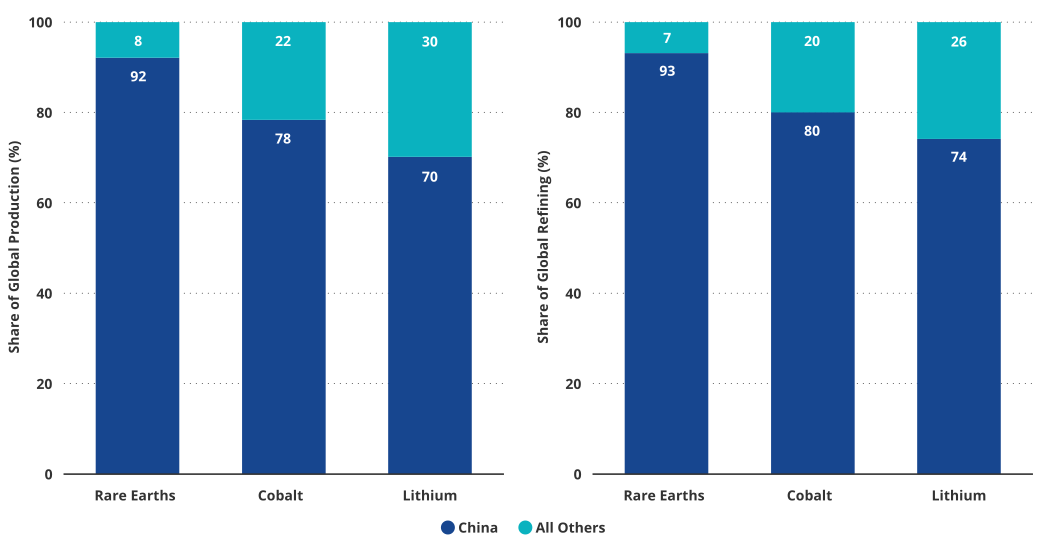
Source: IEA. Data as of December 2024.
China’s dominance was built through decades of centralized state strategy with the country consolidating mines, subsidizing refining, and allowing less stringent environmental standards. And China has shown a willingness to use its position strategically, tightening export restrictions when geopolitics heat up. Recent moves restricting certain exports in response to U.S. tariffs sent prices spiking and supply chains scrambling.
For the U.S. and its allies, access to these materials is no longer just an economic question. It’s a matter of national security and energy independence.
A U.S. and Global Revival
Recognizing the stakes, governments are adapting. In the U.S., MP Materials—the operator of the Mountain Pass mine in California—has become a flagship project. With more than $500 million in funding and offtake agreements from both the Department of Defense and Apple, MP is scaling magnet production and downstream processing.
Other nations are following suit with governments and corporations mobilizing to build rare earth and strategic metals supply chains outside China. Several notable, recent announcements highlight the size, scope, and global coordination of that effort:
| Country | Organization / Lead Entity | 2025 Headline Investment / Project Announcement |
| U.S. | Department of Defense | US$400m preferred-equity investment in MP Materials to build rare earth supply |
| U.S. | Apple | US$500m multi-year offtake commitment with MP Materials |
| E.U. | European Commission | Expected €22.5b covering 47 mining/refining projects across 13 member states |
| Australia | National Reconstruction Fund | AU$200m equity stake in Arafura's Nolans rare earth mine and refinery |
| India | National Critical Mineral Mission | State geological survey tasked with identifying 1,200 exploration projects |
| Japan | JOGMEC | €110m equity/debt for a rare earth refining facility in France |
| U.K. | CirculaREEconomy | £11m grant for building UK magnet-recycling chain |
| South Korea | Supply Chain Stabilization Fund | ₩50b per year fund for public-private overseas mine stakes and stockpiles |
Source: IEA, Reuters. Data as of August 2025
These projects will take years to scale, but the direction is clear: a coordinated effort to diversify supply away from China.
How to Invest
Directly purchasing rare earths isn’t feasible for most investors—these materials are not traded on traditional commodity exchanges. That’s where REMX comes in.
The VanEck Rare Earth and Strategic Metals ETF (REMX) provides pure-play, comprehensive, global exposure with holdings generating at least 50% of revenues from rare earths and strategic metals.
Related Insights

Related Insights
29 January 2026
29 January 2026
Venezuela’s oil sector is reentering the global conversation, and the path toward rebuilding production is likely to favor oilfield services companies first, before any material increase in crude supply reaches the market and benefits refiners thereafter.
21 January 2026
With the energy sector back in headlines, these are several oilfield services companies and refiners to watch in 2026.
14 January 2026
AI-driven power demand and electrification are reshaping resource markets as commodities diverge, metals outperform, energy lags and supply constraints return to focus.
13 January 2026
In 2025, gold and silver drove commodity returns. Looking ahead, structural supply dynamics, geopolitical developments, and global demand trends remain key factors influencing commodity markets.
18 December 2025
Get your portfolio ready for 2026 with detailed insights from VanEck’s investment team about the factors driving risk and returns in their respective asset classes.