Venezuela’s Oil Rebuild and the Case for Oilfield Services and Refiners
29 January 2026
Read Time 6 MIN
Can U.S. Oil Benefit from a Rebuild of Venezuela’s Oil Sector?
Venezuela’s oil sector is back on investors’ radar after years of stagnation. While recent geopolitical developments have driven headlines, the longer-term reconstruction of the country’s oil industry could create sustained opportunities for U.S. oilfield services companies and, over time, downstream refiners.
Years of underinvestment have severely degraded Venezuela’s oil infrastructure. Wells, surface equipment, power systems, and pipelines require extensive maintenance and rehabilitation, meaning that any meaningful increase in production would depend first on workovers, repairs, and field redevelopment rather than rapid new supply.
Recent U.S. engagement has signaled interest in restoring operating capacity, not simply moving existing barrels to market. If investment momentum shifts toward redevelopment, oilfield services providers with technical scale, compliance capabilities, and heavy-oil experience could be among the earliest beneficiaries. Refiners would likely benefit later, as improved reliability of Venezuelan crude supply feeds into global trade flows.
Risks remain significant. Sanctions durability, security conditions, and payment certainly continue to cloud the outlook. Investors should monitor whether policy developments support sustained redevelopment rather than short-term stabilization.
Key factors to watch include:
- A shift from stabilization toward long-term field redevelopment.
- The scale of required maintenance and infrastructure rehabilitation.
- Whether U.S. engagement supports upstream operating capacity.
- Ongoing sanctions, security, and financial risks.
Why Is Venezuela’s Oil Sector Back in Focus?
What Changed in Venezuela’s Oil Outlook?
Recent political developments have widened the range of possible outcomes for Venezuela’s oil sector. The removal of President Nicolás Maduro and subsequent governance uncertainty have increased the potential of policy change, foreign engagement, and gradual normalization. Markets are responding to a shift in probabilities rather than a single defined outcome.
From and investment perspective, two broad paths now appear plausible:
- Constructive scenario: Incremental governance improvement and expanded foreign participation support sustained investment.
- Muddle-through scenario: Reforms stall, uncertainty persists, and capital remains cautious.
Market sentiment appears to assign more weight to the constructive path than in recent years, even as risks remain elevated.
Why Are Investors Paying Attention Now?
Renewed interest in Venezuela is less about near-term production gains and more about optionality. The country holds the world’s largest proven oil reserves, yet years of mismanagement and underinvestment have left production and infrastructure far below potential.
Even limited progress toward normalization, such as clearer legal frameworks or pilot projects, could unlock a multi-year investment cycle. That cycle would likely begin upstream with oilfield services demand before translating into higher output and downstream benefits for refiners.
Venezuela’s Oil Industry Today: Large Reserves, Limited Output
Venezuela holds approximately 303 billion barrels of proven oil reserves, the largest in the world. However, crude production remains at a fraction of historical levels, currently well below one million barrels per day, far beneath its late-1990s peak.
Venezuela holds the world’s largest oil reserves, but the number of operational drilling rigs is near a historic low.
Oil Rig Count Venezuela
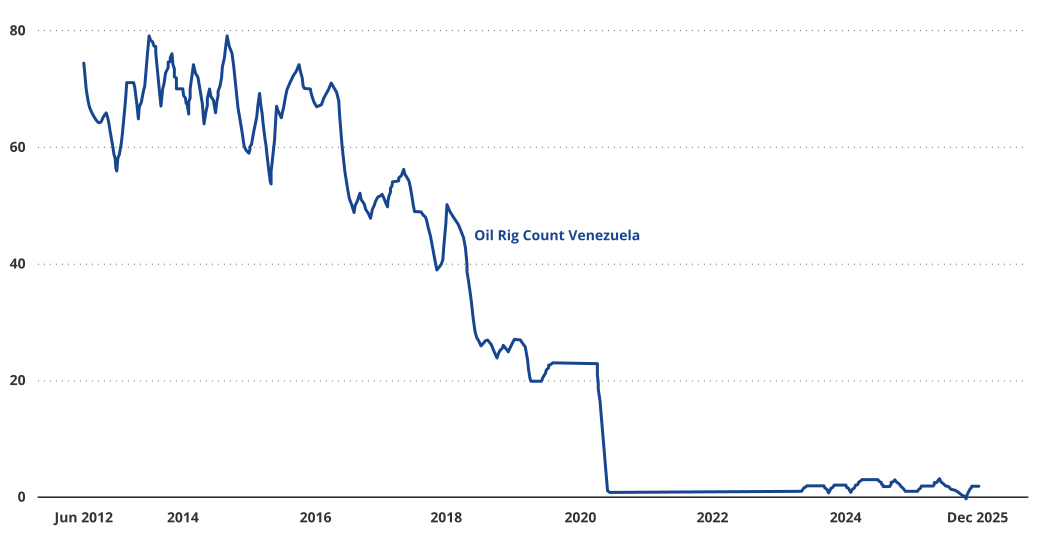
Source: Baker Hughes.
Why Did Oil Production Collapse?
The decline was driven by institutional and operational failures rather than geology:
- Chronic underinvestment and politicized management weakened PDVSA’s operating capacity.
- Nationalization and workforce purges eroded technical expertise.
- Sanctions restricted access to capital, technology, and diluents.
- Infrastructure decay impaired both production and refining capacity.
Despite vast reserves, these factors have left Venezuela unable to sustain output at scale.
Why Does This Matter for Oil Services?
Because the decline reflects operational breakdown rather than resource depletion, rebuilding would be services intensive. Restoring production would require well workovers, maintenance, pipeline and power repairs, and eventually enhanced recovery techniques. The country’s extra-heavy crude further increases demand for specialized expertise, creating potential opportunities for oilfield services firms if conditions stabilize.
How Does a Venezuelan Oil Comeback Impact American Oil Refiners?
A resurgence of Venezuelan exports could be structurally positive for U.S. Gulf Coast refiners, which are among the most complex globally and designed to process heavy, sour crude. Improved access to discounted Venezuelan barrels could enhance feedstock flexibility and support refining margins. However, benefits would be concentrated among refiners with advanced conversion capacity and would depend on supply reliability and policy durability.
What Would a Venezuelan Oil Rebuild Actually Require?
Rebuilding Venezuela’s oil sector would be a long-cycle, capital-intensive process, not a rapid production restart. Decades of underinvestment have left infrastructure degraded, requiring years of coordinated technical work and significant capital before exports meaningfully increase.
While recent engagement suggests interest in deeper operational recovery, risks around sanctions, security, and regulatory clarity remain high. Any credible rebuild would favor service providers with scale, compliance strength, and heavy-oil expertise.
What Do Oilfield Services Companies Do, and Why Do They Benefit First?
Oilfield services companies provide the technical backbone of upstream activity, including drilling, completions, diagnostics, maintenance, and production optimization. In degraded basins, demand for these services often rises before production volumes recover.
Rebuilds typically begin by repairing existing assets rather than launching new projects. In Venezuela, deferred maintenance alone could drive early services demand, historically benefiting services providers before producers or refiners.
How Could U.S. Oil Services and Refiners Be Exposed?
If foreign participation expands, U.S. oilfield services firms could support field rehabilitation, heavy-oil recovery, and equipment modernization. At the same time, refiners configured for heavy crude could benefit downstream as Venezuelan supply reenters global markets and reshapes crude flows.
Markets often price this dynamic early: expectations for future upstream investment can lift oil services equities ahead of realized activity, while refiners may benefit later as supply becomes more reliable.
Could Venezuela Act as a Catalyst for Oil Services and Refiners ETFs?
A Venezuelan rebuild would unfold over years, making it unsuitable as a short-term production thesis but relevant as long-dated optionality. Early signals such as, policy shifts, pilot projects, or limited-service activity, can influence sentiment well before capital spending peaks.
Why the VanEck Oil Services ETF (OIH)?
OIH provides targeted exposure to companies central to drilling and field activity, which have historically been early beneficiaries when upstream investment expectations improve.
What Risks Should Investors Consider?
Political uncertainty remains high. Sanctions changes, governance setbacks, and uneven capital deployment could delay progress. Diversified ETFs such as OIH and CRAK can help mitigate single-country risk.
What Does This Mean for Energy-Focused Investors?
Venezuela should not be viewed as a standalone investment thesis, but as a potential tailwind. For oil services investors, it adds upside asymmetry. For refiners, it represents a possible margin and feedstock advantage over time. Within a diversified energy allocation, services and refining exposure allows participation in recovery cycles without relying on a single outcome.
Conclusion: A Services-First Recovery Story
A rebuild of Venezuela’s oil sector would be slow, complex, and capital-intensive. That reality favors oilfield services first, with refiners positioned to benefit later as supply normalizes. Even limited progress could reshape expectations for global services demand, reinforcing the strategic role of oil services and select refiners within a diversified energy portfolio.
Related Insights



Related Insights
21 January 2026
With the energy sector back in headlines, these are several oilfield services companies and refiners to watch in 2026.
14 January 2026
AI-driven power demand and electrification are reshaping resource markets as commodities diverge, metals outperform, energy lags and supply constraints return to focus.
13 January 2026
In 2025, gold and silver drove commodity returns. Looking ahead, structural supply dynamics, geopolitical developments, and global demand trends remain key factors influencing commodity markets.
18 December 2025
Get your portfolio ready for 2026 with detailed insights from VanEck’s investment team about the factors driving risk and returns in their respective asset classes.
18 November 2025
The trade war is accelerating a U.S. rare-earth revival and other countries are following suit—these are some of the top companies to watch as we head into 2026.