Welcome to VanEck
Select Investor Type
15 June 2026
Read Time 10+ MIN
Key Takeaways:
Rare earths and copper are no longer niche commodity stories. They sit at the center of several of the world’s most urgent structural themes: AI infrastructure, defense modernization, grid expansion and supply chain security.
Recent price action reflects more than short-term geopolitical volatility. Copper has rallied near all-time highs, while rare earth prices remain elevated as export controls, national security concerns and underinvestment expose the limits of today’s supply chains. In rare earths especially, the challenge is not simply mining more material. It is building an integrated, ex-China supply chain that can span mining, separation, alloying, magnet production and recycling.
Supply chain vulnerabilities are being exposed — Recent geopolitical events have again highlighted how fragile commodity supply chains can be. While energy markets often receive the most attention, the impact has extended into metals, mining inputs and critical materials. The result may be continued pressure on both volumes and production costs, creating a more supportive environment for select commodities.
Rare earth prices reflect geopolitical scarcity — Neodymium-praseodymium, often used as a proxy for rare earth pricing, has experienced significant volatility driven by export controls and geopolitical tension. China controls the dominant share of rare earth supply and has restricted exports of both rare earth materials and magnet-making equipment. With limited near-term relief, rare earth prices may remain supported.
Rare earths have an outsized economic impact — Rare earths represent a small physical market, but they play an essential role in aerospace, defense, electronics, communications and transportation. Substitution is difficult in many of these applications, especially where high-strength, high-heat permanent magnets are required.
Defense and robotics may drive magnet demand — Permanent magnets vary by strength and heat tolerance. Defense applications typically require some of the highest-performance magnets, while robotics demand very strong magnets as automation expands. Across transportation, defense, robotics and communications, permanent magnet demand could rise meaningfully over the next decade.
The ex-China supply chain remains incomplete — Western investment has begun to flow into rare earth mining and separation, but the largest opportunity may lie further downstream in alloys, magnets and recycling. A fully integrated “mine-to-magnet” supply chain will require investment across several stages, many of which remain underdeveloped outside China.
Mining is only one piece of the rare earth supply chain. Building a competitive ex-China ecosystem also requires separation, alloying, magnet manufacturing and recycling capacity.
China currently dominates multiple stages of the rare earth value chain, from raw material supply to separation, alloying, magnet production and recycling. Western governments have responded by supporting domestic mining and processing capacity, including price floors and strategic investments. But building a competitive alternative will likely take years.
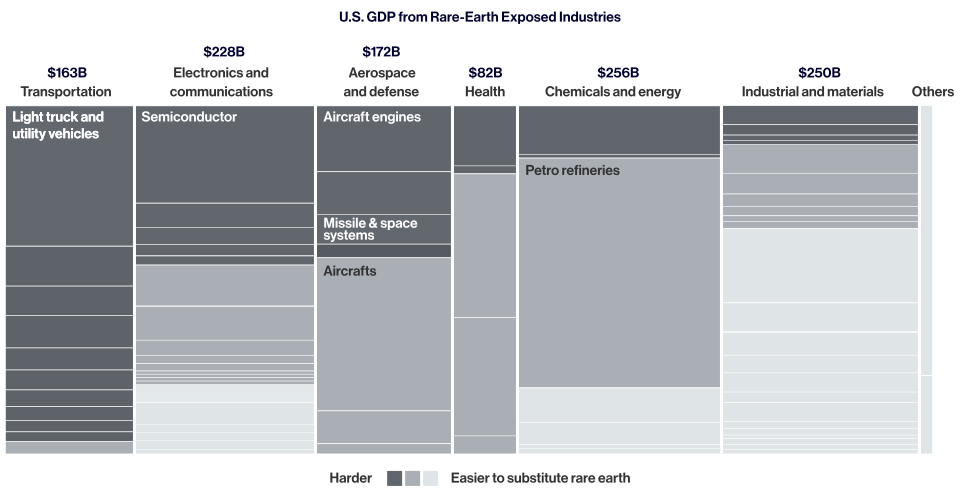
Takeaway: Many exposed industries have limited near-term substitutes, increasing vulnerability to supply disruptions or export controls. Reducing dependence requires years of investment across mining, separation, refining, recycling and magnet production.
Source: Bloomberg Economics. Data as of May 2026. For illustrative purposes only.
The opportunity may be especially meaningful in downstream parts of the chain. Separation, magnet manufacturing and recycling are all critical to reducing reliance on imports. Recycling, in particular, remains underappreciated. China produces a meaningful share of its permanent magnets from recycled material, including end-of-life and factory-floor recycling. Outside China, this infrastructure remains far less developed.
The broader implication is that rare earth supply security will likely require a coordinated effort among governments, private companies, investors and end users. This is not a short sprint to bring a few mines online. It is a long-term industrial buildout.
Key investment risks linked to rare-earth supply-chain equities include price volatility, regulatory changes, and project-execution risk. Risks specific to downstream rare-earth processing and recycling equities include technology risk, funding risk, and commodity-cycle risk.
Copper faces a different but equally important challenge. Unlike rare earths, copper is a much larger and more liquid global market. But supply growth remains difficult.
Long-term constraints include declining ore grades, fewer major discoveries, project delays and increasing capital intensity. New copper projects are becoming more expensive, more complex and harder to develop. Mines are also getting deeper, which can increase operating costs, capital costs and technical risk.
One example is the growing complexity of deep underground projects. Deeper mines often require more infrastructure, ventilation, power, cooling and material movement. These requirements can make future supply more expensive and slower to bring online.
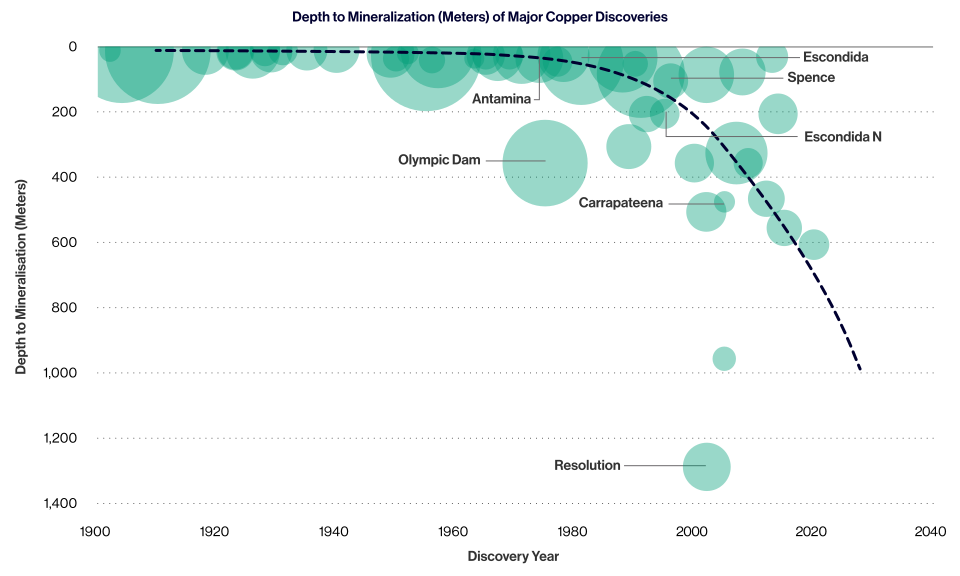
Takeaway: Recent copper discoveries are increasingly deeper, making development more complex, costly and technically challenging. As easier-to-access deposits are depleted, future supply growth may require longer timelines and higher capital investment.
Source: VanEck, Bloomberg. Data as of December 2025. For illustrative purposes only. Not a projection of future results. Past performance is not indicative of future results. Short-term geopolitical dynamics have added another layer. Copper production depends on key inputs such as sulfuric acid, and disruptions around the Strait of Hormuz region have raised concerns about availability and cost. Sulfuric acid prices have risen sharply, adding pressure to production costs and reinforcing the idea that copper may have stronger cost support than in prior cycles.
Key risks of copper-equity exposure include cost inflation, project delays, and geopolitical risk.
AI infrastructure remains a major long-term demand theme, but the metals impact may unfold in phases.
The first phase is physical construction: concrete, steel, buildings and supporting infrastructure. The second phase involves generation, connectivity, grid upgrades and power availability. Metals and minerals become increasingly important as data centers move from construction to full energy integration.
Utilities and data center operators are already thinking years ahead about power supply. That planning has implications for copper, uranium, steel, aluminum and other critical resource markets. While it may be too early to identify the exact point at which metals shortages could slow AI infrastructure deployment, the direction of travel is clear: AI will require more physical materials, more power and more resilient supply chains.
Mining companies are behaving differently than in prior cycles.
Rather than chasing volume growth at any cost, many companies are focused on financial discipline, balance sheet strength and shareholder returns. Capital expenditures have plateaued, and companies are increasingly mining for profit rather than simply mining for production growth.
That matters for investors. Higher commodity prices, combined with disciplined spending, can improve free cash flow generation. Many resource companies have adopted capital allocation frameworks that split cash flow between reinvestment and shareholder returns. In some cases, this has translated into attractive free cash flow yields and the potential for dividends or buybacks. Buybacks are transactions in which a company repurchases its own shares from the market, reducing the number of shares outstanding.
This discipline may be especially important because the opportunity set has broadened. The discussion was not limited to rare earths and copper. Gold, lithium, diversified miners, energy and other resource-related equities may also benefit from supply constraints, geopolitical uncertainty and structural demand growth.
Although rare earths and copper were the primary focus, lithium also entered the discussion.
The lithium market has remained nuanced, but conditions appear more constructive than they were several months ago. Some oversupply from China has faded, while production downgrades at major assets such as Greenbushes in Australia have helped improve the supply picture. Demand is also broadening beyond electric vehicles into battery packs and other storage applications.
This does not eliminate volatility, but it may provide a firmer price floor for select Western lithium producers.
For investors, the central message is not simply that commodity prices could move higher. Selectivity is becoming more important.
Rare earth companies may benefit from national security priorities and government support, but many still face financial, operational and execution risk. Some companies are scaling from pilot operations to commercial production, which can be a difficult transition. China also remains a major competitive force, with established revenue, cash flow and operating capacity.
Copper producers and diversified miners may offer a different profile. Many have operating assets, stronger balance sheets and more visible free cash flow. In an environment where supply constraints and cost inflation support commodity prices, established producers may be well positioned.
VanEck offers several ways to access these themes, including:
VanEck Rare Earth and Strategic Metals UCITS ETF — Provides global exposure to companies involved in mining, refining and recycling rare earths and strategic metals, including materials tied to AI, defense, electrification and advanced technologies. Main Risk Factors: Risk of investing in the natural resources sector, risk of investing in emerging markets, risk of investing in smaller companies.

VanEck Electrification and Power Infrastructure UCITS ETF — Offers investors exposure to a diversified portfolio of companies supporting the global electrification and power infrastructure theme, offering access to businesses involved in grid modernization, energy transmission, storage and industrial electrification. Main Risk Factors: Foreign currency risk, risk of investing in emerging markets issuers, industry or sector concentration risk.

VanEck Global Resources UCITS — A diversified resource equity strategy that provides exposure across natural resources, including base metals, critical metals, energy, agriculture and precious metals. Main Risk Factors: Risk of investing in natural resources companies, equity market risk, industry or sector concentration risk.

VanEck S&P Global Mining UCITS ETF — Provides global exposure to companies involved in the production of key metals that are important inputs for modern economies, including gold, silver, copper, nickel, zinc, iron ore and lithium. Main Risk Factors: Risk of investing in natural resources companies, emerging markets risk, risk of investing in smaller companies.
Please refer to these funds’ KID and the Prospectus for other important information before investing.
The next phase of the critical metals story may be shaped by several developments.
First, rare earth policy support is likely to remain a major factor. Price floors, government investment, export controls and defense procurement could all influence the pace of ex-China supply development.
Second, copper supply remains structurally challenged. Declining grades, deeper mines, fewer major discoveries and higher capital intensity suggest that new supply may struggle to keep pace with demand.
Third, AI and defense demand are still evolving. As data center construction moves toward power generation, grid connectivity and equipment deployment, the metals intensity of the AI buildout may become more visible.
Finally, investors should watch whether capital discipline holds. If mining companies continue prioritizing balance sheets, returns and profitability, resource equities may remain attractive even if commodity markets remain volatile.
To receive more insights, sign up to our newsletter.
Sources for data/information unless otherwise indicated: Bloomberg and company research, June 2026.
IMPORTANT INFORMATION
This is marketing communication.
This information originates from VanEck (Europe) GmbH, which is authorized as an EEA investment firm under the Markets in Financial Instruments Directive (“MiFiD”). VanEck (Europe) GmbH has its registered address at Kreuznacher Str. 30, 60486 Frankfurt, Germany, and has been appointed as distributor of VanEck products in Europe by the Management Company, VanEck Asset Management B.V.(“ManCo”), which is incorporated under Dutch law and registered with the Dutch Authority for the Financial Markets (AFM).
This material is only intended for general and preliminary information and does not constitute an investment, legal or tax advice. No representation or warranty is made as to the accuracy or completeness of the information and no liability is accepted to the fullest extent permitted by law.
The views and opinions expressed are those of the author(s) but not necessarily those of VanEck. Opinions are current as of the publication date and are subject to change with market conditions. Information provided by third party sources is believed to be reliable and has not been independently verified for accuracy or completeness and cannot be guaranteed.
Please refer to the Prospectus – in English language - and the KID/KIID - in local language - before making any final investment decisions and for full information on risks. These documents can be obtained free of charge at www.vaneck.com, from the ManCo or from the appointed facility agent.
VanEck Electrification and Power Infrastructure UCITS ETF ("ETF") is a sub-fund of VanEck UCITS ETFs plc, a UCITS umbrella investment company with limited liability between sub-funds. The ETF is registered with the Central Bank of Ireland, passively managed and tracking an equity index.
The value of the ETF may fluctuate significantly as a result of the investment strategy. The ETF´s holdings are disclosed on each dealing day on www.vaneck.com under the ETF´s Holdings section and as per PCF under the Documents section and published via one or more market data suppliers. The indicative net asset value (iNAV) of the ETF is available on Bloomberg. For details on the regulated markets where the ETF is listed, please refer to the Trading Information section on the ETF page at www.vaneck.com. Investors must buy and sell units of the UCITS on the secondary market via an intermediary (e.g. a broker) and cannot usually be sold directly back to the UCITS. Brokerage fees may incur. The buying price may exceed, or the selling price may be lower than the current net asset value. Investing in the ETF should be interpreted as acquiring shares of the ETF and not the underlying assets. Tax treatment depends on the personal circumstances of each investor and may vary over time. The ManCo may terminate the marketing of the ETF in one or more jurisdictions. The summary of the investor rights is available in English at: summary-of-investor-rights.pdf.
Please refer to the Prospectus – in English language - and the KID/KIID - in local language - before making any final investment decisions and for full information on risks. These documents can be obtained free of charge at www.vaneck.com, from the ManCo or from the appointed facility agent.
VanEck Rare Earth and Strategic Metals UCITS ETF ("ETF") is a sub-fund of VanEck UCITS ETFs plc, a UCITS umbrella investment company, registered with the Central Bank of Ireland and tracking an equity index.
The value of the ETF may fluctuate significantly as a result of the investment strategy. The ETF´s holdings are disclosed on each dealing day on www.vaneck.com under the ETF´s Holdings section and as per PCF under the Documents section and published via one or more market data suppliers. The indicative net asset value (iNAV) of the ETF is available on Bloomberg. For details on the regulated markets where the ETF is listed, please refer to the Trading Information section on the ETF page at www.vaneck.com. Investors must buy and sell units of the UCITS on the secondary market via an intermediary (e.g. a broker) and cannot usually be sold directly back to the UCITS. Brokerage fees may incur. The buying price may exceed, or the selling price may be lower than the current net asset value. Investing in the ETF should be interpreted as acquiring shares of the ETF and not the underlying assets. Tax treatment depends on the personal circumstances of each investor and may vary over time. The ManCo may terminate the marketing of the ETF in one or more jurisdictions. The summary of the investor rights is available in English at: summary-of-investor-rights.pdf.
Please refer to the Prospectus – in English language - and the KID/KIID - in local language - before making any final investment decisions and for full information on risks. These documents can be obtained free of charge at www.vaneck.com, from the ManCo or from the appointed facility agent.
VanEck Global Resources UCITS ("Fund") is a sub-fund of VanEck ICAV, a UCITS umbrella investment company, registered with the Central Bank of Ireland and actively managed. The ManCo transferred the investment management for the Product to Van Eck Associates Corporation, an investment company regulated by the U.S. Securities and Exchange Commission (SEC).
The value of the Fund may fluctuate significantly as a result of the investment strategy. The Fund´s holdings are disclosed on each dealing day on www.vaneck.com under the Fund´s Holdings section and as per PCF under the Documents section and published via one or more market data suppliers. For details on the regulated markets where the Fund is listed, please refer to the Trading Information section on the Fund page at www.vaneck.com. Investors must buy and sell units of the UCITS on the secondary market via an intermediary (e.g. a broker) and cannot usually be sold directly back to the UCITS. Brokerage fees may incur. The buying price may exceed, or the selling price may be lower than the current net asset value. Investing in the Fund should be interpreted as acquiring shares of the Fund and not the underlying assets. Tax treatment depends on the personal circumstances of each investor and may vary over time. The ManCo may terminate the marketing of the Fund in one or more jurisdictions. The summary of the investor rights is available in English at: summary-of-investor-rights.pdf.
Please refer to the Prospectus – in English language - and the KID/KIID - in local language - before making any final investment decisions and for full information on risks. These documents can be obtained free of charge at www.vaneck.com, from the ManCo or from the appointed facility agent.
VanEck S&P Global Mining UCITS ETF ("ETF") is a sub-fund of VanEck UCITS ETFs plc, a UCITS umbrella investment company, registered with the Central Bank of Ireland, passively managed and tracking an equity index.
The value of the ETF may fluctuate significantly as a result of the investment strategy. The ETF´s holdings are disclosed on each dealing day on www.vaneck.com under the ETF´s Holdings section and as per PCF under the Documents section and published via one or more market data suppliers. The indicative net asset value (iNAV) of the ETF is available on Bloomberg. For details on the regulated markets where the ETF is listed, please refer to the Trading Information section on the ETF page at www.vaneck.com. Investors must buy and sell units of the UCITS on the secondary market via an intermediary (e.g. a broker) and cannot usually be sold directly back to the UCITS. Brokerage fees may incur. The buying price may exceed, or the selling price may be lower than the current net asset value. Investing in the ETF should be interpreted as acquiring shares of the ETF and not the underlying assets. Tax treatment depends on the personal circumstances of each investor and may vary over time. The ManCo may terminate the marketing of the ETF in one or more jurisdictions. The summary of the investor rights is available in English at: summary-of-investor-rights.pdf.
Investing is subject to risk, including the possible loss of principal. For any unfamiliar technical terms, please refer to ETF Glossary | VanEck.
No part of this material may be reproduced in any form, or referred to in any other publication, without express written permission of VanEck.
© VanEck (Europe) GmbH
This is a marketing communication. Please refer to the prospectus of the UCITS and to the KID before making any final investment decisions.
This information originates from VanEck (Europe) GmbH, which has been appointed as distributor of VanEck products in Europe by the Management Company VanEck Asset Management B.V., incorporated under Dutch law and registered with the Dutch Authority for the Financial Markets (AFM). VanEck (Europe) GmbH with registered address at Kreuznacher Str. 30, 60486 Frankfurt, Germany, is a financial services provider regulated by the Federal Financial Supervisory Authority in Germany (BaFin).
The information is intended only to provide general and preliminary information to investors and shall not be construed as investment, legal or tax advice VanEck (Europe) GmbH, VanEck Switzerland AG, VanEck Securities UK Limited and their associated and affiliated companies (together “VanEck”) assume no liability with regards to any investment, divestment or retention decision taken by the investor on the basis of this information. The views and opinions expressed are those of the author(s) but not necessarily those of VanEck. Opinions are current as of the publication date and are subject to change with market conditions. Certain statements contained herein may constitute projections, forecasts and other forward-looking statements, which do not reflect actual results. Information provided by third party sources is believed to be reliable and have not been independently verified for accuracy or completeness and cannot be guaranteed. Brokerage or transaction fees may apply.
All performance information is based on historical data and does not predict future returns. Investing is subject to risk, including the possible loss of principal.
No part of this material may be reproduced in any form, or referred to in any other publication, without express written permission of VanEck.
© VanEck (Europe) GmbH / VanEck Asset Management B.V.