Welcome to VanEck
Select Investor Type
15 December 2025
Read Time 7 MIN
This is VanEck’s monthly gold market and economic insights from Imaru Casanova, Portfolio Manager, featuring her unique views on mining and gold’s portfolio benefits.
This article covers market developments through the end of November 2025. All performances are stated in USD. Returns may increase or decrease as a result of currency fluctuations.
Key Takeaways:
Key Risks:
Gold spent November comfortably hovering around the $4,000 mark, even as the odds of a December Fed rate cut declined early in the month1. But once markets began actively pricing in a cut, gold took off. The implied probability of a December rate cut jumped from 23% on November 19 to 83% by month-end and gold responded in a way that aligns with certain historical patterns, though such relationships do not always hold. Historically, gold has sometimes benefited from expectations of lower rates, although this relationship does not always hold. Past performance is not a reliable indicator of future results.
By November 28, gold closed at $4,239.43 per ounce, a gain of $236.52, or 5.91%, for the month. And while equity markets attempted to rebound from their lows, the S&P 500 finished roughly flat at 0.25%2. Meanwhile, gold ended the month just $117 shy of its all-time high of $4,356, and gold equities rallied right alongside it, as both the MVGDX and MVGDXJTR Index advanced sharply, with MVGDX3 up 15.23% and MVGDXJTR4 rising 16.37%.
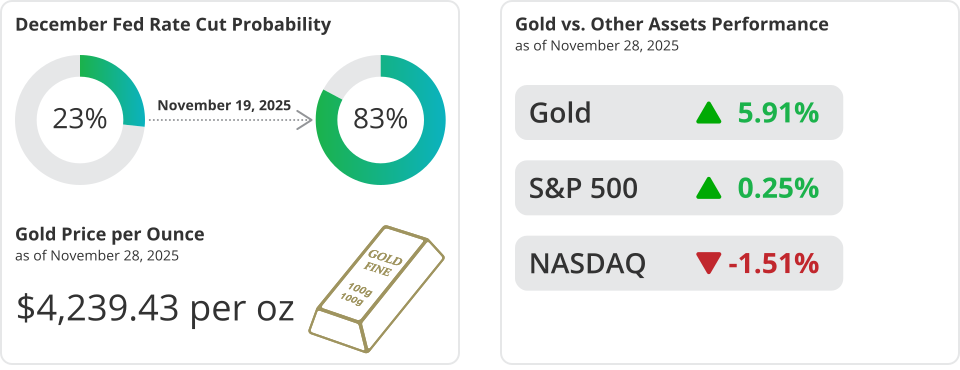
Gold is intended as physical gold, while S&P 500 and NASDAQ are indexes, which have different characteristics. It is not possible to invest directly in an index.
Record gold prices are driving greater deal activity across the mining sector. Strong cash flow generation and improved valuations are giving companies more flexibility to expand and optimize their portfolios. In 2025, the industry saw an uptick in asset sales and purchases, minority equity investments in earlier-stage companies and a rise in corporate-level mergers and acquisitions.
Senior producers have generally focused on portfolio rationalization, using strong gold and silver prices to divest non-core assets at attractive valuations. Rather than pursuing large-scale acquisitions, many are choosing to make smaller, entry-level equity investments in earlier-stage companies to strengthen their longer-term project pipelines. There appears to be an industry preference: funding internally generated, prudently phased growth with operating cash flow rather than higher-risk acquisitions that often require issuing equity, particularly at a time when many companies’ shares still trade at historically low valuations. As a result, many companies across the sector seem to be taking a more disciplined and selective approach to M&A.
Scale does not always translate into increased value in the gold mining industry, and in some cases, becoming too large can introduce additional challenges. Companies are not looking to grow for growth’s sake. They aim to create value by lowering costs, extending mine life, improving returns on invested capital and reducing operational risk. Achieving all of this is no small task. Miners struggle to find assets of sufficient size and quality to justify the substantial acquisition premiums sellers expect in a strong gold-price environment. This reality helps explain why M&A activity has not accelerated as much as many expected during this cycle.
There appear to be opportunities around the world for meaningful regional consolidation, and these tend to be the types of transactions that make the most strategic sense. Mining operations can benefit significantly from synergies created when multiple assets operate as a single district, hub or complex – sharing critical infrastructure, equipment, labor, leadership and technical talent, supply chains and in-country or regional expertise, among other advantages.
Even the most obvious consolidation opportunities carry meaningful risks. Consider the challenges Barrick Mining faced integrating its Nevada assets with Newmont’s to create the Nevada Gold Mines joint venture, the largest gold mining complex in the world. This combination was clearly necessary, yet it still took years to fully integrate, optimize and fine-tune operations. These assets were not far-flung: they were in the same country, the same state, and in close proximity – mature operations run by the two largest gold mining companies in the world when the JV was formed in 2019.
Integration challenges are amplified when operations differ in geology, mining and processing methods. These challenges can become more complex when operations are spread across countries or continents that vary in language, levels of government and community involvement, mining codes, regulatory environments, labor laws and operating and safety cultures. Layer onto that the complexity of proper due diligence and the risks compound quickly. Is the deposit’s size and quality truly what the seller claims? Was the feasibility study underpinning the valuation conducted with sufficient technical and economic rigor? Have years of underinvestment or mismanagement compromised operations, infrastructure or community relationships? The list goes on.
Buying a mining asset is nothing like acquiring a factory that simply produces more of what a company already makes, it brings far greater challenges. That’s why companies must carefully evaluate each transaction and weigh these well-known risks against the synergies and improvements they expect to achieve. Reviewing the most common sources of merger and acquisition synergies highlights just how complex it can be to estimate potential value gains.
Operational Synergies
Financial Synergies
Strategic Synergies
While these examples may sound compelling, and often appear straightforward on paper, many transactions ultimately fall short of delivering their promised synergies. Common pitfalls include overestimated cost savings or productivity gains, unrealistic integration or development timelines, cultural misalignment, loss of key personnel, complex systems and process integration challenges, and regulatory, labor or community obstacles.
Breaking up a company, through a spin-off, split, or divestiture, is often the mirror image of a merger. The premise is that the costs of complexity outweigh the benefits of keeping assets together. A simplified structure can deliver several advantages:
Most companies promise substantial synergies and value creation when announcing transactions, yet only a few track or disclose the actual gains in the years that follow. This lack of transparency makes it difficult for the market to assess the true economic impact of a merger or breakup, and understandably fuels skepticism.
We evaluate each transaction closely, assessing both the potential synergies and the likelihood of realizing them. Do the expected benefits truly outweigh the risks? Are we being adequately compensated for any additional risk, or are we leaving value on the table? We then monitor the financial, operational and stock-price performance of the pro forma entities to gauge how successful these transactions ultimately are.
Our analysis suggests that consolidation may play an important role in addressing structural challenges within the gold mining sector. The industry remains highly fragmented, yet only a limited number of groups worldwide have the proven capability to find, develop, build and operate mines at the highest standards. In such a complex business, the scarcity of top-tier management is a real structural risk; poor leadership destroys value at every stage of the mining cycle.
For equity investors, effective management of assets can potentially enhance the visibility and quality of companies within the investable universe. This might be most effectively achieved in the small-cap and mid-tier space, where opportunities to capture synergies, particularly among geographically proximate operations, can be most compelling.
We also see natural limits to scalability in this industry. Even exceptional teams can lose focus as organizations grow too large and talent becomes stretched, ultimately eroding performance. In mining, bigger isn’t always better, but stronger certainly is. The sector faces a wide and constantly shifting range of risks, and long-term value creation largely depends on management’s ability to eliminate, reduce or manage those risks from discovery through production.
To receive more Gold Investing insights, sign up to our newsletter.
1 World Gold Council (30.11.2025)
2 Bloomberg data (30.11.2025)
3 MarketVector (30.11.2025)
4 MarketVector (30.11.2025)
Sources for other data/information unless otherwise indicated: Bloomberg and company research, November 2025.
IMPORTANT INFORMATION
This is marketing communication.
For investors in Switzerland: VanEck Switzerland AG, with registered office in Genferstrasse 21, 8002 Zurich, Switzerland, has been appointed as distributor of VanEck´s products in Switzerland by the Management Company VanEck Asset Management B.V. (“ManCo”). A copy of the latest prospectus, the Articles, the Key Information Document, the annual report and semi-annual report can be found on our website www.vaneck.com or can be obtained free of charge from the representative in Switzerland: Zeidler Regulatory Services (Switzerland) AG, Stadthausstrasse 14, CH-8400 Winterthur, Switzerland. Swiss paying agent: Helvetische Bank AG, Seefeldstrasse 215, CH-8008 Zürich.
For investors in the UK: This is a marketing communication targeted to FCA regulated financial intermediaries. Retail clients should not rely on any of the information provided and should seek assistance from a financial intermediary for all investment guidance and advice. VanEck Securities UK Limited (FRN: 1002854) is an Appointed Representative of Sturgeon Ventures LLP (FRN: 452811), which is authorised and regulated by the Financial Conduct Authority (FCA) in the UK, to distribute VanEck´s products to FCA regulated firms such as financial intermediaries and Wealth Managers.
This information originates from VanEck (Europe) GmbH, which is authorized as an EEA investment firm under the Markets in Financial Instruments Directive (“MiFiD”). VanEck (Europe) GmbH has its registered address at Kreuznacher Str. 30, 60486 Frankfurt, Germany, and has been appointed as distributor of VanEck products in Europe by the ManCo, which is incorporated under Dutch law and registered with the Dutch Authority for the Financial Markets (AFM).
This material is only intended for general and preliminary information and does not constitute an investment, legal or tax advice. VanEck (Europe) GmbH and its associated and affiliated companies (together “VanEck”) assume no liability with regards to any investment, divestment or retention decision on the basis of this information. All relevant documentation must be first consulted.
The views and opinions expressed are those of the author(s) but not necessarily those of VanEck. Opinions are current as of the publication date and are subject to change with market conditions. Information provided by third party sources is believed to be reliable and has not been independently verified for accuracy or completeness and cannot be guaranteed.
The MarketVector™ Global Gold Miners Index is the exclusive property of MarketVector Indexes GmbH (a wholly owned subsidiary of Van Eck Associates Corporation), which has contracted with Solactive AG to maintain and calculate the Index. Solactive AG uses its best efforts to ensure that the Index is calculated correctly. Irrespective of its obligations towards MarketVector Indexes GmbH (“MarketVector”), Solactive AG has no obligation to point out errors in the Index to third parties. VanEck’s ETF is not sponsored, endorsed, sold or promoted by MarketVector and MarketVector makes no representation regarding the advisability of investing in the ETF. Effective September 19, 2025 the NYSE Arca Gold Miners Index has been replaced with the MarketVector™ Global Gold Miners Index. It is not possible to invest directly in an index.
MVIS® Global Junior Gold Miners Index is the exclusive property of MarketVector Indexes GmbH (a wholly owned subsidiary of Van Eck Associates Corporation), which has contracted with Solactive AG to maintain and calculate the Index. Solactive AG uses its best efforts to ensure that the Index is calculated correctly. Irrespective of its obligations towards MarketVector Indexes GmbH (“MarketVector”), Solactive AG has no obligation to point out errors in the Index to third parties. VanEck’s ETF is not sponsored, endorsed, sold or promoted by MarketVector and MarketVector makes no representation regarding the advisability of investing in the ETF. It is not possible to invest directly in an index.
The S&P 500 Index (“Index”) is a product of S&P Dow Jones Indices LLC and/or its affiliates and has been licensed for use by Van Eck Associates Corporation. Copyright © 2020 S&P Dow Jones Indices LLC, a division of S&P Global, Inc., and/or its affiliates. All rights reserved. Redistribution or reproduction in whole or in part are prohibited without written permission of S&P Dow Jones Indices LLC. For more information on any of S&P Dow Jones Indices LLC’s indices please visit www.spdji.com. S&P® is a registered trademark of S&P Global and Dow Jones® is a registered trademark of Dow Jones Trademark Holdings LLC. Neither S&P Dow Jones Indices LLC, Dow Jones Trademark Holdings LLC, their affiliates nor their third party licensors make any representation or warranty, express or implied, as to the ability of any index to accurately represent the asset class or market sector that it purports to represent and neither S&P Dow Jones Indices LLC, Dow Jones Trademark Holdings LLC, their affiliates nor their third party licensors shall have any liability for any errors, omissions, or interruptions of any index or the data included therein. It is not possible to invest directly in an index.
Investing is subject to risk, including the possible loss of principal. For any unfamiliar technical terms, please refer to ETF Glossary | VanEck.
No part of this material may be reproduced in any form, or referred to in any other publication, without express written permission of VanEck.
© VanEck (Europe) GmbH ©VanEck Switzerland AG © VanEck Securities UK Limited
This is a marketing communication. Please refer to the prospectus of the UCITS and to the KID before making any final investment decisions.
This information originates from VanEck (Europe) GmbH, which has been appointed as distributor of VanEck products in Europe by the Management Company VanEck Asset Management B.V., incorporated under Dutch law and registered with the Dutch Authority for the Financial Markets (AFM). VanEck (Europe) GmbH with registered address at Kreuznacher Str. 30, 60486 Frankfurt, Germany, is a financial services provider regulated by the Federal Financial Supervisory Authority in Germany (BaFin).
The information is intended only to provide general and preliminary information to investors and shall not be construed as investment, legal or tax advice VanEck (Europe) GmbH, VanEck Switzerland AG, VanEck Securities UK Limited and their associated and affiliated companies (together “VanEck”) assume no liability with regards to any investment, divestment or retention decision taken by the investor on the basis of this information. The views and opinions expressed are those of the author(s) but not necessarily those of VanEck. Opinions are current as of the publication date and are subject to change with market conditions. Certain statements contained herein may constitute projections, forecasts and other forward-looking statements, which do not reflect actual results. Information provided by third party sources is believed to be reliable and have not been independently verified for accuracy or completeness and cannot be guaranteed. Brokerage or transaction fees may apply.
All performance information is based on historical data and does not predict future returns. Investing is subject to risk, including the possible loss of principal.
No part of this material may be reproduced in any form, or referred to in any other publication, without express written permission of VanEck.
© VanEck (Europe) GmbH / VanEck Asset Management B.V.