


Introduction to ETF Trading
Exchange-traded funds (ETFs) have revolutionized the way investors access financial markets. ETF trading requires a balance of technical know-how and strategic insight, enabling investors to navigate the intricacies of both primary and secondary markets. Through this Academy, you’ll explore key aspects of ETF trading from understanding the mechanisms of creation and redemption to mastering the science and art of trading, and even identifying the best times to execute your trades.
- Market dynamics: Understand how the primary and secondary markets function, including the roles of authorized participants (APs) and market makers in maintaining liquidity and pricing efficiency.
- Liquidity and costs: Learn how bid-ask spreads indicate market conditions and impact trading costs, enabling smarter trade execution.
- Trading strategies: Master the use of limit orders, identify optimal trading windows, and develop strategies to manage risk and capitalize on market opportunities.
- Timing your trades: Discover the best times to trade ETFs to reduce volatility, improve execution, and achieve better results.
- Science meets art: Balance data-driven strategies with intuition and flexibility to create personalized, effective trading approaches.
Primary Market and Authorized Participants
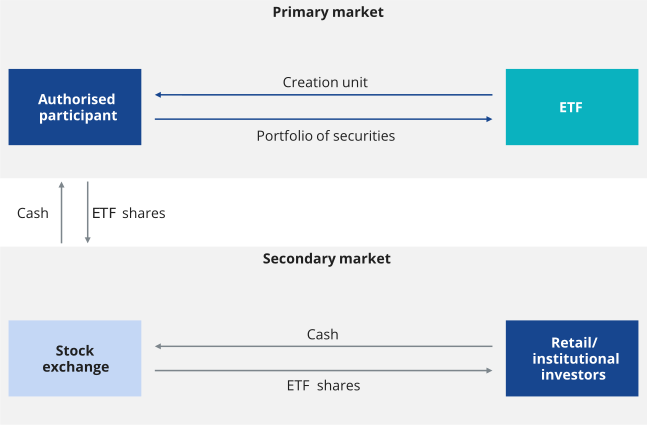
ETFs are issued in the primary market, which plays a pivotal role by enabling issuers to raise new capital. This sets the stage for the secondary market, where ETF securities are subsequently traded.
When institutional or professional investors express interest in purchasing a large volume of ETFs such as 50,000 shares the primary market’s authorized participants (APs) create new shares. This mechanism ensures that significant transactions can occur without disrupting the market’s stability.
ETF Lifecycle and the Market Flow
Source: RBA, VanEck.
What Happens in the ETF Primary Market?

ETFs are not sold directly to retail investors by the issuer. Instead, APs create new ETF shares by exchanging a pre-defined basket of underlying assets or cash equivalent with the ETF provider.

ETFs do not require an underwriting process. Instead of banks pricing and distributing securities, APs create and redeem shares based on market demand. This process allows the supply of ETFs to expand and contract.

ETF issuers do not raise funds when new shares are created, unlike companies. The ETF primary market exists purely to adjust supply according to market needs, ensuring ETF pricing remains close to net asset value (NAV).

When large trades occur, APs handle them without market disruption, creating or redeeming shares in bulk.

Once created, ETF shares trade on stock exchanges in the secondary market, where retail and institutional investors can buy and sell them like stocks.
- ETF issuers do not control secondary market pricing. Instead, market makers and supply/demand dynamics determine price movements.
Role of Authorized Participants in ETF Markets
APs are specialized financial institutions, such as large banks or market-making firms, that ensure the ETF ecosystem functions efficiently. They create and redeem ETF shares, maintaining liquidity, and aligning ETF prices with their underlying assets.
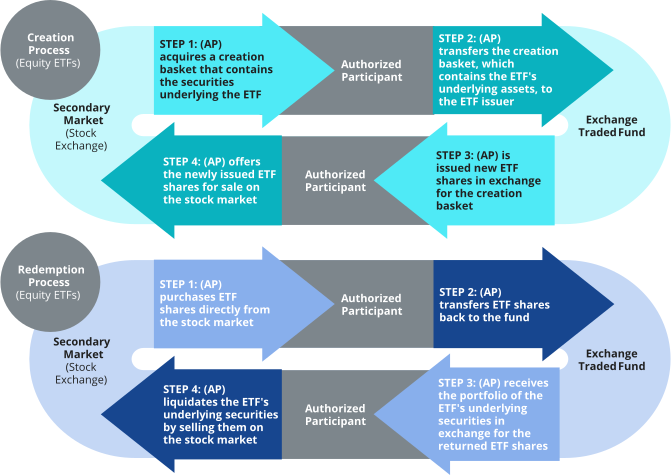
- Creation process: When demand for an ETF rises, APs acquire the underlying assets that the ETF tracks (e.g., a basket of stocks, bonds, or commodities) and deliver them to the ETF issuer, which bundles the assets into ETF shares. The new shares are delivered back to the AP, which sells them in the secondary market, ensuring adequate supply and preventing price inflation.
- Redemption process: If there’s an oversupply of ETF shares in the market, APs redeem the excess by returning ETF shares to the issuer in exchange for the underlying assets. This process aligns the market price with the ETF’s NAV and prevents significant discounts.
- Market liquidity: APs ensure liquidity by providing continuous bid and ask prices, allowing investors to buy and sell ETFs with minimal price impact. They also facilitate bulk transactions efficiently, enabling institutional investors to execute large trades without destabilizing the market.
ETF Creation and Redemption Cycle: Step-by-Step Process
Source: VanEck.
A distinctive feature of ETFs is their use of in-kind transfers during the creation and redemption process. Instead of exchanging cash, authorized participants deliver a basket of securities that mirrors the ETF’s underlying index when creating new shares. In return, they receive newly issued ETF shares, which they can then sell on the secondary market.
The same mechanism works in reverse during redemptions. Authorized participants return ETF shares to the issuer and receive a proportional basket of the underlying securities. This exchange of securities rather than cash is known as an in-kind transfer.
Understanding the ETF Secondary Market
The ETF secondary market is where investors buy and sell ETF shares on stock exchanges.
Why the Secondary Market Matters:
ETFs offer investors real-time trading, transparency, and cost efficiency. While they bring many advantages, it's important to understand the potential risks involved.
Benefits:

Liquidity
ETFs are highly liquid, with shares traded throughout the day and additional support from authorized participants who can create or redeem shares to meet demand

Price Discovery
Prices adjust in real time and stay close to NAV due to arbitrage mechanisms, providing transparency and efficient pricing

Accessibility
ETFs are available to all investors through stock exchanges and can be traded at any time during market hours, offering flexibility and broad market exposure
Risks:
Market Risk
ETF values can fluctuate with market conditions or changes in the underlying assets

Liquidity Risk
Some ETFs may have low trading volumes or wide spreads, impacting trade execution

Tracking Error
An ETF may not perfectly match the return of its benchmark due to structural or operational factors

Premiums and Discounts
ETFs can trade at prices above or below NAV, especially during market stress or low liquiditys

Operational Risk
ETFs rely on third parties like custodians and APs, which can introduce risk if there are failures or disruptions
Market Makers: The Backbone of Liquidity
Market makers are indispensable ETF market participants, ensuring that ETFs remain highly tradable and accessible to investors. By providing liquidity, market makers create a seamless trading environment where buyers and sellers can execute transactions quickly and efficiently.
What Do Market Makers Do in ETF Trading?
Market makers play a vital role in ETF trading:
- Providing continuous bid-ask quotes – Market makers continuously quote buy (bid) and sell (ask) prices, ensuring that ETF investors can enter and exit positions.
- Maintaining tight bid-ask spreads – By keeping the bid-ask spread narrow, market makers reduce transaction costs.
- Aligning ETF prices with NAV – Market makers engage in arbitrage to ensure that ETF prices remain closely aligned with their NAV.
- Facilitating large ETF transactions – Institutional investors or traders executing significant ETF trades rely on market makers to absorb large orders without causing sharp price swings.
Where ETFs Trade in the Secondary Market
- Stock exchanges: ETFs trade on major exchanges and are accessible through brokerage accounts and online platforms.
- Electronic trading platforms: Many ETFs are actively traded through electronic market makers, ensuring tight bid-ask spreads and competitive pricing. This includes RFQ (Request for Quote) platforms, where professional investors can interact directly with market makers in an automated and efficient way.
This structure makes ETFs one of the most efficient and cost-effective ways for investors to gain exposure to a wide range of asset classes.
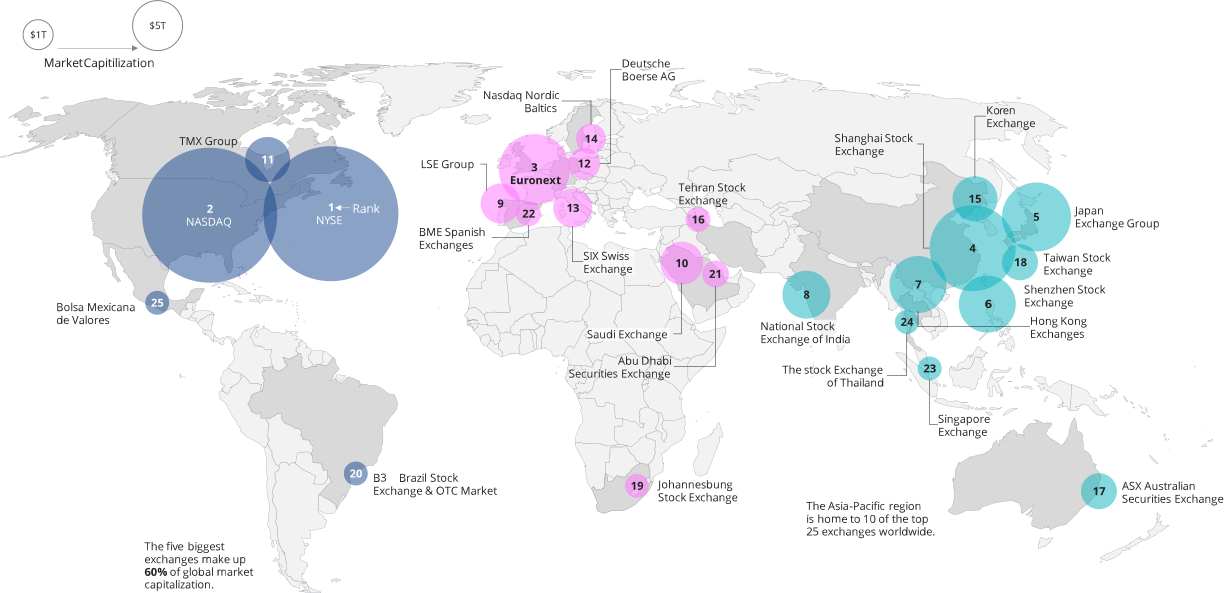
The World's Top 25 Stock Exchanges
Here are the largest stock exchanges in the world, spanning $106T in total market capitalization in 2023.
Source: World Federation of Exchanges, Welcome to the future of markets, (2023).
Where ETFs Trade in Europe
In Europe, ETFs are listed across multiple stock exchanges, making them accessible to a wide range of investors across the continent. These exchanges provide centralized venues for trading and play a vital role in determining market liquidity and investor access.
Major ETF exchanges in Europe include:
- Xetra (Germany)
- Euronext (Netherlands, France, Belgium)
- SIX Swiss Exchange (Switzerland)
- London Stock Exchange (United Kingdom)
- Euronext Milan (Italy)
These platforms provide real-time pricing, high execution standards, and access through online brokers or institutional trading desks. Understanding where an ETF is listed can help investors assess potential trading costs, currency exposure, and overall liquidity.
Trading ETFs in Local Currencies
Many ETFs in Europe are available in multiple trading currencies, depending on the exchange and the investor’s location. For example, the same ETF might be listed in both euros and British pounds, allowing investors to choose the currency that best fits their needs.
Trading in a local currency helps avoid unnecessary foreign exchange (FX) conversions, which can affect returns. For instance, an investor based in the United Kingdom might choose to purchase the GBP version of an ETF, such as VanEck Global Real Estate UCITS ETF (TRET), instead of the EUR version. This reduces FX exposure and makes performance tracking simpler.
It is important to note that while the currency of listing determines how the ETF is traded on an exchange, it does not change the underlying currency exposure of the assets held by the ETF. A euro-hedged or dollar-denominated ETF will still follow the same index performance, regardless of whether it is traded in GBP, EUR, or CHF.
Understanding the difference between trading currency and portfolio currency exposure is essential for accurate portfolio construction and performance evaluation.
ETF Trading: OTC vs On-Exchange Execution
While most ETF trades occur on regulated exchanges, some transactions take place over the counter, or OTC. These are typically arranged directly between two parties, often involving institutional investors who are trading large volumes.
On-exchange execution refers to trading ETFs through public markets, such as the London Stock Exchange or Xetra. These trades are visible to the broader market and benefit from real-time pricing and transparency. On-exchange execution is the standard method used by retail investors, as it is simple, efficient, and accessible through online platforms and brokers.
By contrast, OTC execution is used for large or complex trades that could potentially impact prices if executed publicly. In an OTC transaction, the investor works directly with a broker or market maker to arrange the trade. This allows for customization and discretion, and it reduces market impact. However, it may come with slightly wider spreads and less price transparency.
Both trading venues serve different needs. For most investors, on-exchange execution provides the best balance of convenience and efficiency. For institutions executing block trades, OTC offers flexibility and control over sensitive transactions.
Comparing OTC and On-Exchange ETF Trading
| Feature | On-Exchange Execution | OTC Execution |
| Price transparency | High | Limited |
| Accessibility | Available to all investors | Typically institutional |
| Customization | Standard trade sizes | Flexible trade terms |
| Market impact | May affect prices | Reduced due to private negotiation |
| Typical users | Retail and institutional | Mostly institutional investors |
Source: Financial markets: Exchange or Over the Counter. (2019, June 15). IMF.
ETF Trading through Limit Orders
Trading ETFs using limit orders is a strategic and tactical approach that offers investors precise control over their trading decisions. By allowing investors to specify the maximum price they are willing to pay (when buying) or the minimum price they are willing to accept (when selling), limit orders mitigate the risks associated with market volatility.
Why Limit Orders Are Helpful in ETF Trading
Limit orders play a crucial role in ETF trading, helping investors manage execution risk, optimize pricing strategies, and improve cost efficiency. They provide greater control over trade execution.
Order Book: A Window into ETF Market Liquidity
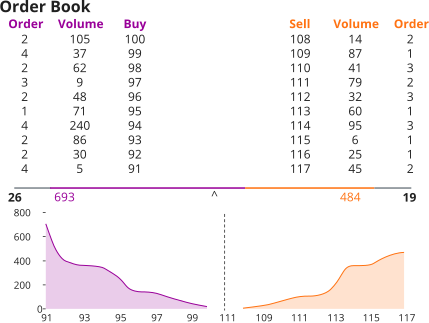
Market makers play a crucial role in maintaining the ETF order book, which records all active buy and sell orders for a specific ETF. Analyzing the order book provides key insights:
A deeper order book, with significant buy and sell orders at various price levels, indicates a highly liquid ETF with low trading costs.
Tracking the balance of buy and sell orders helps investors gauge market sentiment. For ETFs, large buy orders may signal increased demand, and heavy selling pressure the opposite.
Market makers ensure that ETF prices reflect real market conditions.
Simulated Order Book
Source: VanEck Simulation.
Using Stop-Loss Orders in ETF Trading
Stop-loss orders are an additional tool that ETF investors can use to manage downside risk. A stop-loss order automatically triggers a market sell order when the ETF reaches a specified price, known as the stop price. This mechanism can help protect a portfolio from further losses during periods of rapid market decline.
Although stop-loss orders may seem straightforward, they require careful use. Once the stop price is reached, the order becomes a market order and will execute at the best available price. In volatile markets or periods of low liquidity, the actual execution price may differ significantly from the stop price, leading to unexpected outcomes.
For this reason, stop-loss orders are best used with ETFs that have high trading volumes and narrow bid-ask spreads. Investors should also avoid placing stop-loss orders near the market open or close, when price fluctuations tend to be more extreme.
While stop-loss orders offer a degree of automation, they do not guarantee execution at a specific price. They are most effective when combined with other trading strategies and a clear understanding of market conditions.
Understanding the Bid-Ask Spread
The bid-ask spread is a fundamental concept in ETF trading and a critical metric for assessing market conditions. It represents the difference between the bid price (the price at which a market maker or buyer is willing to purchase an ETF) and the ask price (the price at which a market maker or seller is willing to sell the ETF). This spread reflects the cost of trading and is an important indicator of the ETF’s liquidity and market efficiency.
Breaking Down the Bid-Ask Spread
Bid Price
The bid price is the highest price a buyer (or market maker) is willing to pay for an ETF. It reflects demand for the security. For example, if the bid price is $100, buyers are ready to pay $100 per share.
Ask Price
The ask price is the lowest price a seller (or market maker) is willing to accept for an ETF. It represents the supply of the security. For instance, if the ask price is $101, sellers are willing to sell the ETF for at least $101 per share.
Spread
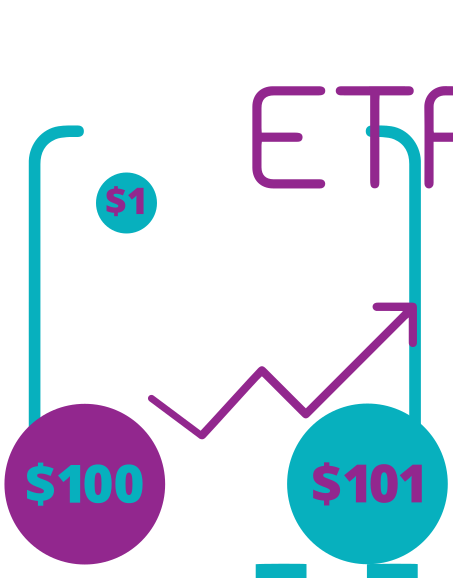
The bid-ask spread is simply the difference between the bid and ask prices. In the above example, the spread is $1 ($101 - $100), which represents a transaction cost incurred when entering and exiting a trade.
Bid-Ask Spread Visualized
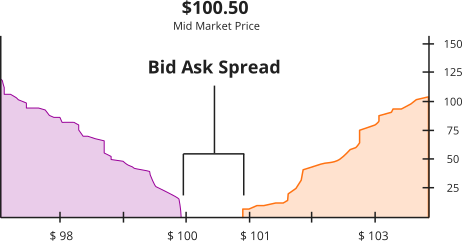
Source: VanEck Simulation.
Comparing Core vs. Satellite ETFs: Why Spreads Differ
Not all ETFs trade the same way. One key difference lies in the bid-ask spread, which can vary depending on what the ETF holds and how much it is traded.
- Core ETFs, such as those that track major indices like the S&P 500 or Euro Stoxx 50, tend to have very tight spreads, often just a few cents or basis points. That’s because these ETFs are popular, trade frequently, and hold large, liquid companies. The more an ETF is traded, the easier it is for market makers to match buyers and sellers efficiently.
- Satellite ETFs, on the other hand, often focus on specific themes, industries, or countries that are less mainstream. Examples include ETFs focused on clean energy, frontier markets, or emerging technologies. These funds usually have lower trading volumes and hold assets that are harder to buy and sell quickly. As a result, market makers take on more risk and quote wider spreads to protect themselves. Additionally, because of the lower volume, temporary peaks in bid-ask spreads are more common, as even small shifts in supply or demand can cause disproportionate changes in pricing.
This means trading in satellite ETFs may come with higher costs, especially during times of market stress or outside core trading hours. Being aware of these differences helps investors plan their trades more carefully and choose ETFs that match their needs - whether building a broad portfolio foundation or adding more targeted exposures.
Why ETFs May Trade at a Discount (or Premium) to NAV
While ETFs are designed to trade closely in line with the net asset value (NAV) of their underlying holdings, temporary price differences can occur. When an ETF’s market price is lower than its NAV, it is considered to be trading at a discount. If the market price is higher than the NAV, the ETF is trading at a premium.
These differences are usually short-lived and reflect momentary imbalances between buying and selling activity. For example, a wave of sell orders during a volatile session may push the ETF price below NAV, creating a discount. On the other hand, strong buying interest in less liquid markets may lead the ETF price to exceed its NAV.
Authorized participants (APs) play a crucial role in correcting these discrepancies. Through arbitrage, they buy ETF shares when prices fall below NAV or sell them when prices rise above it. This process helps align the ETF’s market price with the value of its underlying assets.
Although premiums and discounts are generally small, they can widen during periods of market stress or low trading volume. For investors, it is important to consult the ETF’s daily premium or discount data, which is typically available from the issuer. This information can help investors better understand pricing behavior and potential execution risks.
Liquidity and Costs
Total Cost of ETF Ownership: Beyond the Management Fee
While ETFs are often marketed for their low total expense ratios (TERs), the management fee is only part of the equation. Investors also need to account for implicit costs that occur during trading, most notably bid-ask spreads and brokerage commissions. These costs are not immediately visible but can have a measurable impact on long-term returns, especially for frequent traders or investors in less liquid funds.
For example, a core equity ETF may have a TER of just 0.07%, but if the investor pays a 0.05% spread on both buying and selling, that’s an additional 0.10% in round-trip cost, effectively raising the overall cost of the investment. If the same ETF is traded multiple times during the year, these costs compound.
For satellite ETFs or those in less liquid markets, the spread might be 0.20% or more, meaning transaction costs could rival or exceed the TER. As a result, evaluating total cost of ownership (particularly for short-term or tactical allocations) is key to preserving performance.
Traders and long-term investors alike should always weigh not only the published TER, but also:
- Bid-ask spread (typically expressed in basis points)
- Brokerage fees or platform costs
- Market impact (especially in large-size orders)
- Tracking difference (how closely the ETF matches its index over time)
Market Dynamics Throughout the Trading Day
When to Trade ETFs: The Importance of Market Overlap
ETF prices are influenced by the trading hours of the underlying securities. As such, the best time to trade an ETF often depends on where its benchmark assets are listed. For U.S. equity ETFs domiciled in Europe - such as UCITS ETFs tracking the S&P 500 or Nasdaq 100 - bid-ask spreads tend to be narrowest during the overlap between U.S. and European trading hours, typically from 3:30pm to 5:30pm Central European Time.
During this period, market makers benefit from full price discovery in the U.S. markets, allowing them to quote tighter spreads with more confidence. Execution quality improves, and investors are more likely to receive prices that align closely with net asset value (NAV).
Conversely, placing trades in the early morning, just after European markets open, often leads to wider spreads. This is because U.S. markets are still closed, and the price signals from the underlying securities are stale. Similarly, during the final minutes before market close, spreads can widen again as volatility rises and liquidity thins.
As a best practice:
- Avoid placing trades in the first 15 minutes after market open or just before close.
- Target the overlapping window with the underlying market for optimal spread and execution.
- This principle applies broadly, whether trading a U.S.-focused ETF or one tracking Asia or emerging markets, aligning trade times with the hours of the underlying exchange can help minimize costs.
Day Trading Volatility
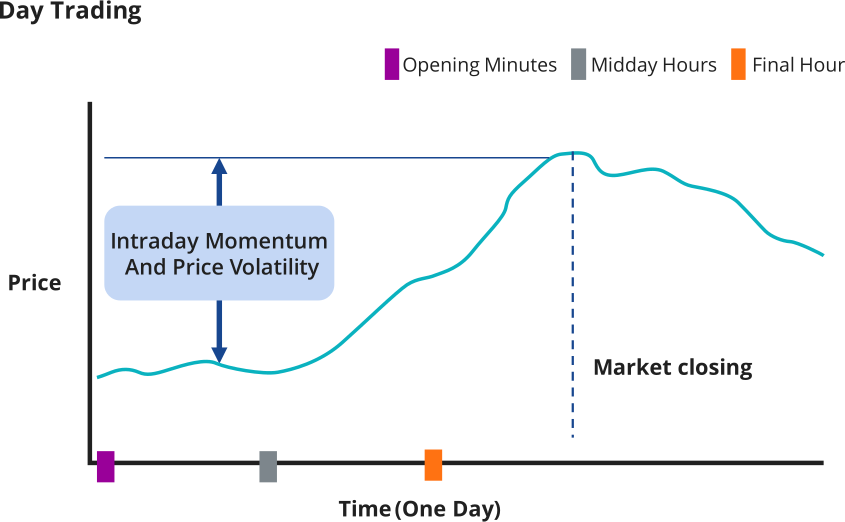
Source: VanEck Simulation.