Volatile Quarter, But Fallen Angels Still on Top YTD
14 July 2025
Read Time 10+ MIN
Fallen angels (as represented by the ICE US Fallen Angel High Yield 10% Constrained Index, “H0CF”) finished the first half of the year outperforming the broad high yield market (as represented by the ICE BofA US High Yield Index, “H0A0”) by 0.16% (4.71% vs. 4.55%), despite underperforming by 0.46% in Q2.
Q2 was marked by significant volatility for high yield investors, beginning with the tariff announcements on April 2 (credit spreads had already been widening since February in anticipation of policy shifts). The April tariff announcement accelerated this trend, causing spreads to widen by over 100bps and peak nearly 200bps above their tightest levels of the year. However, this widening was short lived. The “Liberation Day” selloff fully reversed by mid-May, and high yield spreads finished the quarter nearly 60bps tighter than where they started.
Interest rates were also volatile during the quarter. Long-term bond yields initially declined but later rose sharply due to mounting concerns over inflation and fiscal sustainability.
Fallen angels underperformed in April by 1.25% but rebounded in May and June with outperformance of 0.22% and 0.61%, respectively. The 2.47% return in June was the strongest monthly performance since late 2023, following a solid 1.90% return in May. The asset class benefited from a 17bps decline in the 10Y yield, as well as signs of easing geopolitical tensions and improving trade conditions.
Overall, BB rated bonds continue to lead performance, while CCC & lower rated bonds recovered swiftly following the "Liberation Day" event.
BB Outperformed, but Lower Quality Trying to Catch Up
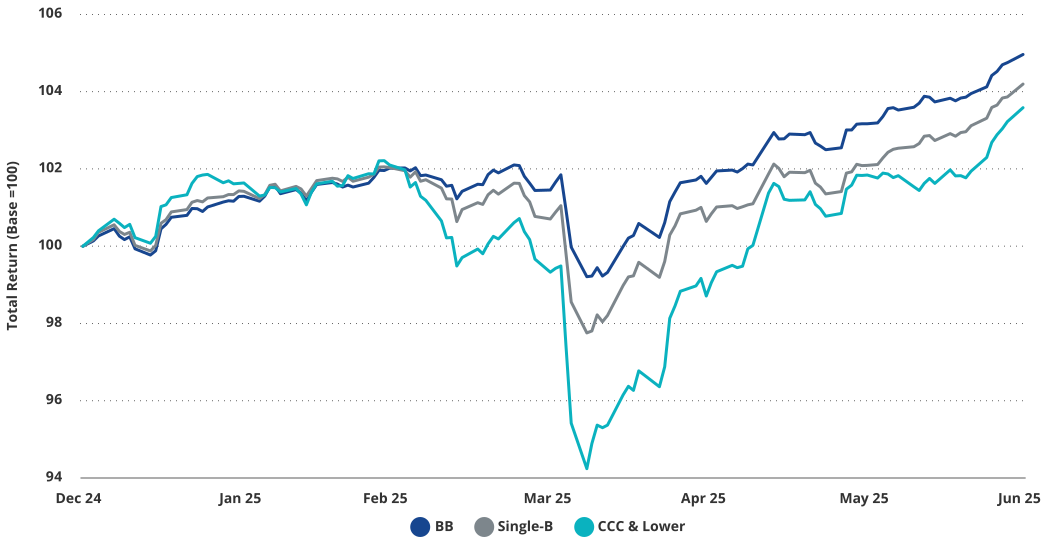
Source: ICE Data Services as of 6/30/2025, VanEck. BB represented by ICE BofA BB US High Yield Index; B represented by ICE BofA Single-B US High Yield Index; CCC and below represented by ICE BofA CCC & Lower US High Yield Index. ICE BofA BB US High Yield Index is a subset of ICE BofA US High Yield Index including all securities rated BB1 through BB3, inclusive. ICE BofA Single-B US High Yield Index is a subset of ICE BofA US High Yield Index including all securities rated B1 through B3, inclusive. ICE BofA CCC & Lower US High Yield Index is a subset of ICE BofA US High Yield Index including all securities rated CCC1 and below.
Rate dynamics were further influenced at the end of Q2 by the passage of President Trump’s tax bill, which is projected to add approximately $3 trillion to the national debt. This contributed to the ongoing steepening of the yield curve, a trend that has persisted over the past two years.
Despite this, corporate fundamentals remain notably strong. As a result, we expect inflationary pressures, elevated interest rates, and slowing economic growth to impact fallen angels primarily through idiosyncratic events rather than through a broad-based downgrade cycle, barring a major economic shock.
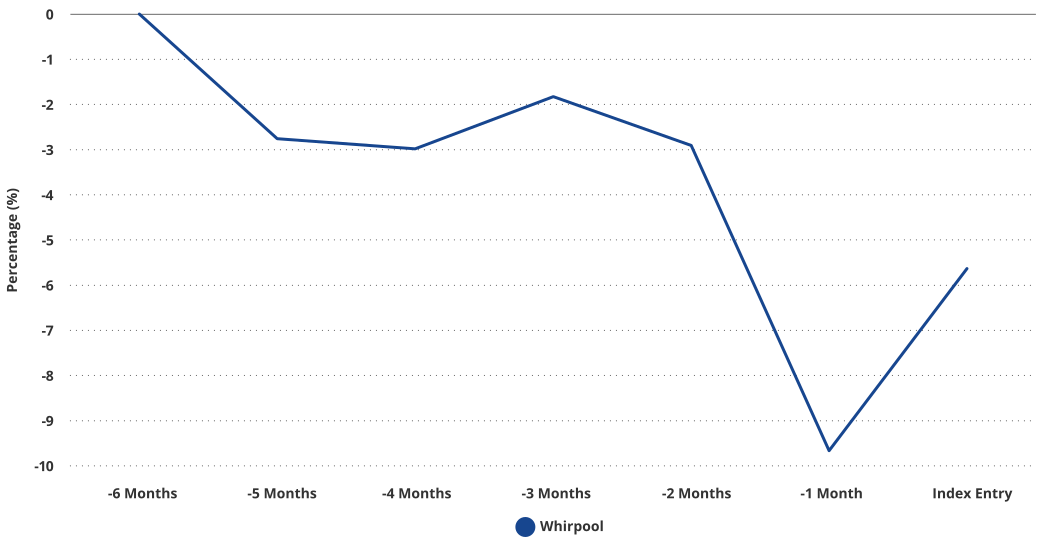
A clear example of this is Whirlpool Corporation, the only company to enter the fallen angels index during the quarter. Whirlpool’s bonds entered the index with a significant weight of 4.2%, following a downgrade of approximately $3.3 billion in outstanding debt. The downgrade was driven by a combination of high leverage, shareholder friendly capital allocation, and sluggish sales performance. Consistent with historical trends, the bonds experienced a price decline of nearly 10% prior to the downgrade, entering the index at a discounted level.
Whirlpool Corporation Bond Average Cumulative Price Return 6m Before Index Inclusion
Source: ICE Data Services as of 6/30/2025, VanEck.
Despite being one of the largest downgrades in the high yield space, Warner Brothers Discovery ultimately did not enter the fallen angels segment. The company was downgraded to high yield in early June, with approximately $31 billion in debt, which would have potentially made it one of the top five largest fallen angels in index history. The downgrade came amid a corporate restructuring intended to split the company into two separate entities.
However, following the initial downgrade by Moody’s, Warner Brothers Discovery undertook a novel liability management exercise, rarely seen in the investment grade market. The company initiated a debt exchange that effectively compelled bondholders to accept new terms. As a result, while the original bonds technically qualified as fallen angels, their outstanding size was significantly reduced due to a tender offer, disqualifying most from index inclusion.
Additionally, because the debt exchange and tender process were ongoing at the end of June, ICE Data Indices elected to exclude Warner Brothers Discovery bonds from all of its high yield indices until July. The newly issued debt, in conjunction with the transaction, does not qualify as fallen angels, as these are considered newly issued securities.
Fallen Angels Overall Statistics: Fallen angels and broad high yield spreads were notably volatile during the second quarter. Fallen angels spreads began the quarter at 257bps, widened sharply to 357bps in early April, and then steadily declined to end the quarter at 237bps. Broad high yield spreads followed a similar pattern, widening by 115bps from 342 to 457bps in early April before tightening to finish the quarter just below 300bps. This tightening was a key driver of broad high yield’s relative outperformance in Q2. Yields for both indices remained elevated relative to their 10Y averages, though they ended the quarter at their lowest levels year-to-date. This reflects both the decline in spreads and movement in underlying interest rates. Fallen angels duration increased during Q2, particularly in June, driven by the removal of several bonds, most notably an issue from Walgreens, with less than 12 months to maturity. In contrast, broad high yield duration continued to shorten, reaching an all-time low of 2.89 years. This ongoing divergence in duration highlights the increasing role of interest rate sensitivity in differentiating returns between fallen angels and the broader high yield market. From a pricing perspective, broad high yield has experienced a continued increase, with prices now exceeding their 10Y average by approximately $1. Fallen angels prices have risen moderately and remain below their 10Y average, which could signal continued potential for outperformance, as has been the case year-to-date.
| Fallen Angels | Broad HY | |||||
| 12/31/2024 | 3/31/2025 | 6/30/2025 | 12/31/2024 | 3/31/2025 | 6/30/2025 | |
| Yield to Worst | 7.00 | 6.72 | 6.43 | 7.47 | 7.73 | 7.06 |
| Par Weighted Price | 91.52 | 93.11 | 93.70 | 95.48 | 94.97 | 97.12 |
| Effective Duration | 4.89 | 4.56 | 4.88 | 3.22 | 3.19 | 2.89 |
| Full Market Value ($mn) | 53,393 | 67,566 | 63,035 | 1,338,887 | 1,357,142 | 1,375,495 |
| OAS | 249 | 257 | 237 | 292 | 355 | 296 |
| No. of Issues | 122 | 134 | 126 | 1,879 | 1,902 | 1,868 |
Source: ICE Data Services, VanEck. Fallen Angels: ICE US Fallen Angel High Yield 10% Constrained Index. Broad HY: ICE BofA US High Yield Index. OAS refers to “option-adjusted spread.” Please see definition for this and other terms referenced herein in the disclosures and definitions portion of this blog. Past performance is no guarantee of future results. Index performance is not representative of strategy performance. It is not possible to invest in an index.
Fallen Angels: Fallen angels continued to exhibit an idiosyncratic profile in Q2. Whirlpool Corporation entered the index in May after being downgraded by all three major rating agencies. The downgrades cited weakening consumer demand, a slow U.S. housing market, elevated leverage, and anticipated impacts from tariffs. Whirlpool joined the index at 4.23% weight, which rose to 4.75% in June. The bonds carried a duration exceeding seven years and had experienced a notable price deterioration of nearly 6% over the six months prior to index inclusion. However, a partial price recovery occurred in June, with the bonds closing the month at $88.54, reflecting a 3.5% gain over their entry price. This rebound made Whirlpool one of the top three contributors to fallen angels outperformance during the month, trailing only Hudson Pacific Properties (a January 2024 fallen angel) and Celanese (a February 2025 fallen angel).
JP Morgan recently updated its forecast for the fallen angels pipeline, estimating approximately $12 billion of index eligible debt could be downgraded over the remainder of the year. However, they also highlight a broader pool of $65 billion in debt from issuers currently holding one high yield rating and a negative outlook. Given persistent economic uncertainty, JP Morgan expects the trend of more downgrades than upgrades to continue in the coming quarters.
| Month-end Addition | Name | Rating | Sector | Industry | % Mkt Value | Price |
| January | Aptiv PLC / Aptiv Global Financing DAC | BB1 | Automotive | Auto Parts & Equipment | 0.95 | 99.71 |
| February | Celanese US Holdings Llc | BB1 | Basic Industry | Chemicals | 10.06 | 103.69 |
| February | Nissan Motor Acceptance Co LLC | BB1 | Automotive | Auto Loans | 4.82 | 97.64 |
| February | Nissan Motor Co Ltd. | BB1 | Automotive | Automakers | 5.41 | 97.26 |
| May | Whirlpool Corp. | BB1 | Consumer Goods | Personal & Household Products | 4.23 | 85.52 |
Source: ICE Data Services, VanEck. Fallen Angels: ICE US Fallen Angel High Yield 10% Constrained Index. Past performance is no guarantee of future results. Not a recommendation to buy or sell any of the names/securities mentioned herein. Index performance is not representative of strategy performance. It is not possible to invest in an index.
Rising Stars: In May, Constellation Insurance and Royal Caribbean became the second and third rising stars of the year. Constellation Insurance was upgraded Fitch while Royal Caribbean was upgraded by S&P and Moody’s. Fitch’s upgrade of Constellation Insurance was based on the agency’s view that the company had enhanced its business profile by expanding operations and focusing on lower volatility insurance products. These strategic shifts were seen as strengthening financial stability and reducing overall business risk. Constellation had originally entered the fallen angels index in July 2022 at a price of $99.87, resulting in a negative total price return of approximately 4% over its time in the index. Royal Caribbean, a notable "COVID" fallen angel from April 2020, was upgraded by both S&P and Moody’s. The upgrade reflected the company's strong financial performance, improved leverage metrics, and a positive operating outlook. Royal Caribbean entered the index at $70.29, and over five years, delivered a 42% price return.
| Month-end Exit | Name | Rating | Sector | Industry | % Mkt Value | Price |
| February | Western Alliance Bancorp | BB1 | Banking | Banking | 1.05 | 93.75 |
| May | Constellation Insurance Inc. | BB1 | Insurance | Life Insurance | 1.04 | 95.74 |
| May | Royal Caribbean Group | BB1 | Leisure | Recreation & Travel | 1.27 | 99.78 |
Source: ICE Data Services, VanEck. Fallen Angels: ICE US Fallen Angel High Yield 10% Constrained Index. Past performance is no guarantee of future results. Not a recommendation to buy or sell any of the names/securities mentioned herein. Index performance is not representative of strategy performance. It is not possible to invest in an index.
Fallen Angels Performance by Sector: There were changes to sector composition during the quarter, as Whirlpool entered the index, adding approximately 3% to the Consumer Good Sector while Tech and Retail saw their exposures decrease by approximately 2% each, due to Seagate and a Walgreens issue being removed from the index in June. Real Estate spreads tightened during the quarter by close to 150bps while its price increase the most, making it the top performer in the quarter and YTD. Real Estate, Retail, and Telecom were the top contributors relative to performance vs broad high yield during the quarter, while Media, Healthcare, and Services detracted the most from relative performance.
| Wgt (%) | OAS | Price | Total Return | ||||||||
| 12/31/2024 | 3/31/2025 | 6/30/2025 | 12/31/2024 | 3/31/2025 | 6/30/2025 | 12/31/2024 | 3/31/2025 | 6/30/2025 | QTD | YTD | |
| Automotive* | 10.80 | 10.78 | 182 | 253 | 96.58 | 95.34 | -0.15 | -1.51 | |||
| Banking | 4.94 | 3.92 | 3.19 | 181 | 176 | 142 | 96.00 | 103.69 | 107.29 | -0.41 | 1.07 |
| Basic Industry | 4.94 | 14.03 | 14.55 | 181 | 188 | 148 | 96.00 | 100.89 | 102.86 | 3.52 | 5.85 |
| Capital Goods | 5.55 | 4.52 | 4.56 | 179 | 209 | 157 | 96.48 | 95.90 | 97.92 | 3.54 | |
| Consumer Goods | 4.37 | 3.41 | 6.41 | 184 | 243 | 220 | 98.89 | 95.87 | 88.78 | 4.76 | 3.24 |
| Energy | 9.16 | 7.53 | 8.18 | 273 | 305 | 301 | 91.72 | 91.82 | 91.21 | 0.98 | 2.65 |
| Financial Services | 3.22 | 2.05 | 2.35 | 282 | 357 | 261 | 91.46 | 89.83 | 93.67 | 5.49 | 6.16 |
| Healthcare | 4.10 | 3.45 | 3.83 | 195 | 214 | 173 | 90.40 | 91.71 | 94.14 | 4.08 | 7.12 |
| Insurance | 2.49 | 1.67 | 0.68 | 193 | 214 | 208 | 98.34 | 99.12 | 100.04 | -0.66 | 1.25 |
| Leisure | 4.53 | 3.70 | 2.68 | 220 | 280 | 374 | 93.65 | 93.18 | 90.10 | 1.62 | 2.45 |
| Real Estate | 10.71 | 8.30 | 9.10 | 450 | 448 | 229 | 86.94 | 87.85 | 93.17 | 7.60 | 10.69 |
| Retail | 22.15 | 18.18 | 16.72 | 219 | 221 | 225 | 86.26 | 88.43 | 87.64 | 2.16 | 6.30 |
| Services | 0.83 | 0.67 | 0.77 | 189 | 234 | 145 | 95.97 | 96.12 | 99.63 | 4.91 | 6.45 |
| Technology & Electronics | 6.78 | 5.45 | 3.26 | 208 | 262 | 269 | 90.50 | 88.87 | 87.07 | 4.66 | 4.22 |
| Telecommunications | 12.56 | 10.07 | 10.40 | 311 | 366 | 326 | 92.24 | 89.80 | 92.06 | 5.46 | 4.63 |
| Transportation | 0.59 | 0.48 | 0.54 | 156 | 217 | 174 | 104.16 | 102.60 | 105.77 | 4.76 | 4.87 |
| Utility | 2.22 | 1.78 | 1.99 | 173 | 217 | 191 | 96.71 | 95.53 | 97.28 | 3.26 | 3.45 |
| Grand Total | 100 | 100 | 100 | 249 | 257 | 237 | 91.52 | 93.11 | 93.70 | 3.11 | 4.71 |
Source: ICE Data Services, VanEck. *Returns are based on partial period data. Fallen Angels: ICE US Fallen Angel High Yield 10% Constrained Index. Not intended as a recommendation to invest or divest in any of the sectors mentioned herein. Index performance is not representative of strategy performance. It is not possible to invest in an index.
Fallen Angels Performance by Rating: There were no major change in overall rating composition during the quarter, with BB rated bonds still being the highest exposure within the fallen angels index. In terms of performance, CCC & Lower rated bonds outperformed higher quality bonds in the second quarter as these quickly recovered following “Liberation Day”.
| Wgt (%) | OAS | Price | Total Return | ||||||||
| 12/31/2024 | 3/31/2025 | 6/30/2025 | 12/31/2024 | 3/31/2025 | 6/30/2025 | 12/31/2024 | 3/31/2025 | 6/30/2025 | QTD | YTD | |
| BB | 83.93 | 82.22 | 79.91 | 197 | 220 | 197 | 93.33 | 95.43 | 96.30 | 2.29 | 3.51 |
| B | 10.09 | 13.22 | 14.98 | 474 | 322 | 294 | 86.36 | 88.45 | 88.79 | 6.63 | 14.31 |
| CCC | 4.72 | 3.78 | 4.16 | 425 | 496 | 477 | 88.24 | 86.54 | 86.63 | 1.88 | 1.67 |
| CC | 1.26 | 0.78 | 0.95 | 1262 | 1955 | 1651 | 54.65 | 39.08 | 45.75 | 20.60 | -9.00 |
| Total | 100.00 | 100.00 | 100.00 | 249 | 257 | 237 | 91.52 | 93.11 | 93.70 | 3.11 | 4.71 |
Source: ICE Data Services, VanEck. Fallen Angels: ICE US Fallen Angel High Yield 10% Constrained Index. Not intended as a recommendation to invest or divest in any of the sectors mentioned herein. Index performance is not representative of strategy performance. It is not possible to invest in an index. BB index: ICE BofA BB US High Yield Index; Single-B index: ICE BofA Single-B US High Yield Index; CCC & Lower rated index ICE BofA CCC & Lower US High Yield Index.
Related Insights

Related Insights
04 March 2026
BDC valuations reflect NII, dividend coverage, credit quality and rate expectations. With P/B below average, markets may already price in cuts, creating potential income opportunities.
24 February 2026
With attractive yields, improving credit fundamentals, and a growing role as a liquid access point to private credit markets, BDCs offer a compelling alternative to traditional fixed income.
24 February 2026
Preferred securities offer income potential above bonds and lower volatility than equities. Understanding sector differences helps investors position preferreds within diversified portfolios.
23 February 2026
How do floating rate notes perform when credit spreads widen? Learn how spread risk, income and low duration shape corporate FRN returns.
18 February 2026
Returns in floating rate notes are driven by two main components: short-term interest rates and credit spreads.