The Muni Brief: NYC's Pied-à-Terre Tax
19 May 2026
Read Time 2 MIN
NYC's Pied-à-Terre Tax: A Signal Worth Watching, Not a Solution
New York City is facing one of the most significant fiscal challenges in recent memory. The NYC Comptroller has projected a $2.2 billion budget shortfall for FY2026, growing to a $10.4 billion gap in FY2027 (Source: New York City Comptroller, January 2026). That is a two-year deficit of roughly $12.6 billion.
Into that context steps the pied-à-terre tax.
What Is The Pied-à-Terre Tax?
The proposal would levy an annual surcharge on condos, co-ops, and 1-3 family homes valued above $5 million where the owner maintains a primary residence outside New York City. Governor Hochul estimates approximately 13,000 properties would qualify. The city projects $500 million in annual revenue (Source: New York State Government, April 2026).
Even at the $500 million headline figure, the pied-à-terre tax covers less than 5% of the projected two-year gap. At the more realistic $340 to $380 million range, the contribution is smaller still.
NYC Budget Gap: Potential Revenue Falls Short
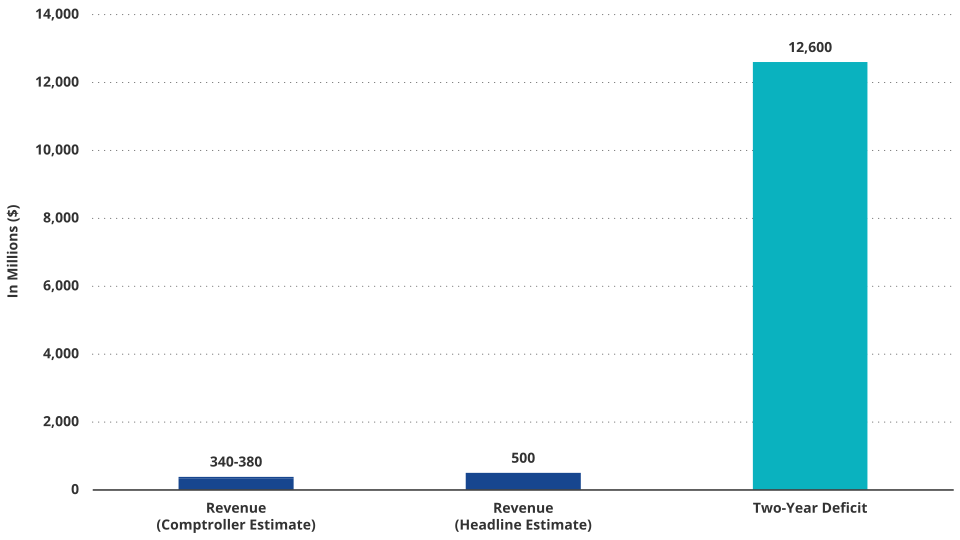
Source: NYC Comptroller Office as of 01/16/26.
What The Pied-à-Terre Tax Tells Muni Investors
This is not a deficit solution. It is an incremental revenue measure in a city that is reaching for every available lever.
For muni investors, NYC remains one of the largest and most liquid issuers in the market, with GO bonds and agency paper touching virtually every corner of the muni universe. The incremental yield delivered by NYC issues remains valuable as a portfolio building block.
Final Thoughts
Since this commentary was drafted, Mayor Mamdani has released his FY2027 executive budget, closing the near-term gap with a combination of state aid, pension amortization extensions, and approximately $2.8 billion in one-time measures. The pied-à-terre tax remains part of that plan. The Comptroller projects outyear gaps of $7.1 billion in FY2028, growing to $9.8 billion by FY2030. The structural challenge remains intact.
Related Insights

Related Insights
26 August 2026
Treasury’s pivot toward long-bond buybacks gives duration buyers their first clear green light in months — and the November midterms may add a second leg.
11 August 2026
Redemptions are hitting a 24-month high just as summer winds down. Jim Colby on why municipal valuations and credit still make the case to stay invested.
09 July 2026
A simple question, what's the weather, has a deep apparatus behind it. It starts at the federal level and flows down to the states. Here is how that works.
02 July 2026
The discount of XMPT's underlying muni CEFs has been a historically reliable entry signal. Wide discounts have historically preceded strong returns. Tight readings may suggest waiting for the next shock.
17 June 2026
Muni ETFs just posted record inflows. Jim Colby on why low volatility, strong risk-adjusted returns, and tax-advantaged yields keep drawing investors in.