The Muni Brief: Stay in the Game
11 August 2026
Read Time 4 MIN
Key Takeaways
- Redemptions, maturities, and coupon payments are set to hit a 24-month high over the next two weeks, adding a reinvestment bid even as new issuance continues at a healthy pace.
- July's returns disappointed, but the math still works: munis carry a real taxable-equivalent yield advantage, and credit spreads still offer real opportunities across the curve, particularly single-A credits in the 10-13 year range.
- Iran cease-fire volatility is unsettling markets broadly, but a formalized truce and normalized trade would likely push yields lower, not higher. That's another reason to stay allocated through the noise.
Welcome back to The Muni Brief, a series on municipal credit and markets. In each installment, Senior Municipal Strategist James Colby examines current events, policy developments, and fiscal trends through the lens of the muni investor, covering topics both local and national.
What Is the Municipal Reinvestment Bid?
August has a reputation in the municipal market: thin trading, light calendars, desks running on a skeleton crew. This year, that reputation doesn't much matter. Over the next two weeks, redemptions, maturities, and coupon payments across the municipal market are set to hit a 24-month high. That's a meaningful jump in cash coming back to investors, on top of two years of record new issuance. The reinvestment math is working in the municipal investor's favor.
Are Muni Tax-Equivalent Yields Still Competitive?
July's returns were disappointing, and the headline numbers didn't do the asset class any favors. That disappointment obscures something that hasn't changed: munis still carry a real taxable-equivalent yield advantage over comparable taxable alternatives, and credit quality across the municipal market remains strong. The chart below shows just how wide that advantage can get. At the short end, a AA muni's after-tax yield runs close to a comparable Treasury's. Stretch out to 30 years, and the tax-equivalent yield on that same AA muni tops 7%, more than two full points above the Treasury.
Muni Tax-Equivalent Yields Compared to Treasuries
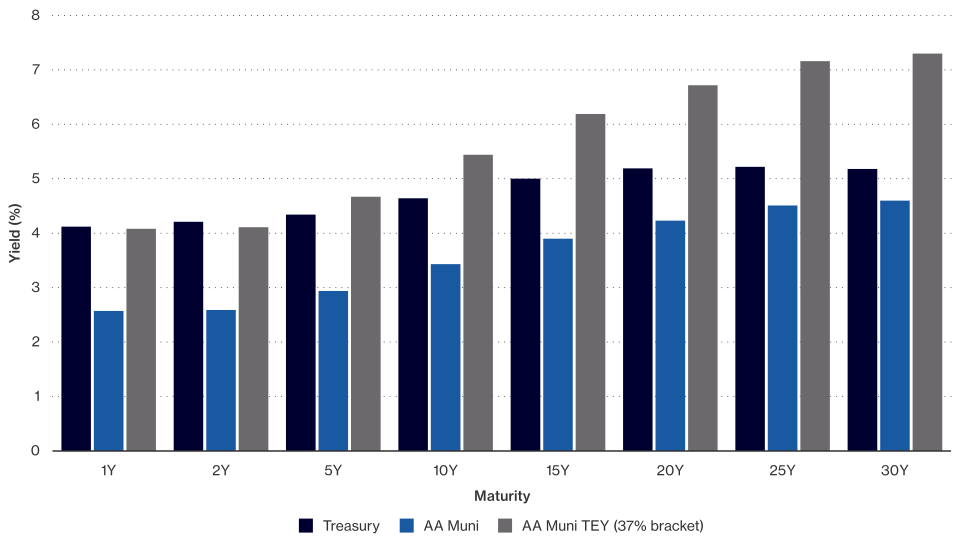
Source: ICE Curve Viewer (Yield & Spread), as of 8/4/26. AA Muni TEY calculated at a 37% federal tax rate. Past performance is no guarantee of future results. For illustrative purposes only.
Where Are Credit Spreads Offering Value Right Now?
Spreads between credit tiers do look rich by historical standards, but “rich” isn't the same as “uniform.” Breaking spreads out by rating tier across the curve shows some real pockets of value. Single-A credits, for instance, see their spread over AAA peak around the 12- to 13-year mark near 38 basis points, then compress back down to roughly 30 basis points by 30 years. That's a value pocket: intermediate single-A paper is priced relatively cheap compared to where that same credit trades further out on the curve.
Municipal Credit Spreads by Rating Tier
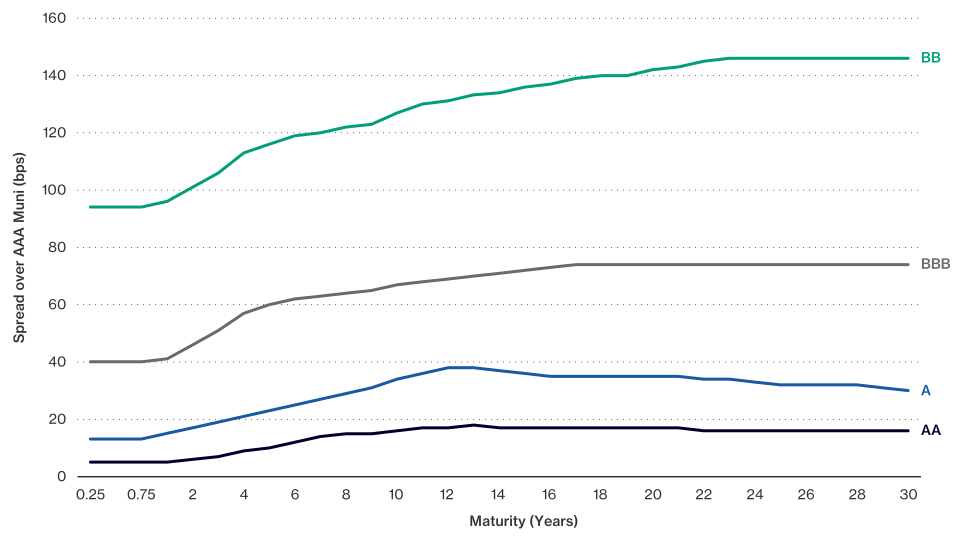
Source: ICE Curve Viewer (Yield & Spread), as of 8/4/26. Spreads shown in basis points over AAA municipal benchmark. For illustrative purposes only.
How Does Iran Cease-Fire Volatility Affect Muni Investors?
Zoom out and the bigger story this month isn't really about munis at all. It's about Iran. The on-again, off-again cease-fire discussions have generated real volatility across nearly every asset class, munis included. But that volatility is itself informative. If those talks formalize into an actual truce, and international trade normalizes alongside it, the more likely path for yields is lower, not higher. Lower rates would put the market back on a path to positive performance after a rough July.
Put it together and the case for staying in the game holds up. The reinvestment bid isn't going away, the yield advantage hasn't gone anywhere, and credit spreads still have real pockets of value for investors who look for them. The macro overhang is more likely to resolve toward lower rates than higher ones too.
What This Means for Muni Investors
August will look quiet on the surface. Underneath it, the yield and credit story hasn't changed just because one month's returns disappointed, and the curve still rewards investors who look past the headline spread numbers. The bigger risk this month isn't being in munis. It's stepping out of them right before the valuation case and the macro overhang both turn back in their favor.
IMPORTANT DISCLOSURES
Please note that VanEck may offer investment products that invest in the asset class(es) or industries included herein.
This is not an offer to buy or sell, or a recommendation to buy or sell any of the securities, financial instruments or digital assets mentioned herein. The information presented does not involve the rendering of personalized investment, financial, legal, tax advice, or any call to action. Certain statements contained herein may constitute projections, forecasts and other forward-looking statements, which do not reflect actual results, are for illustrative purposes only, are valid as of the date of this communication, and are subject to change without notice. Actual future performance of any assets or industries mentioned are unknown. Information provided by third party sources are believed to be reliable and have not been independently verified for accuracy or completeness and cannot be guaranteed. VanEck does not guarantee the accuracy of third party data. The information herein represents the opinion of the author(s), but not necessarily those of VanEck or its other employees.
The yields and market values of municipal securities may be more affected by changes in tax rates and policies than similar income-bearing taxable securities. Certain investors' incomes may be subject to the Federal Alternative Minimum Tax (AMT) and taxable gains are also possible.
All investing is subject to risk, including the possible loss of the money you invest. As with any investment strategy, there is no guarantee that investment objectives will be met and investors may lose money. Diversification does not ensure a profit or protect against a loss in a declining market. Past performance is no guarantee of future results.
© Van Eck Associates Corporation.
666 Third Avenue | New York, NY 10017
Related Insights

Related Insights
26 August 2026
Treasury’s pivot toward long-bond buybacks gives duration buyers their first clear green light in months — and the November midterms may add a second leg.
09 July 2026
A simple question, what's the weather, has a deep apparatus behind it. It starts at the federal level and flows down to the states. Here is how that works.
02 July 2026
The discount of XMPT's underlying muni CEFs has been a historically reliable entry signal. Wide discounts have historically preceded strong returns. Tight readings may suggest waiting for the next shock.
17 June 2026
Muni ETFs just posted record inflows. Jim Colby on why low volatility, strong risk-adjusted returns, and tax-advantaged yields keep drawing investors in.
26 May 2026
Puerto Rico and four U.S. territories can issue tax-exempt bonds under congressional authority. Here’s why that “triple exemption” matters for muni investors.