Waha: No Longer Just Giving Natural Gas Away
22 July 2026
Read Time 5 MIN
Key Takeaways:
- The Waha Hub spent years as one of the most distorted natural gas markets in the U.S., where producers literally have to pay to have their gas taken away — a direct consequence of oil-driven associated gas flooding a pipeline-constrained basin.
- A wave of new pipeline infrastructure is now connecting Permian gas to surging sources of demand, including LNG exports, AI-powered data centers, and Mexico, marking a structural inflection, not just a cyclical bounce.
- For Permian-focused E&P companies, this shift means finally getting paid fair value for their natural gas, reinforcing VanEck's conviction in maintaining an outsized allocation to the sector.
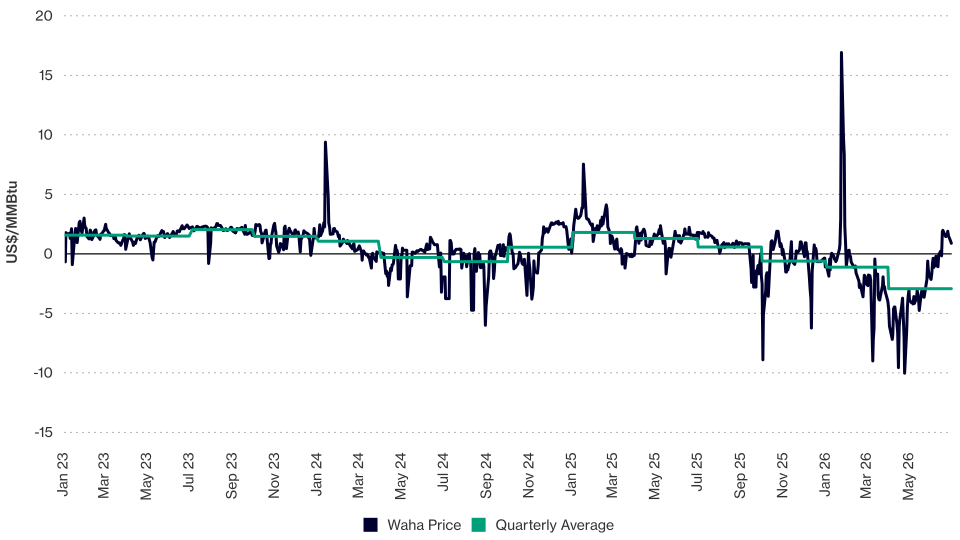
The Waha Hub is the benchmark for natural gas pricing in West Texas’ Permian Basin. Over the past three and half years, however, it has become known for something far less desirable: one of the most distorted natural gas markets in the United States.
For nearly 30% of that period, natural gas at Waha was worth less than nothing. Producers weren’t simply giving it away, they were paying others to take it. The market reached peak devastation on April 24, 2026 when Waha settled at -$10.03/MMBtu, an oil-equivalent price of -$58.17 per barrel.
Today, that era appears to be coming to an end.
Waha: From Negative to Positive
Source: Bloomberg. Data as of July 2026.
The irony is that this occurred in the nation’s largest oil-producing basin.
Every barrel of oil produced in the Permian also brings associated natural gas to the surface. Over the five years ending December 31, 2025, Permian natural gas production grew at a 15.9% compound annual rate, far outpacing 9.0% annual oil production growth.
Yet, producers don’t drill for natural gas, they drill for oil.
As long as oil economics remain attractive, associated gas continues to flow regardless of whether natural gas prices are positive or negative. The result was a persistent mismatch between production growth and pipeline takeaway capacity. With more gas production than pipelines could move, the excess supply pushed local prices lower year after year.
By 2024, Waha averaged $0.17/MMBtu for the entire year and traded below zero on 36% of all trading days. The Permian had become home to the cheapest natural gas on the planet.
Conditions improved modestly after the Matterhorn Express Pipeline entered service in September 2024, but the market remained fragile. In 2026, scheduled pipeline maintenance once again exposed the lack of excess takeaway capacity, resulting in 134 consecutive days of negative pricing.
Fortunately, the story is beginning to change.
After years of underinvestment in takeaway capacity, the pipeline industry is finally catching up. The first step came in May 2026, when Kinder Morgan’s Gulf Coast Express Expansion entered service. While modest in size, the project demonstrated just how responsive the market could be once additional capacity became available.
More importantly, it is only the beginning.
Over the next three years, the Permian Basin is expected to add more than 10 billion cubic feet per day of incremental takeaway capacity through a series of major pipeline projects. Together, these projects should do more than alleviate the region’s structural bottleneck. They will connect Permian gas to rapidly expanding sources of demand.
Upcoming Permian Natural Gas Pipelines Projects
| Pipeline | Capacity (mmcf/d) | In-Service |
| Gulf Coast Express Expansion | 570 | May 2026 |
| Blackcomb | 2,500 | Q4 2026 |
| Hugh Brinson Phase 1 | 1,500 | Q4 2026 |
| Hugh Brinson Phase 2 | 700 | Q1 2027 |
| Eiger Express | 3,700 | Q3 2028 |
| Desert Southwest Expansion | 2,300 | Q4 2029 |
| Total | 11,270 |
Source: EIA, Data as of May 2026.
Growing U.S. LNG exports continue to increase demand for natural gas along the Gulf Coast. Electricity consumption is accelerating as data centers and artificial intelligence infrastructure require enormous amounts of reliable power. One notable example is Chevron’s recently-announced 20-year power agreement with Microsoft in West Texas. The project is expected to utilize seven natural gas turbines with 2.67 GW of generating capacity. Based on VanEck’s proprietary power model, this facility alone is expected to consume approximately 600 MMcf/d of natural gas. Meanwhile, Mexico remains an increasingly important and growing destination for U.S. natural gas exports.
The market is already recognizing this shift.
Forward Waha basis differentials to Henry Hub have tightened meaningfully as pipeline in-service dates have become more certain. Winter 2026/2027 basis is currently averaging approximately -$1.07/MMBtu, a dramatic improvement from -$3.60/MMBtu during the prior winter. While Waha will likely continue to trade at a discount to Henry Hub, the magnitude of the discount is expected to narrow considerably as new infrastructure comes online.
For Permian producers, this represents a meaningful change in economics. Companies have spent years accepting deeply discounted gas prices or in some cases curtailing production. They are finally positioned to realize materially higher value from every molecule they produce.
This is more than a cyclical recovery; it is a structural inflection point.
The chronic bottlenecks and negative price days that defined the Waha market from 2023 through first half of 2026 are giving way to a more balanced system. For the first time in years, Permian producers can reasonably expect something that once seemed impossible: getting paid a fair price for their natural gas. This improving outlook is one more reason we continue to favor an outsized allocation to Permian-focused exploration and production companies within our natural resources portfolio.
Important Disclosures
This is not an offer to buy or sell, or a recommendation to buy or sell any of the securities, financial instruments or digital assets mentioned herein. The information presented does not involve the rendering of personalized investment, financial, legal, tax advice, or any call to action. Certain statements contained herein may constitute projections, forecasts and other forward-looking statements, which do not reflect actual results, are for illustrative purposes only, are valid as of the date of this communication, and are subject to change without notice. Actual future performance of any assets or industries mentioned are unknown. Information provided by third party sources are believed to be reliable and have not been independently verified for accuracy or completeness and cannot be guaranteed. VanEck does not guarantee the accuracy of third-party data. The information herein represents the opinion of the author(s), but not necessarily those of VanEck or its other employees.
You can lose money by investing in the Fund. Any investment in the Fund should be part of an overall investment program, not a complete program. The Fund is subject to risks which may include, but are not limited to, risks associated with active management, agriculture companies, commodities and commodity-linked instruments, commodities and commodity-linked instruments tax, derivatives, direct investments, emerging market issuers, equity securities, ESG investing strategy, foreign currency, foreign securities, global resources sector, market, gold and silver mining companies, growth investing, operational, investing in other funds, small- and medium capitalization companies, special purpose acquisition companies, and special risk considerations of investing in Canadian issuers, all of which may adversely affect the Fund. Emerging market issuers and foreign securities may be subject to securities markets, political and economic, investment and repatriation restrictions, different rules and regulations, less publicly available financial information, foreign currency and exchange rates, operational and settlement, and corporate and securities laws risks. Small- and medium-capitalization companies may be subject to elevated risks. Derivatives may involve certain costs and risks such as liquidity, interest rate, and the risk that a position could not be closed when most advantageous. Investments in gold and silver mining companies may be impacted by various factors, such as industry competition, the price of gold and silver bullion, inflation, currency exchange rates, environmental or labor costs, worldwide economic, financial and political, as well as other potential factors.
Investing involves substantial risk and high volatility, including possible loss of principal. An investor should consider the investment objective, risks, charges and expenses of a Fund carefully before investing. To obtain a prospectus and summary prospectus, which contain this and other information, call 800.826.2333 or visit vaneck.com. Please read the prospectus and summary prospectus carefully before investing.
© Van Eck Securities Corporation, Distributor
Related Insights

Related Insights
12 October 2026
07 October 2026
21 October 2026
Stay invested in AI and the physical buildout behind it, tune out bubble noise, and remain diversified.
14 October 2026
Energy drove Q3 2026 commodity gains as conflicts and refining constraints lifted refined-product prices, while CMCITR and BCOM each ended September up roughly 32% for the year.
12 October 2026
Hormuz disruption and the Fed's first rate hike in three years kept resource markets volatile in Q3 2026. See what drove sector results and which out-of-favor areas we're watching for Q4.
07 October 2026
Electricity demand is forecast to climb more than 40% by 2035, while oil and gas capex sits well below its 2014 peak and major copper discoveries have slowed to a trickle.
25 September 2026
A proposed diesel export ban could idle much of Gulf Coast refining, push up gasoline prices, and discourage the investment needed to ease supply over time.