VanEck Crypto Monthly Recap for December 2025
06 January 2026
Read Time 9 MIN
Please note that VanEck may have a position(s) in the digital asset(s) described below.
Key takeaways:
- Year-end risk appetite faded: Crypto markets declined broadly in December with volatility compression and subdued institutional activity, reflecting caution rather than disorderly selling.
- Fundamentals diverged from price: Ethereum and Solana continued to demonstrate strong onchain usage, particularly in stablecoin settlement, Layer-2 throughput, and revenue tied to real economic activity.
- Token design remains a key risk: The AAVE episode highlighted ongoing challenges around tokenholder value capture, reinforcing the need for clearer alignment between governance and economic control.
December delivered muted price action across crypto markets. Bitcoin fell (-4%), Ethereum fell (-3%), and altcoins as proxied by MVSCLE (MarketVector Smart Contract Leaders Index) dropped 8%. Of the 35 smart contract platform tokens we track, 33 posted negative returns. Hopes for a seasonal “Santa Claus rally” failed to materialize.
Price Returns
| Index/Asset | December (%) | YTD (%) |
| S&P 500 Index | 0.05 | 16.39 |
| Nasdaq Index | -0.80 | 20.16 |
| Ethereum | -1.49 | -11.02 |
| Bitcoin | -3.87 | -6.47 |
| MarketVector Smart Contract Leaders Index | -8.46 | -37.39 |
| MarketVector Global Digital Assets Equity Index | -14.51 | 14.38 |
| MarketVector Decentralized Finance Leaders Index | -15.73 | -66.50 |
| Coinbase | -17.11 | -8.92 |
| MarketVector Meme Coin Index | -17.63 | -73.34 |
| MarketVector Infrastructure Application Leaders Index | -19.73 | -67.44 |
Source: Bloomberg as of 12/31/2025. Index performance is not representative of fund performance. It is not possible to invest directly in an index. Past performance is no guarantee of future results. Not intended as a recommendation to buy or sell any securities named herein.
The selloff was gradual rather than disorderly. Volatility declined 8% for BTC and 15% for ETH. Bitcoin’s 30-day volatility ended the month at 40%, roughly the 52nd percentile for the year, while ETH volatility fell to 59%, placing it in the 14th percentile of 2025. Historically, December tends to see volatility compression: BTC volatility has declined in 7 of the last 11 Decembers, with prices rising in 6 of those years.
Digital asset treasury (DAT) activity was subdued. Public companies we track purchased just 22.2k BTC and 414k ETH, marking the second-lowest monthly total for both BTC and ETH DATs in 2025 since the ETH accumulation cycle began in July 2025. Investor fatigue also showed up in ETP flows, with December outflows of 12.5k BTC (-1% AUM) and 212k ETH (-3% AUM).
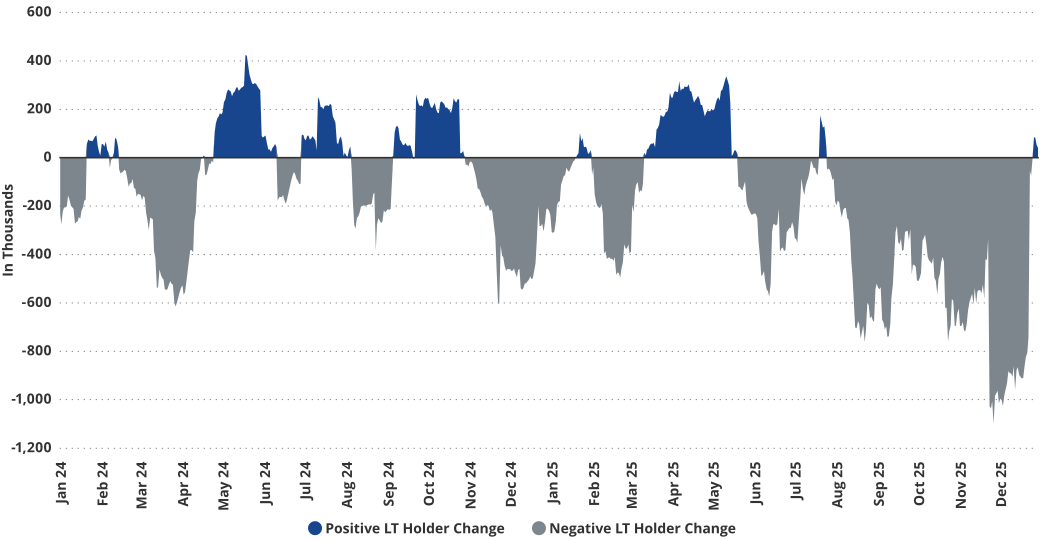
Onchain data echoed this caution. Bitcoin long-term holders reduced positions every day in December, while Ethereum long-term holders modestly increased balances during the final four days of the month.
Long-Term ETH Holders Turned to Accumulators After Long Distribution
Source: Artemis XYZ as of 12/29/2025. Past performance is no guarantee of future results. Not intended as a recommendation to buy or sell any securities named herein.
Note: “LT Holder” is considered an address that has held ETH > 155 days
DEX spot volumes declined 22% m/m, though Solana remained dominant, accounting for 35% of total DEX spot volume. Notably, Solana’s DEX share exceeded that of Ethereum and all Ethereum L2s combined for the first time since June 2025.
From a revenue standpoint, Hyperliquid again led L1s, generating approximately $45M in revenue through December 28. Stablecoin supply edged slightly lower to $285B, down from $286B in November, while transfer volumes increased 12% m/m. Base continued to lead stablecoin transfer activity, capturing an estimated 41% market share in December.
Tokenized real-world assets (RWAs) onchain totaled $18.7B, up 2.5% m/m. Private credit assets not included in this figure, such as Figure Technologies’ HELOCs, grew 4%, from $18.8B to $19.8B.
Major news in December:
- Ethereum activated the Fusaka upgrade, increasing blob capacity via the BPO-1 fork on December 17 and setting the stage for a further increase with BPO-2 on January 7, 2026.
- China’s PBOC intensified scrutiny of digital assets, citing KYC/AML concerns, prompting Ant Group and JD.com to pause stablecoin initiatives. 400,000 Bitcoin mining machines were reportedly disconnected in China, leading to the biggest overall decline in the Bitcoin hashrate since 2024, before recovering at month-end.
- Circle and Ripple were granted preliminary approvals to establish national trust banks, while BitGo, Paxos, and Fidelity began converting state trust charters to national trust charters.
- Vanguard, long an anti-crypto advocate, allowed trading of crypto ETPs on its platform despite continuing to avoid launching proprietary products.
- Hong Kong’s insurance regulator proposed rules that would allow insurance capital into crypto/infrastructure, with a 100% risk capital charge for crypto assets.
- Visa expanded USDC settlement for B2B payments through its pilot with Lead Bank and Cross River.
- SoFi launched its stablecoin SoFiUSD.
- Klarna announced plans to partner with Coinbase to launch a stablecoin.
Ethereum Technical Developments and Outperformance
Ethereum L2 Blob Count is +30% Y/Y in December 2025

Source: Dune, @Hildobby as of 12/29/2025. Past performance is no guarantee of future results. Not intended as a recommendation to buy or sell any securities named herein.
Although ETH underperformed on price in December, the network made meaningful technical progress. The Fusaka upgrade, initiated on December 3, improves the user experience, makes the network more resilient to spam and abuse, and boosts throughput across both L1 and L2.
Key changes include:
- EIP-7951, enabling simpler wallet authentication via precompiles.
- Improved gas pricing and transaction limits to reduce attack surfaces.
- An increase in the L1 gas limit to 60M from 45M.
- A 66% increase in blob throughput on December 17, with another increase scheduled for January 7, bringing total L2 transaction capacity up 133%.
Ethereum fees have already declined roughly 25% since the upgrade. The network is also advancing toward data sampling, reducing node storage requirements. With the Ethereum blockchain now exceeding 1.4 TB and growing at approximately 21% CAGR, these optimizations are critical for preserving decentralization and lowering participation costs.
We view Ethereum’s relative resilience versus Bitcoin in December as early positioning for 2026 narratives, particularly around tokenization, settlement, and institutional blockchain adoption. Unlike Bitcoin, Ethereum’s programmability enables use cases such as asset tokenization, collateral management, and onchain recordkeeping. These applications increasingly drive adoption independent of speculative trading.
Token vs Equity: A December Case Study
AAVE is Earning $720M in Annualized Revenue

Source: Artemis XYZ as of 12/30/2025.Past performance is no guarantee of future results. Not intended as a recommendation to buy or sell any securities named herein.
Note: AAVE DAO received ~14% of Revenues in cashflows in 2025
Crypto tokens continue to straddle an ambiguous space between commodity and quasi-equity. While teams seek to create tokenholder value, legal uncertainty often leads to unclear or fragile value-accrual mechanisms. Tokens may capture fees, enable governance, or function as payment units, but they frequently lack enforceable claims on underlying cash flows.
This tension surfaced prominently at AAVE in December. Although the AAVE DAO governs protocol parameters, a separate for-profit entity, Aave Labs, controls key commercial relationships, including front-end distribution. A new arrangement with CoW Swap redirected certain fees away from the DAO and toward Labs, reversing the prior precedent set with partners like ParaSwap.
Community estimates suggest the CoW Swap integration could generate up to $200k in fees per week. In response to backlash, AAVE founder Stani Kulechov purchased approximately $15M of AAVE tokens. A subsequent DAO vote to transfer brand assets from Labs to the DAO failed. Despite protocol TVL increasing 4.2% in December, AAVE’s token price fell 15%, reaching levels last seen during the April 2025 tariff selloff.
This episode highlights a broader risk across crypto: tokenholders may exert governance influence without controlling the economic surface area that determines value. Unless clearer alignment mechanisms emerge, tokens risk being structurally subordinated to equity interests.
Looking Ahead: Tokenization, Velocity, and Settlement
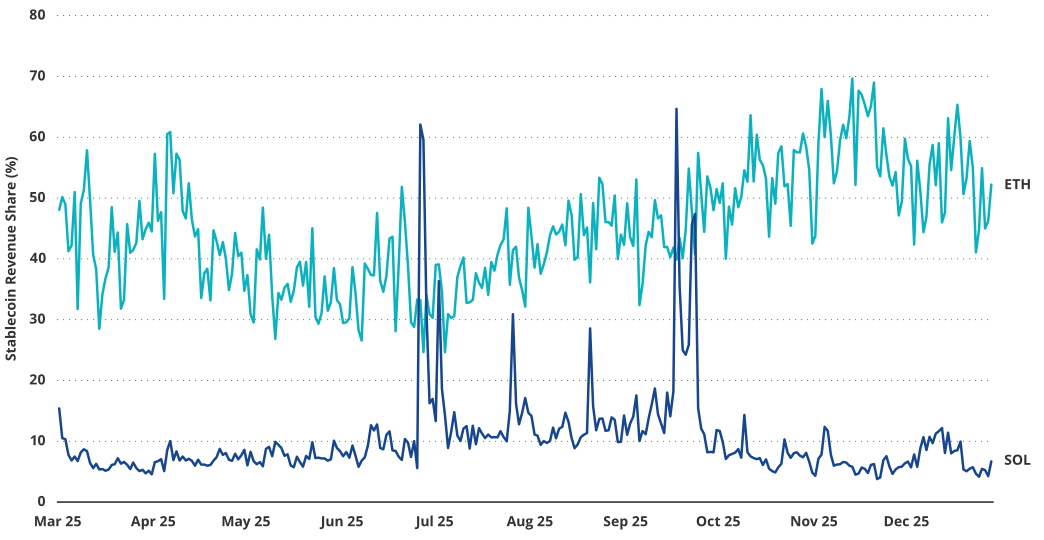
Share of Blockchain Revenues from Stablecoin Transfers
Source: Artemis XYZ as of 12/29/2025.Past performance is no guarantee of future results. Not intended as a recommendation to buy or sell any securities named herein.
Despite ongoing challenges around token value accrual, we remain constructive on blockchains with demonstrated usage, improving economics, and credible paths to monetization, particularly Ethereum and Solana. Both networks increasingly generate revenue from stablecoin activity, signaling a shift toward real-world financial flows rather than purely speculative trading.
In 2025, stablecoin transfers accounted for approximately 43% of Ethereum’s total fees and 10% of Solana’s. Stablecoin velocity on Solana is especially high, with roughly 74% of supply turning over daily, compared to 36% on Ethereum. Viewed through a fee-capture lens, Solana currently earns roughly 13 basis points annually on its stablecoin supply, while Ethereum earns approximately 10 basis points.
Ethereum processes fewer, higher-value transfers, averaging $77k per transaction, while Solana processes smaller transfers averaging $1.3k. However, Solana facilitates more than 10x the number of daily stablecoin transfers, approximately 7.5 million versus 700k. In practice, lower transaction costs enable greater economic activity, allowing Solana to generate comparable or higher aggregate revenue despite minimal per-transaction fees.
As tokenization accelerates, blockchains may increasingly function as settlement and collateral management infrastructure rather than primary trading venues. While centralized exchanges remain superior for execution and liquidity concentration, public blockchains can materially improve settlement speed and collateral mobility across venues.
Today, collateral is typically siloed at individual exchanges, custodians, or clearing members to meet margin and settlement requirements. Faster, programmable settlement could reduce these capital inefficiencies, allowing the same collateral to support activity across multiple venues. This dynamic could lower liquidity buffers, increase capital velocity, and enable emerging markets such as prediction markets to scale more efficiently.
If atomic settlement becomes more widely adopted, with multi-leg trades executing only if all components settle simultaneously, settlement risk could decline further. In this framework, blockchains like Ethereum and Solana function less as speculative assets and more as financial infrastructure, providing core plumbing for capital markets activity.
Under this model, network valuations may be supported by usage and fee generation even if native tokens do not function primarily as monetary assets. For example, if Solana were to host $10 trillion in tokenized assets and maintain a take rate similar to its current stablecoin activity, annual network revenue could approach $13 billion.
For context, the combined value of U.S. equities, Treasuries, corporate bonds, and M2 money supply exceeds $130 trillion. While large-scale tokenized settlement and collateral mobility remain long-dated, early institutional efforts already point in this direction. One example that worked in December is the Canton Network, a blockchain-based settlement framework designed to enable regulated financial institutions to tokenize assets and settle transactions on shared infrastructure. In December, Canton Coin (CC), the network’s native token, rallied from roughly $0.07 to $0.15 following increased institutional validation and visibility around Canton’s role in tokenization initiatives, including participation by firms such as DTCC, Goldman Sachs, Nasdaq, Tradeweb, DRW, and Figure Technologies. While this price action highlights growing investor interest in purpose-built consortium models aligned with regulated finance, it does not resolve broader questions about token value capture, reinforcing the need to evaluate such opportunities on a case-by-case basis and making index strategies less interesting in this space.
Links to third party websites are provided as a convenience and the inclusion of such links does not imply any endorsement, approval, investigation, verification or monitoring by us of any content or information contained within or accessible from the linked sites. By clicking on the link to a non-VanEck webpage, you acknowledge that you are entering a third-party website subject to its own terms and conditions. VanEck disclaims responsibility for content, legality of access or suitability of the third-party websites.
Index Definitions
S&P 500 Index: is widely regarded as the best single gauge of large-cap U.S. equities. The index includes 500 leading companies and covers approximately 80% of available market capitalization.
Nasdaq 100 Index: is comprised of 100 of the largest and most innovative non-financial companies listed on the Nasdaq Stock Market based on market capitalization.
MarketVector Centralized Exchanges Index: designed to track the performance of assets classified as 'Centralized Exchanges'.
MarketVector Decentralized Finance Leaders Index: designed to track the performance of the largest and most liquid decentralized financial assets, and is an investable subset of MarketVector Decentralized Finance Index.
MarketVector Media & Entertainment Leaders Index: designed to track the performance of the largest and most liquid media & entertainment assets, and is an investable subset of MarketVector Media & Entertainment Index.
MarketVector Smart Contract Leaders Index: designed to track the performance of the largest and most liquid smart contract assets, and is an investable subset of MarketVector Smart Contract Index.
MarketVector Infrastructure Application Leaders Index: designed to track the performance of the largest and most liquid infrastructure application assets, and is an investable subset of MarketVector Infrastructure Application Index.
MarketVector Digital Assets 100 Large-Cap Index: market cap-weighted index which tracks the performance of the 20 largest digital assets in The MarketVector Digital Assets 100 Index.
MarketVector Digital Assets 100 Small-Cap Index: market cap-weighted index which tracks the performance of the 50 smallest digital assets in The MarketVector Digital Assets 100 Index.
MarketVector Meme Coin Index: modified market cap-weighted index which tracks the performance of the 6 largest meme coins. Meme coin refers to crypto assets often named after characters, individuals, animals, artworks, or other memetic elements. Initially supported by enthusiastic online traders and communities, these coins are intended for entertainment purposes.
Coin Definitions
Bitcoin (BTC): A decentralized digital currency enabling peer-to-peer transactions without intermediaries or a central authority.
Ethereum (ETH): A decentralized smart-contract platform used to build and run applications and Layer-2 networks.
Aave (AAVE): The governance token of the Aave decentralized lending protocol, used for protocol governance and incentives; tokenholders do not have direct claims on protocol revenues.
Canton Coin (CC): The native token of the Canton Network, a blockchain-based settlement and tokenization framework designed for regulated financial institutions to transact on shared infrastructure.
Binance Coin (BNB): The native asset of BNB Chain used for transaction fees, staking, and ecosystem utilities.
Solana (SOL): A high-throughput Layer-1 blockchain; SOL is used for fees and staking to secure the network.
Tron (TRX): A Layer-1 blockchain focused on high-volume payments and stablecoin transfers; TRX is used for fees and staking.
Avalanche (AVAX): A Layer-1 platform supporting custom subnets; AVAX is used for fees, staking, and governance.
Polygon (POL): The ecosystem token for Polygon’s multi-chain/L2 stack, used for staking/validation and governance.
Arbitrum (ARB): The governance token of the Arbitrum Layer-2 ecosystem; not required for gas on Arbitrum chains.
Toncoin (TON): The native asset of The Open Network (TON), used for fees, staking, and on-chain applications.
Mantle (MNT): An Ethereum Layer-2 network; MNT is a governance/utility token within the Mantle ecosystem.
Worldcoin (WLD): The token of the Worldcoin identity/payments ecosystem (Worldchain), used for governance and incentives.
USD Coin (USDC): A fiat-backed U.S.-dollar stablecoin issued by regulated partners, designed to maintain a 1:1 USD peg.
Cosmos (ATOM): The staking/governance token of the Cosmos Hub within the IBC interoperability ecosystem.
Hyperliquid (HYPE): The native token of the Hyperliquid L1 + perps DEX, used for staking/fee-sharing and protocol governance.
Aster (ASTER): The token of the Aster perpetuals DEX on BNB Chain, used for incentives, fees, and governance.
Plasma (XPL): The native token of the Plasma Layer-1 chain, used for transaction fees, network security, and governance (launched with an airdrop).
dYdX (DYDX): A governance/utility token for the dYdX derivatives protocol, supporting staking and ecosystem incentives.
GLP (GLP): GMX’s liquidity-provider index token representing a basket of collateral on GMX; entitles holders to a share of protocol fees.
NET (NET): A proposed stablecoin for agentic/automated payments referenced in the draft; details and issuance are subject to change.