China – Debilidad del crecimiento frente al optimismo del mercado
30 noviembre 2022
Read Time 2 MIN
China Slowdown
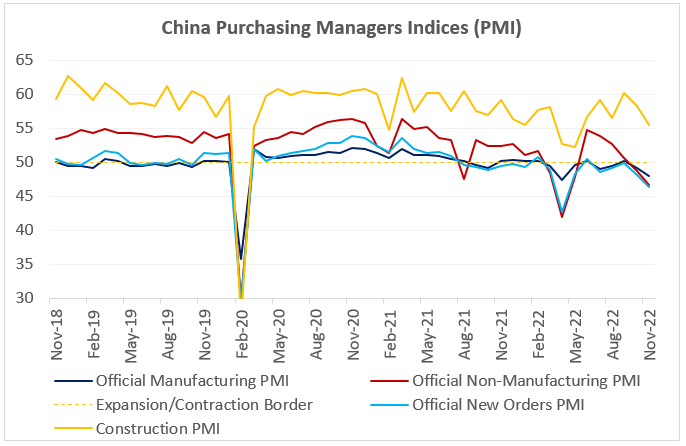
China’s domestic activity gauges for November were bad, no question about it. Most indices were well in contraction zone and deteriorating (see chart below). Even the construction PMI1 (Purchasing Managers Index) – which benefited from the earlier infrastructure stimulus – eased from 58.2 to 55.4. So, why is the market choosing to downplay the weakness? The answer is that authorities made several pre-emptive policy moves before the release, and, importantly, these initiatives address the underlying reasons of the slowdown – primarily real estate and re-opening.
China Real Estate Developers
The re-opening is still very tentative – the 20-point plan focuses on the optimization of the pandemic control, quarantine times, the frequency of testing and risk area delineations – but support for property developers looks more solid. The real estate package includes “stable financing” (the resumption of equity funding for listed companies, bond issuance, “reasonable” loan extension, relending facilities and absolving lenders from personal responsibility if something goes wrong), equal treatment of state-owned and private developers and mortgage support for homebuyers. Given the foregoing, it is not surprising that China’s High Yield/developers’ bonds staged a nice rally in the past week or so.
China Growth – Global Implications
One problem that China cannot fix on its own is weakening global demand – the new export orders PMI dropped to 46.7, which is the lowest level since May. “2023 Growth Cliff” is the most likely scenario for China’s main trade partners, and this underscores the importance of domestic pro-growth policies and orderly re-opening. Earlier reports about vaccination plans for the elderly and the easing of COVID restrictions in Guangzhou look encouraging, even though the progress will probably be slow and uneven (despite assertions that the anti-lockdown protests might turn out “stimulative”). The prospect of China’s domestic rebound – and commodity prices’ reaction to it – raises some interesting questions about (a) global disinflation and (b) growth spillovers in emerging markets (EM) (especially for commodity exporters). But this might be a story for Q2-Q3 next year. Stay tuned!
Chart at a Glance: China Activity Gauges – Still Sliding Down
Source: Bloomberg LP.
1 We believe PMIs are a better indicator of the health of the Chinese economy than the gross domestic product (GDP) number, which is politicized and is a composite in any case. The manufacturing and non-manufacturing, or service, PMIs have been separated in order to understand the different sectors of the economy. These days, we believe the manufacturing PMI is the number to watch for cyclicality.
Related Insights

Related Insights
20 noviembre 2026

19 noviembre 2026
20 octubre 2026
13 agosto 2026
20 noviembre 2026
La investigación de MSCI concluye que la fortaleza de la renta variable estadounidense proviene de una reinvención constante: los líderes rotan, las ofertas públicas iniciales (IPO) reconstruyen el índice y la siguiente ola aún es privada.
20 octubre 2026
El alza en los rendimientos y los precios del petróleo presionó a la renta variable, ya que la Fed elevó las tasas en 25 pb, mientras que Moderna lideró las ganancias del Índice BUZZ por el optimismo en oncología e IREN afectó los rendimientos.
13 agosto 2026
Vea cómo las perspectivas de Jan van Eck para el tercer trimestre pueden traducirse en ideas accionables de fondos cotizados en bolsa (ETF) en semiconductores, crédito privado, oro y bitcoin.
10 agosto 2026
Mientras una venta masiva vinculada a la inteligencia artificial (IA) hizo caer al sector tecnológico en julio, el Moat Index registró un avance gracias a la solidez de los sectores financiero y de salud, mientras que el SMID Moat Index avanzó impulsado por sus posiciones en salud y consumo.
29 julio 2026
El mercado de 2026 parece tranquilo en la superficie, pero la dinámica sectorial dista mucho de serlo. La concentración en semiconductores es extrema, mientras que las acciones de valor, la energía y el sector salud ganan terreno de manera gradual.