Global Rates – The Adjustment Bureau
14 June 2022
Read Time 2 MIN
It is still an open question whether EMs will be forced to follow the Fed’s more hawkish policy stance. The market thinks this might not necessarily be the case for some of them.
Global Rate Expectations Sharply Higher
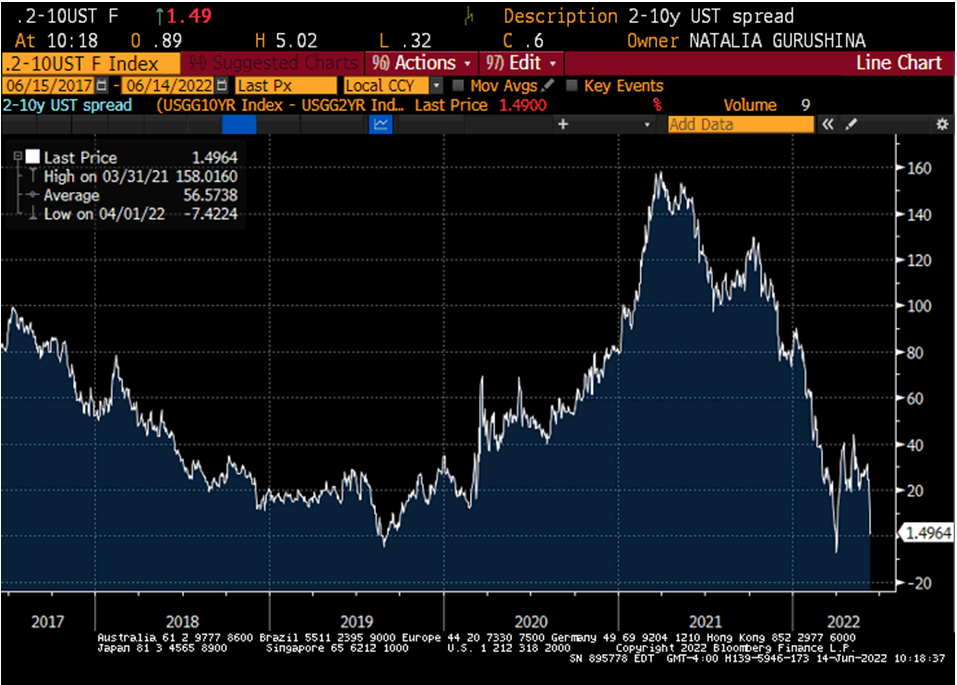
Yesterday’s market tantrum was brutal. The daily increase in the 2-year U.S. Treasury yield was the 10thlargest since 1983. The market expectations for this week’s U.S. Federal Reserve (Fed) decision jumped to +74bps (from 56bps on Friday), and Bloomberg’s Fed Funds Futures page continued to show a +75bps/+70bps rate hike combo for June/July this morning. The near-inversion of the U.S. Treasury curve (see chart below) – the world’s favorite recession indicator – is back on the front-burner, and today’s sad-looking small business optimism index (which comes on the heels of the shockingly weak University of Michigan survey) added to concerns about the U.S. – and global – growth outlook.
No Additional Hikes Price in Brazil
The current tightening cycle in the U.S. is different for many emerging markets (EM), because they started to adjust their own policy rates (in response to rising inflation) well before the Fed. The Brazilian central bank was among the trailblazers – and it frontloaded rate hikes very aggressively (Brazil’s real policy rate adjusted by expected inflation is the highest in EM). And we are wondering whether this is the reason why the local swap curve is not in a hurry to price in a lot of additional tightening, despite the more hawkish Fed (the terminal rate in the U.S. is now seen above 4%). The market-implied rate expectations for Brazil stayed close to +55bps for tomorrow’s rate-setting meeting (a slower pace of tightening), followed by an even smaller (35-38bps) hike in August.
EM Central Banks – Potential Surprises Ahead
We have several policy meetings scheduled in EM until the end of the month – but some will be watched more carefully than others, starting with the Czech National Bank, which is going through a dovish board reshuffle, and where the outgoing hawks might deliver an oversized “goodbye” rate hike. Mexico is another interesting case – inflation pressures suggest that it will be difficult to avoid stepping up the pace of hikes to 75bps, especially if the Fed does the same. Finally, in EM Asia, Indonesia is among very few countries with inflation still within the official target range – but the central bank had fired the first warning shot last month in the form of an additional hike in the reserve requirements for banks, and the buzz about a proper rate hike there is getting louder. Stay tuned!
Chart at a Glance: 2Y-10Y U.S. Treasury Curve Near-Inversion Re-Ignites Recession Fears
Source: Bloomberg LP
Related Insights

Related Insights
10 febrero 2026
06 marzo 2025
20 febrero 2025
10 febrero 2026
La erosión del valor de la moneda vuelve a estar en el centro de atención. A continuación, analizamos qué lo está impulsando, qué podría revertirlo y cómo estamos posicionando las carteras en ambos escenarios.
07 abril 2025
Los aranceles de Trump avivan los temores de una guerra comercial, impulsando la volatilidad del mercado, el riesgo inflacionario y la amenaza de una recesión. Ante posibles represalias globales, el crecimiento a corto plazo corre un riesgo evidente.
06 marzo 2025
Los aranceles de Trump, la próxima fase de la IA y una posible revalorización del oro estadounidense podrían sacudir los mercados; los inversores que se adelanten a estas transiciones estarán mejor posicionados.
20 febrero 2025
El avance de la IA en China, la persistente inflación, el rendimiento superior del oro y el aumento de la demanda energética ponen de relieve un panorama de inversión cambiante.
16 enero 2025
En 2025, superar los problemas significa equilibrar la innovación tecnológica, las coberturas contra la inflación, los cambios energéticos y los riesgos derivados de los recortes del gasto y la inflación.