Guardrails Up!
28 September 2022
Read Time 2 MIN
Global QT
Some emerging markets (EM) are trying to stay in a “business as usual” mode (Thailand’s leisurely 25bps rate hike), but sharp asset price moves and surprising policy U-turns in developed markets (DM) raised questions about EMs’ ability to stay on the sidelines. The Bank of England’s decision to abandon its quantitative tightening (QT) plans and start buying long-dated government bonds to stabilize the market after this week’s massive selloff had an immediate impact – the 30-year U.K. yield narrowed by 107bps following the announcement. However, it also led to multiple “Japanification/policy contagion” comments. The market also made a small adjustment in its expectations (measured by Fed Funds Futures) for the next policy rate hike in the U.S. (to 65bps), as well as for the Federal Reserve’s terminal policy rate (4.4%).
China Currency
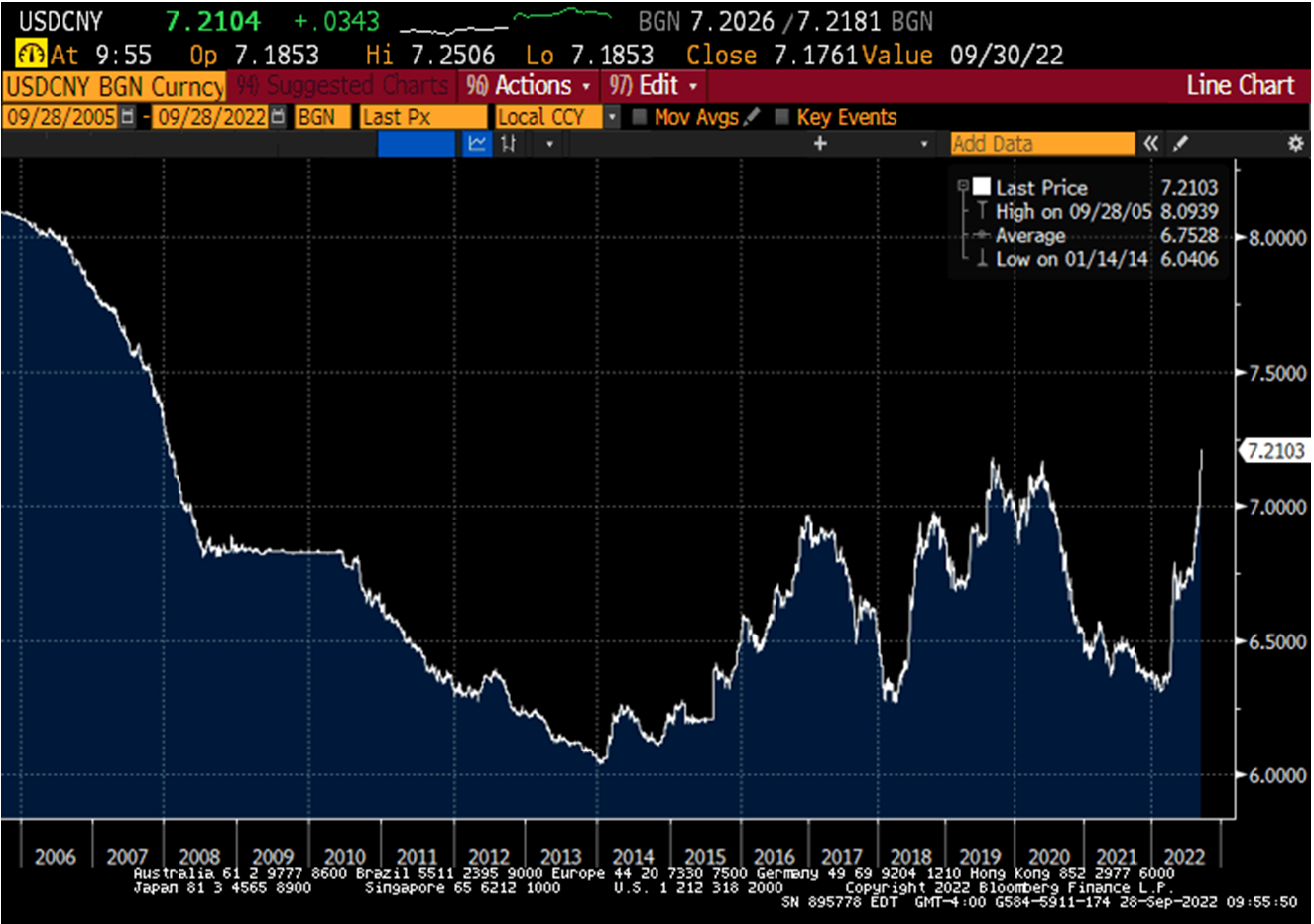
J.P. Morgan’s EM FX index bounced after the initial morning weakness, but some currencies required more support than others. China’s central bank resorted to verbal intervention after the renminbi broke through 7.20/U.S. Dollar to the weakest level since 2007 (see chart below). Some reports also suggested that authorities might bring back the counter-cyclical factor in the daily currency fixings to reduce volatility. The renminbi’s moves are affected both by the U.S. Dollar’s general strength (“safe haven” status, a more favorable interest rate differential with major currencies) and China’s policy divergence (easing while the rest of the world is tightening). The latter reflects China’s worsening near-term growth outlook, which is why the official activity gauges for September – to be released on Thursday - will be closely watched.
EM Rate Hikes
EM’s ability to conduct independent monetary policy – rather than to follow in lockstep with DMs - will be tested in this environment. And this includes tomorrow’s rate-setting meetings in Mexico, Colombia, and the Czech Republic. Given Mexico’s never-ending upside inflation surprises, the central bank might have no other choice but to deliver another sizable 75bps rate hike. The Czech National Bank was trying to make a dovish turn by keeping its policy rate on hold in August – the market continues to see room for a small rate cut, but only in a few months. Stay tuned!
Chart at a Glance: CNY Weakness Continues*
Source: Bloomberg LP
USDCNY – Exchange rate for U.S. Dollar/Chinese Yuan
Related Insights

Related Insights
10 febrero 2026
06 marzo 2025
20 febrero 2025
10 febrero 2026
La erosión del valor de la moneda vuelve a estar en el centro de atención. A continuación, analizamos qué lo está impulsando, qué podría revertirlo y cómo estamos posicionando las carteras en ambos escenarios.
07 abril 2025
Los aranceles de Trump avivan los temores de una guerra comercial, impulsando la volatilidad del mercado, el riesgo inflacionario y la amenaza de una recesión. Ante posibles represalias globales, el crecimiento a corto plazo corre un riesgo evidente.
06 marzo 2025
Los aranceles de Trump, la próxima fase de la IA y una posible revalorización del oro estadounidense podrían sacudir los mercados; los inversores que se adelanten a estas transiciones estarán mejor posicionados.
20 febrero 2025
El avance de la IA en China, la persistente inflación, el rendimiento superior del oro y el aumento de la demanda energética ponen de relieve un panorama de inversión cambiante.
16 enero 2025
En 2025, superar los problemas significa equilibrar la innovación tecnológica, las coberturas contra la inflación, los cambios energéticos y los riesgos derivados de los recortes del gasto y la inflación.