Policy Reaction to Mixed Data Signals
02 December 2022
The Pace of Fed Hikes
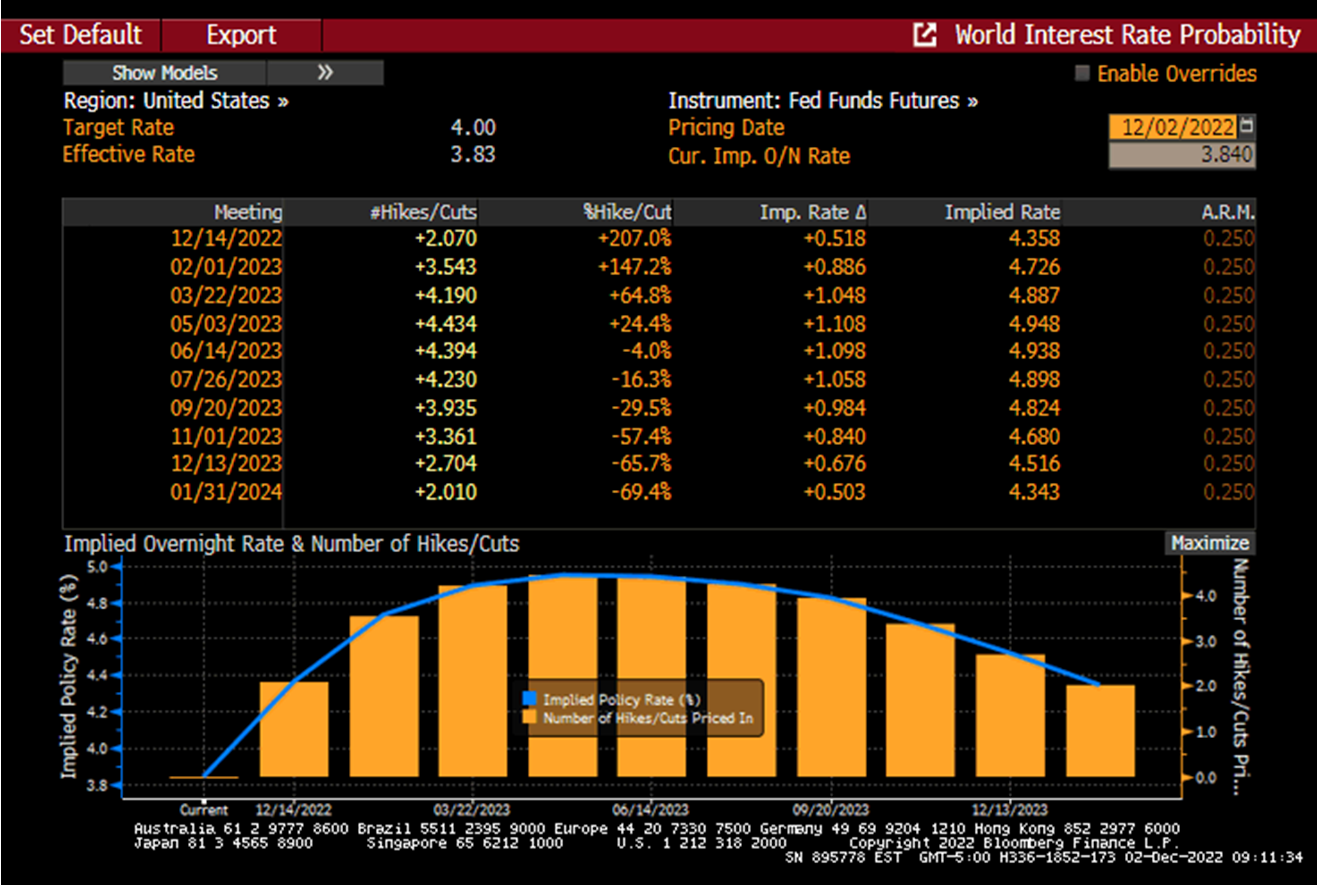
The global data flow does not challenge the slowdown narrative, but it also shows that the momentum is very uneven – today’s strong labor market report in the U.S. could not have looked more different from this week’s ISM survey, which sent a much weaker signal. Both releases are, however, consistent with the market view that the U.S. Federal Reserve (Fed) can and should continue raising its policy rate, but at a slower pace (see chart below). At the same time, upside surprises like the strong labor market report raise a question mark as to whether the Fed would indeed have room for around 40bps of rate cuts in H2-2023.
EM Disinflation
The data flow in emerging markets (EM) is also not uniform – especially on the inflation front. The overall trend in EM inflation surprises is down, but it does not mean that we do not get an occasional above-consensus print, like in Peru. Peruvian headline inflation unexpectedly accelerated to 8.45% year-on-year in November, interrupting the nascent disinflation trend and signaling that the underlying price pressures may prove more persistent than previously thought. The year-to-date total return on Peru’s local debt (J.P. Morgan’s GBI-EM Peru U.S. Dollar Unhedged Index1) is still positive, but future performance will depend on the central bank’s ability to navigate the situation credibly (and this includes the expected 25bps rate hike next week). South Korea’s inflation print was the opposite of Peru – a nice downside surprise, which can allow the central bank to pause going forward.
EM Growth Slowdown
As regards upside growth surprises, some (if not most) of them require additional context. For example, Chile’s economic activity was stronger than expected in October, but it was still contracting at an accelerated pace (-1.2% year-on-year). In the same vein, today’s upside surprise in the Czech Republic’s Q3 GDP masked another sequential decline (-0.2% quarter-on-quarter), which might get worse going forward judging by the super-weak November PMI (41.6). There is no question that the central bank will stick to its “on hold” stance under these circumstances. Finally, Brazil’s industrial production growth also beat consensus in October, but the new administration’s policy agenda could have an impact (and not necessarily positive) on the business sentiment – a worrying prospect against the backdrop of a sharp decline in Brazil’s manufacturing PMI (to 44.3). Stay tuned!
Chart at a Glance: Market Sticks to Its Policy Rate Expectations for the Fed
Source: Bloomberg LP
1J.P. Morgan GBI-EM Peru U.S. Dollar Unhedged Index is the Peru subset of the GBI-EM Index, defined below.
Related Insights

Related Insights
10 febrero 2026
06 marzo 2025
20 febrero 2025
10 febrero 2026
La erosión del valor de la moneda vuelve a estar en el centro de atención. A continuación, analizamos qué lo está impulsando, qué podría revertirlo y cómo estamos posicionando las carteras en ambos escenarios.
07 abril 2025
Los aranceles de Trump avivan los temores de una guerra comercial, impulsando la volatilidad del mercado, el riesgo inflacionario y la amenaza de una recesión. Ante posibles represalias globales, el crecimiento a corto plazo corre un riesgo evidente.
06 marzo 2025
Los aranceles de Trump, la próxima fase de la IA y una posible revalorización del oro estadounidense podrían sacudir los mercados; los inversores que se adelanten a estas transiciones estarán mejor posicionados.
20 febrero 2025
El avance de la IA en China, la persistente inflación, el rendimiento superior del oro y el aumento de la demanda energética ponen de relieve un panorama de inversión cambiante.
16 enero 2025
En 2025, superar los problemas significa equilibrar la innovación tecnológica, las coberturas contra la inflación, los cambios energéticos y los riesgos derivados de los recortes del gasto y la inflación.