Reviewing Our 2023 EM Assumptions
21 February 2023
Read Time 2 MIN
EM Tightening Cycle
Emerging markets’ (EM’s) credible and pro-active policy response to rising price pressures and China’s rebound are among key factors underpinning our 2023 outlook for EM bonds. How have these assumptions been holding so far this year? EM monetary authorities are passing with flying colors. EM inflation is moderating, but various central banks are not taking any chances and staying cautious, as the process of disinflation is rather bumpy and might take longer than previously thought. Mexico and the Philippines raised their respective policy rates by more than expected earlier this month, and even central banks that stayed on hold signaled that the bar for rate cuts is very high. The latest hawkish surprise came from Israel, where the central bank opted for a larger 50bps rate hike yesterday, instead of expected 25bps, and signaled more tightening, because activity and inflation turned out much stronger than expected.
China Rebound
EMs’ relatively high real interest rates (vs. developed markets (DM)) provide a nice policy cushion against the (potentially) more hawkish U.S. Federal Reserve (Fed), but for this cushion to translate into actionable trades, a decent growth outlook is often a must. China’s rebound is an important driver here, and various gauges/high frequency indicators show that domestic activity is definitely bottoming out. We are also hearing about additional policy measures to prop up the housing sector and promote bank lending – such as draft new rules on banks’ risk-weighting and a pilot scheme to allow real estate investments by private equity funds. Still, there are plenty of questions about the recovery’s timeline – especially as regards consumption. A recent sell-side report suggested that excess savings might be smaller and partly used for precautionary purposes. Further, the use of excess savings might be slower initially, pushing the recovery to H2/early 2024.
Global Growth Outlook
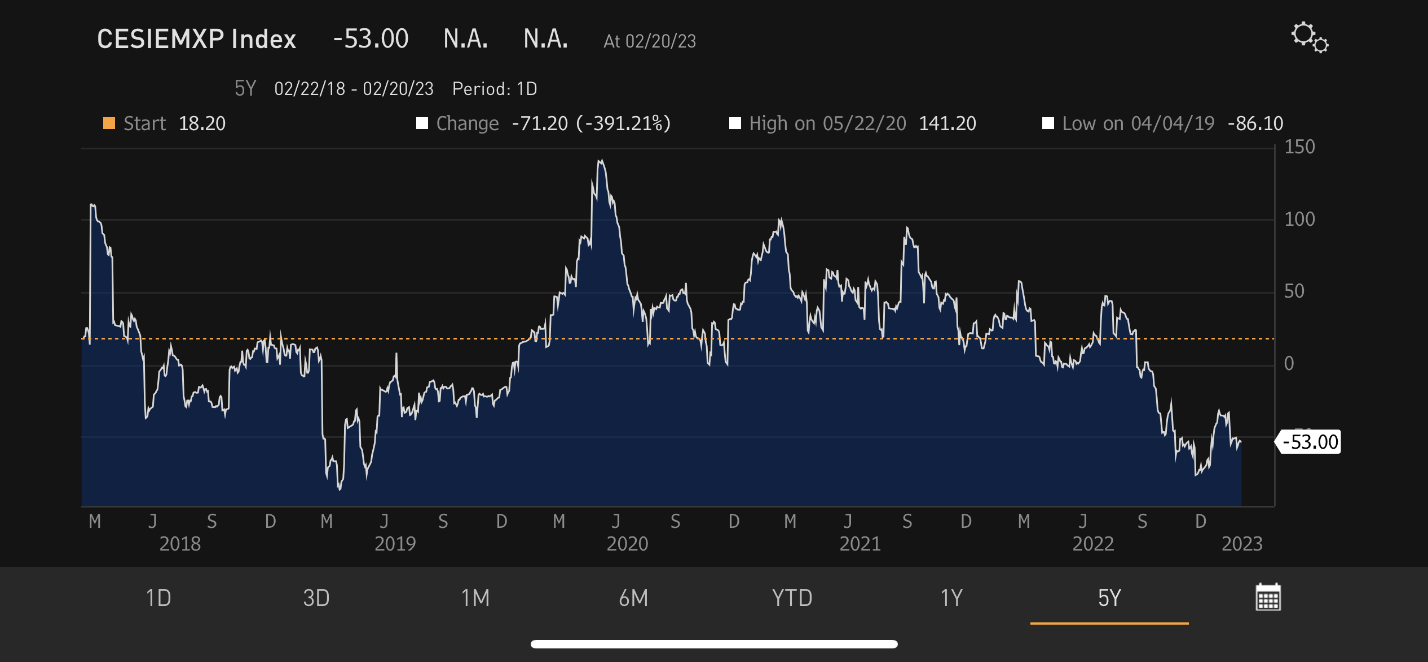
China is not the only growth story we are watching – the growth outlook in advanced economies is also important, especially for more open EMs (note that the economic surprise index for EM exports is still in the red – see chart below). February’s preliminary activity gauges for the Eurozone (PMIs, or Purchasing Managers Indices) looked mixed – a very strong reading for the services PMI (53.0), but the manufacturing PMI (48.5) remains contractionary. The U.S. PMIs looked almost as “conflicted” – the expansionary services PMI and the contractionary manufacturing PMI – except that manufacturing was better than expected. There was nothing in the release to suggest that the Fed should stop hiking – so, it’s good that EM central banks are en garde. Stay tuned!
Chart at a Glance: EM Export Surprises – Still in the Red
Source: Bloomberg LP.
Citigroup Economic Surprise Index (CESI) tracks whether a core set of economic data series has been coming in under expectations, at expectations, or over expectations.
Related Insights

Related Insights
10 febrero 2026
06 marzo 2025
20 febrero 2025
10 febrero 2026
La erosión del valor de la moneda vuelve a estar en el centro de atención. A continuación, analizamos qué lo está impulsando, qué podría revertirlo y cómo estamos posicionando las carteras en ambos escenarios.
07 abril 2025
Los aranceles de Trump avivan los temores de una guerra comercial, impulsando la volatilidad del mercado, el riesgo inflacionario y la amenaza de una recesión. Ante posibles represalias globales, el crecimiento a corto plazo corre un riesgo evidente.
06 marzo 2025
Los aranceles de Trump, la próxima fase de la IA y una posible revalorización del oro estadounidense podrían sacudir los mercados; los inversores que se adelanten a estas transiciones estarán mejor posicionados.
20 febrero 2025
El avance de la IA en China, la persistente inflación, el rendimiento superior del oro y el aumento de la demanda energética ponen de relieve un panorama de inversión cambiante.
16 enero 2025
En 2025, superar los problemas significa equilibrar la innovación tecnológica, las coberturas contra la inflación, los cambios energéticos y los riesgos derivados de los recortes del gasto y la inflación.