Surprises and Consequences
27 May 2022
Read Time 2 MIN
Some countries buck negative trends in global economic surprises, but China is not one of them. The “feel good” factor stemming from the improving growth outlooks can affect policies in parts of LATAM.
Global Economic Surprises
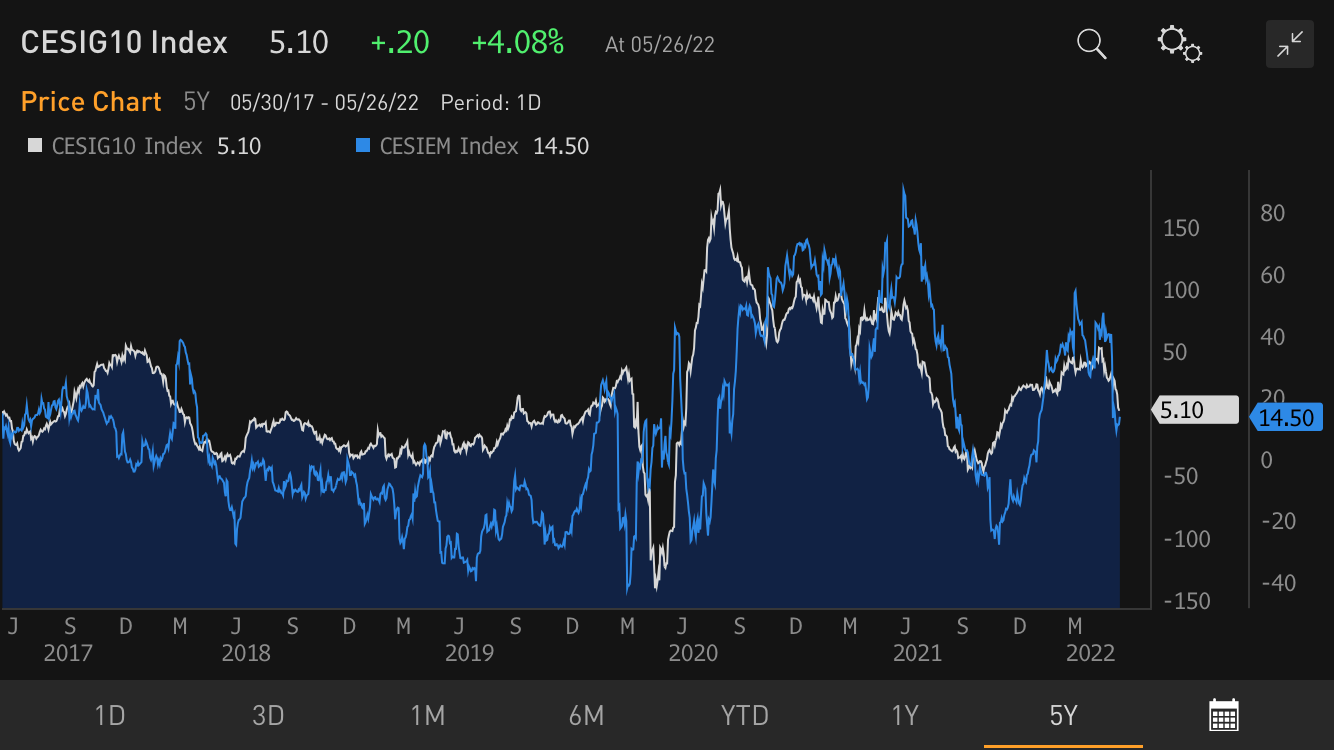
Economic surprises are moving south again – both in emerging markets (EM) and developed markets (DM) (see chart below) – but aggregate numbers mask a lot of important country nuances. The economic surprise index for EM is to a big extent driven by China, which experienced several big data misses lately. The next important milestone is the release of official and Caixin activity gauges for May early next week. The consensus expectation is that the worst is already behind us – i.e., we should see some improvement vs. April – but both the services and the manufacturing PMIs (Purchasing Managers Indices) should remain in contraction zone. And this means that the real GDP forecast for 2022 (cut to 4.7%) will continue to move away from the official target of about 5.5% – without more active policy support that is (=not just statements and slogans).
Brazil Growth, Fiscal Policy
Among other major EMs, Brazil is still struggling with inflation, but its 2022 growth forecast is gradually moving away from the brink (raised to a “mighty” 0.7% recently), and the country’s fiscal performance has been significantly better than expected so far this year. The question is whether Brazil can avoid getting carried away by its macro successes in the election year. This week’s approval by the lower house of a bill that lowers taxes on certain goods (re-branded as essential) is an example of such policies. The bill is supposed to reduce inflation pressures, but the problem is that while the anti-inflation impact will be short-lived, the loss of revenue for the budget can be sizable (to the tune of 0.7-0.9% of GDP) and longer lasting.
Colombia Presidential Elections
Brazil’s regional peer, Colombia, is also doing quite well as regards the growth outlook (the 2022 forecast raised from 3.7% to 4.8%). And this “feel good” factor might be an important consideration in this weekend’s presidential election. Colombia used to be among the countries where policy continuity was never in question (so we always watched the elections, but did not really worry too much). However, the current list of frontrunners includes a rather interesting personality from the far left – Gustavo Petro – who is also leading in the polls by a wide margin. And many observers argue that Petro’s victory is to yet fully priced in by the market. So, stay tuned!
Chart at a Glance: Global Economic Surprises Moving South Again
Source: Bloomberg LP
The Citigroup Economic Surprise Indices (CESI) measure data surprises relative to market expectations. A positive reading means that data releases have been stronger than expected and a negative reading means that data releases have been worse than expected. CESIG10 measures economic data surprises across the world's largest "G10" economies as a whole; CESIEM measures economic data surprises across emerging markets economies.
Related Insights

Related Insights
10 febrero 2026
06 marzo 2025
20 febrero 2025
10 febrero 2026
La erosión del valor de la moneda vuelve a estar en el centro de atención. A continuación, analizamos qué lo está impulsando, qué podría revertirlo y cómo estamos posicionando las carteras en ambos escenarios.
07 abril 2025
Los aranceles de Trump avivan los temores de una guerra comercial, impulsando la volatilidad del mercado, el riesgo inflacionario y la amenaza de una recesión. Ante posibles represalias globales, el crecimiento a corto plazo corre un riesgo evidente.
06 marzo 2025
Los aranceles de Trump, la próxima fase de la IA y una posible revalorización del oro estadounidense podrían sacudir los mercados; los inversores que se adelanten a estas transiciones estarán mejor posicionados.
20 febrero 2025
El avance de la IA en China, la persistente inflación, el rendimiento superior del oro y el aumento de la demanda energética ponen de relieve un panorama de inversión cambiante.
16 enero 2025
En 2025, superar los problemas significa equilibrar la innovación tecnológica, las coberturas contra la inflación, los cambios energéticos y los riesgos derivados de los recortes del gasto y la inflación.