BDCs: A Look Beyond the Headlines
16 June 2026
Read Time 3 MIN
Key Takeaways:
- Publicly traded BDCs aren't the private credit story making headlines — daily pricing, no lockups, and no gating mechanisms set them apart structurally.
- Credit quality is holding: the nonaccrual rate stands at just 1.4% as of Q4 2025, well below the 5%+ seen at the height of COVID.
- Large-cap BDCs are yielding 12.6% on average which is roughly double leveraged loans and triple the 10-year US Treasury.
The Large-cap BDC Dividend Yield is derived from a basket of BDCs from S&P Capital IQ and SEC filing as of May 3, 2026. Index performance is not illustrative of fund performance. It is not possible to invest directly in an index. Past performance is no guarantee of future results.
The Headlines vs. The Data
Private credit has had a noisy year. Redemption requests at non-traded funds, questions about whether private NAV marks reflect current market conditions, and high-profile transaction failures have generated a steady stream of negative coverage.
But there is an important distinction that is getting lost in the coverage: the publicly traded BDC market is a different vehicle. Shares price daily. Holdings are disclosed quarterly and there are no lock-up periods or gating mechanisms. The stress in private credit has largely been a story about illiquid structures meeting investor demand for liquidity. That is not the publicly traded BDC story.
Credit Quality: What the Numbers Actually Show
According to the Houlihan Lokey BDC Monitor Spring 2026, which tracks more than 170 BDC funds, the nonaccrual rate across publicly traded BDCs was 1.4% as of Q4 2025. To put that in context, during the height of COVID in 2020, that number exceeded 5%. The current level is not the profile of an asset class in distress.
Exhibit 1: Nonaccrual Rate Over Time (2019 to Q4 2025)
Nonaccrual Investments as a Percentage of Total Portfolio(2)
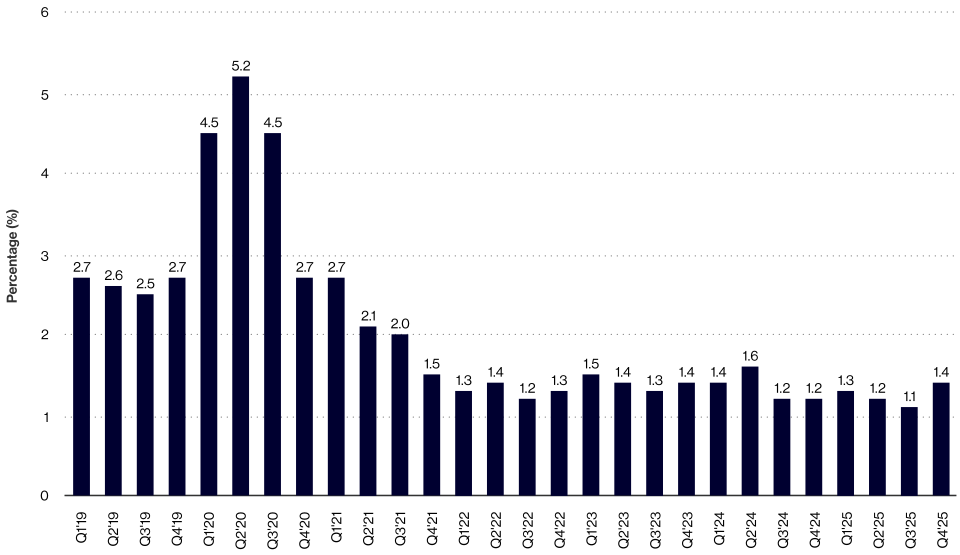
Source: Advantage Data, as of 31 December 2025.(2) Reflects the cost of nonaccrual investments as a percentage of total portfolio cost for BDCs tracked by Advantage Data.
The underlying loan portfolios support that picture. As of Q4 2025, 87.6% of loans in publicly traded BDC portfolios were priced above 97 cents on the dollar, and first lien senior secured loans represent the dominant share of holdings. These are not equity positions in speculative companies. They are senior loans to middle-market businesses, with real collateral behind them.
None of this means the asset class is without risk. Nonaccruals ticked up 28 basis points in Q4, and implied recovery rates on nonaccrual loans declined during the quarter. The picture is stable, not perfect. But stable, when the headlines suggest otherwise, is worth noting.
The Income Case
Even with the macro noise, publicly traded BDCs continue to deliver some of the most attractive income available in the market. The average dividend yield across large-cap publicly traded BDCs is 12.6% as of Q4 2025. For context, that is roughly double the yield on leveraged loans, nearly double high yield bonds, and approximately three times the yield on the 10-year US Treasury.
That income is built on floating-rate, senior secured loans to middle-market companies — borrowers who pay a credit spread above SOFR that has historically been durable across rate cycles. NII margins have compressed from their 2023 peak, and new first lien loans are pricing at tighter spreads than two years ago. That is worth watching. But the credit spread component above base rates has persisted, and the income from publicly traded BDCs has remained in an attractive range even as the rate environment has shifted.
Why Diversification Matters More Than Ever
Not all publicly traded BDCs are created equal. A look at the large-cap peer group as of Q4 2025 illustrates the point: price-to-NAV ratios range from 0.45x at the low end to 1.60x at the high end within the same universe. The spread reflects real differences in credit quality, manager track record, portfolio composition, and borrower sector exposure.
That dispersion is a reason to be thoughtful about how you access this asset class. In an environment where headlines are driving sentiment broadly, the fundamentals underneath individual names matter more, not less.
BIZD: Diversified Access to Publicly Traded BDCs
The VanEck BDC Income ETF (BIZD) tracks the MVIS US Business Development Companies Index, providing diversified exposure across the publicly traded BDC market in a single, liquid vehicle. Rather than concentrating in one manager or one borrower pool, BIZD spreads exposure across the industry's largest and most established names, capturing the income potential of the asset class while reducing single-issuer risk.
For investors who believe that the recent sentiment overshoot in private credit has created an opportunity in publicly traded BDCs — where credit quality is holding, income remains attractive, and the structural concerns driving headlines elsewhere do not apply — BIZD offers a straightforward way to express that view.
MVIS US Business Development Companies Index is the exclusive property of MarketVector Indexes GmbH (a wholly owned subsidiary of Van Eck Securities Corporation), which has contracted with Solactive AG to maintain and calculate the Index. Solactive AG uses its best efforts to ensure that the Index is calculated correctly. Irrespective of its obligations towards MarketVector Indexes GmbH, Solactive AG has no obligation to point out errors in the Index to third parties. The VanEck BDC Income ETF is not sponsored, endorsed, sold or promoted by MarketVector Indexes GmbH and MarketVector Indexes GmbH makes no representation regarding the advisability of investing in the Fund.
Related Insights

Related Insights
15 October 2026

15 October 2026
Fallen angels lagged broad high yield by 1.14% in Q3 2026 as the 10-year Treasury climbed to 5.29%. With index yields at the 80th percentile, see what drove the drop and what carry may mean ahead.
11 August 2026
Many investors need more than traditional bonds can deliver. VanEck provides access to a range of higher-yielding asset classes built for today's income environment.
14 July 2026
After a volatile Q1, fallen angels bounced back sharply in Q2 2026, outperforming broad high yield by 1.23%, as geopolitical de-escalation and tighter spreads drove strong returns.
02 July 2026
The discount of XMPT's underlying muni CEFs has been a historically reliable entry signal. Wide discounts have historically preceded strong returns. Tight readings may suggest waiting for the next shock.