BDCs: The Liquid Way to Access to Private Credit
24 February 2026
Read Time 4 MIN
In a recent webinar, VanEck’s Coulter Regal, CFA and Nico Cortese, CFA discussed the key factors supporting BDCs, including their institutional scale, more conservative portfolio construction, and stable credit quality.
For the full discussion, watch the replay of High Yield Opportunities in BDCs.
Key takeaways:
- Investors are increasing allocations to private credit - The BDC market has grown rapidly, reflecting a broader institutional shift toward private credit (2:50).
- How BDCs offer consistent high yield potential relative to other income-oriented investments - At 11.3%, the MVIS US BDC Index dividend yield is nearly double those of leveraged loans and high yield bonds, and roughly triple the 10-year Treasury, creating a compelling income advantage in today’s market (4:56).
- More conservative portfolio construction - The BDC industry has meaningfully de-risked its portfolio construction over recent years (13:25).
- Insights from Houlihan Lokey’s BDC Monitor - Industry leverage has fallen, nonaccrual rates are low, and loan prices remain near par, signaling that the recent price weakness is a sentiment-driven discount, not a credit problem (15:15).
- Benefits of a diversified BDC investment approach - The VanEck BDC Income ETF (BIZD) provides broad, liquid access to the publicly traded BDC market, eliminating single-manager concentration risk while capturing the asset class’s income premium (26:45).
How Do BDC Yields Compare to High Yield Bonds, Leveraged Loans and Treasuries?
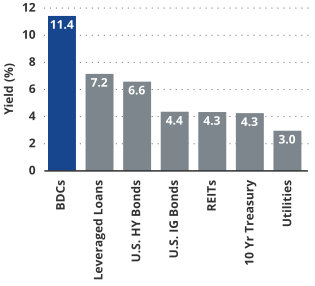
BDCs stand out as one of the highest-yielding income-oriented asset classes available today. As of December 31, 2025, BDCs' MVIS US Business Development Companies Index dividend yield was 11.3%, nearly double that of leveraged loans (6.8%) and U.S. high yield bonds (6.5%), and roughly triple the yield on 10-year Treasuries (4.2%). This yield advantage reflects the structural premium investors earn for accessing middle-market private credit through a publicly traded vehicle.
Investors Are Increasing Allocations to Private Credit
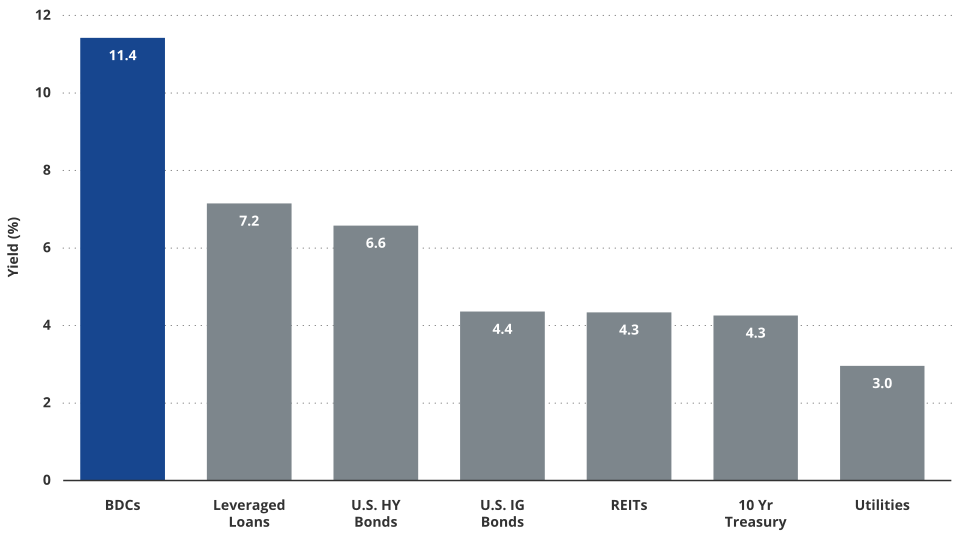
Source: FactSet and ICE Data Indices. Past performance is no guarantee of future results. Yield for Mortgage REITs, BDCs, Equity REITs, and Utilities Stocks represented by dividend yield. Yield for Leveraged Loans, U.S. HY Bonds, U.S. IG Bonds, and 10 Yr Treasury represented by yield-to-worst. Mortgage REITs represented by MVIS US Mortgage REITs Index; BDCs represented by MVIS US Business Development Companies Index, U.S. HY Bonds represented by ICE BofA US High Yield Index; U.S. IG Bonds represented by ICE BofA U.S. Corporate Index; U.S. 10 Yr Treasury represented by ICE BofA Current 10-Year US Treasury Index; Equity REITs represented by FTSE NAREIT All Equity REITs Index; Utilities Stocks represented by S&P Utilities Index; Leveraged Loans represented by Bloomberg US Leveraged Loan (Ba/B) Index. See important disclosures and descriptions at end.
BDC Credit Quality Remains Strong
Multiple indicators confirm that BDC credit quality is healthy. Nonaccrual rates, investments where borrowers have stopped making payments, sit at just 1.2% of total portfolios as of Q2 2025, well below the 5.2% peak during the COVID era and below pre-pandemic levels. Weighted average loan prices for first-lien debt remain near par at 99.3%, and the vast majority of BDC investments are priced above 97% of par value. PIK (payment-in-kind) income, a potential early warning sign of borrower stress, has also remained manageable at 6.4% of total interest income.
- Nonaccrual rates are at 1.2%, well below the COVID-era peak of 5.2% and below pre-pandemic levels.
- First-lien weighted average loan prices are near par at 99.3%.
- PIK income remains manageable at 6.4% of total interest income.
- Loan price distribution shows 87% of investments are priced above 97% of par.
BIZD: Diversified BDC Exposure in a Single ETF
The VanEck BDC Income ETF (BIZD) provides investors with diversified access to the publicly traded BDC market. Rather than picking individual BDCs, which carry concentration risk tied to specific managers, sectors, and borrower pools, BIZD offers broad exposure across the industry’s largest and most liquid names. For income-focused investors looking beyond traditional bonds, BIZD provides a way to capture the BDC yield premium with institutional-scale diversification and daily liquidity.
- BIZD offers diversified exposure across the largest publicly traded BDCs.
- The ETF eliminates single-BDC concentration risk tied to specific managers or borrower pools.
- Daily liquidity and broad diversification make it an accessible way to capture the BDC income premium.
Related Insights


Related Insights
10 April 2026
Two large fallen angels entered the index in Q1, including Paramount at 10% weight. Yields back above 7% and a historically wide price discount may signal a compelling entry point.
04 March 2026
BDC valuations reflect NII, dividend coverage, credit quality and rate expectations. With P/B below average, markets may already price in cuts, creating potential income opportunities.
24 February 2026
Preferred securities offer income potential above bonds and lower volatility than equities. Understanding sector differences helps investors position preferreds within diversified portfolios.
02 February 2026
BDCs and private credit funds finance middle-market firms but differ in access. BDCs offer liquidity and transparency; private credit funds are less liquid with limited access and longer lock-ups.
30 January 2026
Headline yield shows income potential, but taxes reduce what you keep. Equity investors should focus on after-tax yield. Preferreds may help boost income and improve tax efficiency.