What is Driving BDC Valuations?
04 March 2026
Read Time 6 MIN
Key Takeaways:
- BDC valuations hinge on NII, dividend coverage, credit quality and price to NAV levels.
- Current P/B of 0.83x sits below the 0.97x average, reflecting rate and credit concerns.
- BDC yields near 12% highlight durable spread income across rate cycles.*
What Drives BDC Valuations?
Business development companies (BDCs) are publicly traded investment vehicles that lend to small and mid-sized U.S. businesses, primarily through floating-rate loans. Because BDCs are required to distribute the majority of their taxable income, they are popular among income-focused investors. Several key factors drive how the market values public BDCs:
- Net investment income (NII): The core earnings measure for BDCs, reflecting the spread between income earned on the loan portfolio and operating/financing costs. NII is the primary source of shareholder dividends.
- Dividend yield and coverage: Whether a BDC's earnings sufficiently cover its distribution is a key signal of sustainability.
- Price-to-NAV (book value): BDCs report NAV quarterly, but shares trade in the secondary market at prices that may differ. A discount to NAV may reflect macro concerns; a premium often signals confidence in management and portfolio quality.
- Credit quality and leverage: Non-accrual rates, portfolio composition, and balance sheet leverage influence risk assessment.
- Macro conditions and sentiment: GDP projections, rate policy, the credit environment, and investor appetite for income assets all shape valuations. More recently, concerns about potential credit deterioration and the impact of AI-driven disruption on certain BDC borrowers have weighed on sentiment, sometimes independently of underlying fundamentals.
Why Interest Rates Matter for BDC Performance
Because BDC loan portfolios are predominantly floating rate, typically benchmarked to SOFR, changes in Federal Reserve rate policy flow directly through to BDC earnings. When rates are elevated, BDCs earn more on their assets. When rates decline, floating-rate coupons reset lower, reducing income.
The impact is not entirely one-sided, however. Lower rates can also reduce a BDC's own borrowing costs, partially offsetting the decline in asset income. Many BDC loans also include interest rate floors that set a minimum coupon, providing a cushion in a rate-cutting cycle. The Fed currently holds the federal funds rate at a target range of 3.50% to 3.75% following three consecutive cuts in late 2025, with FOMC members divided on the path forward.
Are BDC Valuations Pricing in Rate Cuts?
One of the clearest ways to gauge whether the market has already adjusted for rate expectations is to examine the price-to-book (P/B) ratio of the public BDC universe. Using the MVIS US Business Development Companies Index (the index underlying BIZD), the index-level P/B ratio as of February 27, 2026 sits at approximately 0.83x, well below the long-term historical average of roughly 0.97x. That is a discount of about 14% relative to the historical norm.
Historical BDC Price-to-Book Ratios:
| Period | Price/Book Ratio | Context |
| Sep 2015 (pre-hike low) | 0.83x | Energy/credit concerns |
| Jan 2016 (selloff trough) | 0.81x | Energy sector stress |
| Aug 2016 (recovery) | 1.00x | Credit stabilization |
| Mar 2020 (COVID low) | 0.63x | Pandemic-driven selloff |
| Late 2024 (recent high) | 1.10x | Strong BDC fundamentals |
| Feb 2026 (current) | 0.83x | Credit/rate sentiment discount |
| Long-term average | 0.97x | Aug 2011 to Feb 2026 |
Source: MVIS US Business Development Companies Index. Data as of 2/27/2026. Past performance is not indicative of future results. Index performance is not illustrative of fund performance. It is not possible to invest directly in an index.
The current P/B level is comparable to the discount seen in September 2015, just before the first Fed rate hike in nearly a decade, and early 2016, when energy sector stress weighed on credit sentiment. In both cases, valuations subsequently recovered as conditions stabilized, with the index reaching 1.00x by August 2016. While some of the current discount reflects expectations for lower NII as rates come down, it also captures a broader shift in sentiment around private credit. Concerns about credit quality in certain pockets of BDC lending, particularly among software and technology-exposed borrowers facing potential disruption from artificial intelligence, have contributed to the recent selloff. For investors with a constructive view on the overall credit environment, this type of valuation backdrop has historically represented attractive entry points.
BDC Yields in Historical Context
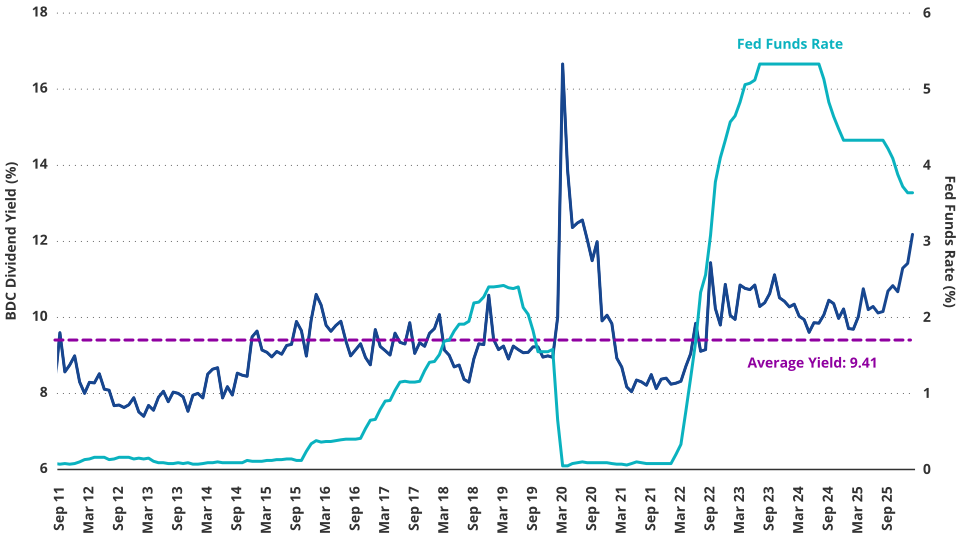
While yields across asset classes naturally fluctuate with interest rate cycles, BDC yields have historically remained in an attractive range regardless of the prevailing rate environment. As illustrated in the chart below, the MVIS BDC Index dividend yield has generally stayed between roughly 8% and 12% over the past 14 years, even as the effective federal funds rate moved from near zero to above 5% and back down.
Source: FactSet; Federal Reserve Bank of St. Louis. BDCs represented by MVIS US Business Development Companies Index (MVBDCTRG); Index data prior to June 19, 2023 reflects that of the MVIS US Business Development Companies Liquid Index (MVBIZDTG). From June 19, 2023 forward, the index data reflects that of the MVIS US Business Development Companies Index (MVBDCTRG). Index history which includes periods prior to June 19, 2023 links the performance of the indices and is not intended for third party use. Past performance is no guarantee of future results. Index performance is not illustrative of fund performance. It is not possible to invest directly in an index.
This durability reflects the fact that a significant portion of BDC income comes from the credit spread above base rates, the premium that middle-market borrowers pay for private financing. That spread component has historically persisted across rate cycles, helping to support BDC yields even when base rates decline. As of February 2026, the index dividend yield sits at approximately 12.2%, with the federal funds rate in the mid threes.
How Do BDCs Perform When Rates Fall?
While declining rates can reduce the floating-rate income BDCs earn on their loan portfolios, the impact is often partially offset by lower borrowing costs and by the credit spreads BDCs earn above base rates. Historically, BDCs have continued to deliver attractive income across a variety of rate environments, particularly when credit fundamentals remain sound.
Looking at past cycles, the 2019 rate cuts saw BDC P/B ratios remain near or above 1.0x as the economic backdrop stayed supportive. The rate hiking cycle of 2022 to 2023 was particularly favorable for BDC earnings as floating-rate income surged and credit fundamentals remained strong. The key takeaway is that rates are just one variable. Credit performance, borrower fundamentals, and manager quality all play significant roles in determining outcomes, and periods where sentiment overshoots to the downside have often been followed by recoveries once underlying credit data stabilized.
What This Means for Income Investors
Are BDC dividends at risk if rates fall? Dividends may see some adjustment as base rates decline, given that underlying loans are predominantly floating rate. However, BDC managers have several levers to help mitigate the impact, including optimizing portfolio spreads, generating fee income from origination activity, managing leverage, and reducing operating costs. The credit spread component of BDC income, the premium borrowers pay above the base rate, has historically been a durable source of yield that persists across rate environments.
Diversification Benefits of BDC Exposure
For income-focused investors, BDCs can play a complementary role within a broader portfolio. Their floating-rate orientation provides a differentiated return profile relative to traditional fixed-rate bonds, which tend to lose value when rates rise but benefit when rates fall. BDCs offer essentially the opposite dynamic, making them a useful diversifier alongside core fixed income holdings.
BDCs also provide accessible exposure to private credit markets, which have historically offered attractive yields and low correlation to bonds and other core areas of the income market. For investors looking to broaden income sources beyond Treasuries, investment-grade corporates, and high-yield bonds, BDCs represent an accessible way to tap into private lending with the transparency, liquidity, and regulatory oversight of publicly traded securities.
Gaining Exposure Through the VanEck BDC Income ETF (BIZD)
The VanEck BDC Income ETF (BIZD) offers diversified exposure to publicly traded BDCs in a single, liquid vehicle. Rather than picking individual BDCs, which carry concentration risk tied to specific managers and borrower pools, BIZD tracks the MVIS US Business Development Companies Index across the industry's largest names. For investors who believe that much of the recent selling in BDCs reflects sentiment rather than a fundamental deterioration in credit quality, the current environment may represent an attractive entry point for private credit income.
* Index yield shown is for the MVIS US Business Development Companies Index and is not representative of the yield of any VanEck fund; yields are not guaranteed and may fluctuate based on market conditions, portfolio composition and changes in interest rates. Past performance is no guarantee of future results.
Related Insights

Related Insights
24 February 2026
With attractive yields, improving credit fundamentals, and a growing role as a liquid access point to private credit markets, BDCs offer a compelling alternative to traditional fixed income.
24 February 2026
Preferred securities offer income potential above bonds and lower volatility than equities. Understanding sector differences helps investors position preferreds within diversified portfolios.
02 February 2026
BDCs and private credit funds finance middle-market firms but differ in access. BDCs offer liquidity and transparency; private credit funds are less liquid with limited access and longer lock-ups.
30 January 2026
Headline yield shows income potential, but taxes reduce what you keep. Equity investors should focus on after-tax yield. Preferreds may help boost income and improve tax efficiency.
15 January 2026
Fallen angels outperformed broad high yield in 2025, driven by security selection, longer duration, and resilient credit quality. Attractive yields and selective downgrades support 2026.