Emerging Markets Equity: Understanding the Financials Exposure
04 December 2019
The VanEck Emerging Markets Equity Strategy is an actively managed, bottom-up, growth portfolio that tends not to invest in value-driven, cyclical, large cap names – many of which happen to be state-owned enterprises (“SOEs”) that fall into the Financials sector. Given the Strategy’s Financials exposure of 31.1% as of 31 October 2019, it is important to understand our weighting in this sector. This write-up aims to look inside the Financials sector and its composition, and explain our conviction with regards to the portfolio’s largest sector allocation.
Evolution of the Financials Sector
In the past, the Financials sector predominantly comprised of SOEs that were highly regulated by governments, mostly large cap, value-driven and cyclical in nature. Today, the Financials sector is well diversified and includes Banks, Insurance companies, Consumer Finance, Capital Markets and other financials issuers, as outlined below.
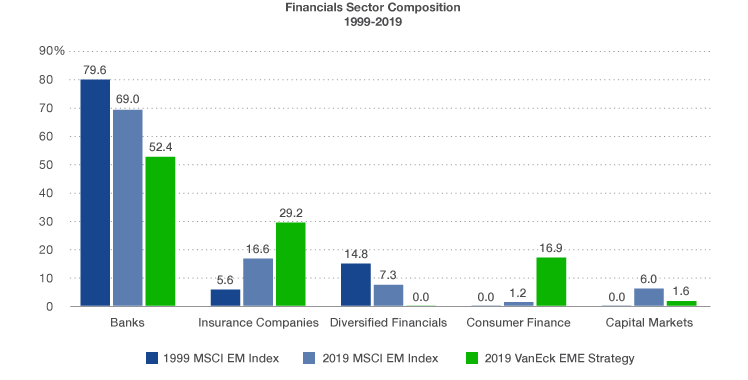
Source: Bloomberg, FactSet. Data as of 31/12/1999 and 31/10/2019. Diversified Financials also include Industrial Conglomerates and Thrifts & Mortgage Finance.
Our Approach to Financials
When investing in the Financials sector, the VanEck Emerging Markets Equity Strategy primarily focuses on Micro Finance, Insurance and high quality Consumer Banks. Our companies specialize in the following services, among others: consumer lending, life and health insurance, credit cards, savings, mortgages and auto financing. We buy and hold high conviction names in this space because we believe that these investment opportunities represent visible and persistent growth that will survive and thrive in a rapidly changing asset class. The structural growth, domestic demand and consumer-led themes that we look for in emerging markets companies are: lift at the bottom of the socio-economic pyramid, growing middle class and increase in the market penetration.

Source: FactSet. As of 31/10/2019.
Inside the Financials Sector: EME Portfolio Stock Examples
Our investment approach and decision-making are 100% driven by the companies that we invest in. Below please find examples of three Financials currently included in our portfolio – Bank Tabungan Pensiunan Nasional Syariah (“BTPS”), Ping An Insurance Company of China (“Ping An”) and HDFC Bank Limited (“HDFC”). We believe that each one of these companies is unique and exhibits structural growth at a reasonable price (“S GARP”) characteristics that we seek to identify and invest in across emerging markets around the world.
Micro Lending: BTPS is empowering rural impoverished women in Indonesia
Why we invest in this company:
- BTPS has a low-risk business model that lends to groups of impoverished women who co-underwrite each other.
- It has high social impact, allowing these women to own and manage micro businesses where working capital would typically be unavailable to them.
- The company forecasts minimum lending growth of 20% from structurally growing market penetration over the next five-seven years.
- It maintains high and persistent ROE, a secondary structural driver.
- Low and persistent non-performing loans result in a lower risk profile than most MSCI EM Index financials.
Insurance: Ping An is an innovative provider of life and non-life insurance in China
Why we invest in this company:
- Insurance tends to follow general/structural middle class consumption trends in emerging markets, especially in China.
- Ping An has scale, product superiority and technology moats compared to most SOE competitors.
- Technology leadership has accelerated growth and enabled complimentary new business verticals to leverage/cross sell their 500 million active customers.
- We perceive regulatory constraints to be a low risk to this business.
High Quality Consumer Bank: HDFC is leveraging the structurally growing and emerging consumer with massive visible runway to growth in India.
Why we invest in this company:
- Secured and unsecured consumer lending tends to be less risky and grow structurally in emerging markets (e.g. mortgages, credit cards, etc.).
- HDFC is good at both lending money and, more importantly, getting it back. Credit costs are structurally low.
- As India formalizes and digitizes, use of formal banking products is expected to grow substantially.
- Technology, product and pricing advantages should ensure HDFC achieves its structural target of growing customer number from 20 million today to 50 million in five years.
Informations importantes
À des fins d’information et de publicité uniquement.
Ces informations proviennent de VanEck (Europe) GmbH qui a été désignée comme distributeur des produits VanEck en Europe par la société de gestion VanEck Asset Management B.V., de droit néerlandais et enregistrée auprès de l’Autorité néerlandaise des marchés financiers (AFM). VanEck (Europe) GmbH, dont le siège social est situé Kreuznacher Str. 30, 60486 Francfort, Allemagne, est un prestataire de services financiers réglementé par l’Autorité fédérale de surveillance financière en Allemagne (BaFin). Les informations sont uniquement destinées à fournir des informations générales et préliminaires aux investisseurs et ne doivent pas être interprétées comme des conseils d’investissement, juridiques ou fiscaux. VanEck (Europe) GmbH et ses sociétés associées et affiliées (ensemble « VanEck ») n’assument aucune responsabilité en ce qui concerne toute décision d’investissement, de cession ou de rétention prise par l’investisseur sur la base de ces informations. Les points de vue et opinions exprimés sont ceux du ou des auteurs, mais pas nécessairement ceux de VanEck. Les avis sont à jour à la date de publication et sont susceptibles d’être modifiés en fonction des conditions du marché. Certains énoncés contenus dans les présentes peuvent constituer des projections, des prévisions et d’autres énoncés prospectifs qui ne reflètent pas les résultats réels. Les informations fournies par des sources tierces sont considérées comme fiables et n’ont pas été vérifiées de manière indépendante pour leur exactitude ou leur exhaustivité et ne peuvent être garanties. Tous les indices mentionnés sont des mesures des secteurs et des performances du marché commun. Il n’est pas possible d’investir directement dans un indice.
Toutes les informations sur le rendement sont historiques et ne garantissent pas les résultats futurs. L’investissement est soumis à des risques, y compris la perte possible du capital. Vous devez lire le Prospectus et le DICI avant d’investir.
Aucune partie de ce matériel ne peut être reproduite sous quelque forme que ce soit, ou mentionnée dans toute autre publication, sans l’autorisation écrite expresse de VanEck.
© VanEck (Europe) GmbH
Related Insights

Related Insights

11 décembre 2025

13 novembre 2025

26 août 2025
11 décembre 2025
13 novembre 2025
26 août 2025

18 juillet 2025