Bienvenue chez VanEck
Sélectionnez le type d’investisseur
16 November 2020
We wrote last month about the attractive yield pickup that onshore Chinese bonds currently offer versus U.S. and developed markets fixed income, which is particularly striking given several technical and fundamental tailwinds impacting the asset class. Like many non-U.S. dollar investments, particularly in emerging markets, investors need to consider not only the yield level but also the potential for currency appreciation or depreciation. Local currency emerging markets bonds have historically provided several tactical opportunities to take advantage of bouts of U.S. dollar weakness over the past five years, but overall currency movements have detracted from total return. We believe that the Chinese yuan (CNY), however, should not be grouped into the broad category of emerging markets currencies (EMFX) and has several characteristics that set it apart, potentially making exposure attractive to global bond investors—even those wary of EMFX volatility. These characteristics may also help China’s onshore bonds improve the risk-return profile of broad emerging markets local currency debt allocations.
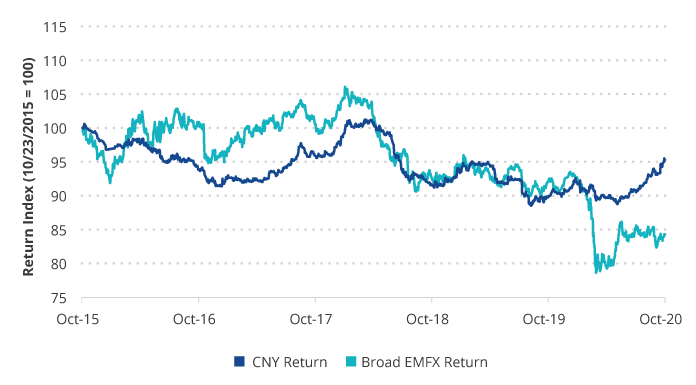
Source: J.P. Morgan and VanEck as of 26/10/2020. Broad EMFX is represented by the foreign currency return of the J.P. Morgan GBI-EM Global Diversified Index.
Looking at the chart above, CNY has been less volatile and displayed greater resiliency than the basket of currencies that represent broad emerging markets exposure. In fact the correlation between the CNY and this basket has been historically low, at only 20%.1 CNY’s value is determined through a managed rate pegged to a basket of currencies, and is only allowed to move within a narrow band on a daily basis. This has reduced the currency’s volatility, but longer term the currency’s value should generally reflect fundamentals. Even with the recent removal of the “countercyclical adjustment,” there are many factors that we believe provide long term support.
Strong and resilient economic growth, particularly this year, has been a key driver of CNY strength relative to the U.S. dollar and in contrast to the weakness experienced by other more vulnerable emerging markets. More broadly, China’s massive economy and role in driving global growth set it apart from other emerging markets. Although no currency can match the U.S. dollar in terms of its role in the global economy, the CNY is growing in importance. It now makes up approximately 2% of foreign exchange reserve assets and that is expected to grow to up to 10% by 2030, according to Morgan Stanley. That will make it the third largest reserve currency, behind the U.S. dollar and euro. As China’s economy continues its transformation into a more consumer led economy that is less dependent on lower value exports, policymakers have also continued the gradual opening of onshore markets to foreign investment. As China’s weight in global bond and equity indices continues to increase, foreign investor flows may provide further support to the CNY. Note in the chart above that, despite the improving fundamental and technical stories, the currency is still 5% weaker versus the U.S. dollar than it was just two-and-a-half years ago.
In the context of a portfolio or index of emerging markets local currency bonds, China’s onshore bonds’ growing weight may act as a stabilizer in future periods of U.S. dollar strength. With less than half the volatility and a low correlation with the broader EMFX universe, CNY exposure can provide valuable diversification benefits and relative stability within a portfolio while also still providing an attractive yield pickup.
1 Source: Bloomberg. Data as of 31/10/2020.
À des fins d’information et de publicité uniquement.
Ces informations proviennent de VanEck (Europe) GmbH qui a été désignée comme distributeur des produits VanEck en Europe par la société de gestion VanEck Asset Management B.V., de droit néerlandais et enregistrée auprès de l’Autorité néerlandaise des marchés financiers (AFM). VanEck (Europe) GmbH, dont le siège social est situé Kreuznacher Str. 30, 60486 Francfort, Allemagne, est un prestataire de services financiers réglementé par l’Autorité fédérale de surveillance financière en Allemagne (BaFin). Les informations sont uniquement destinées à fournir des informations générales et préliminaires aux investisseurs et ne doivent pas être interprétées comme des conseils d’investissement, juridiques ou fiscaux. VanEck (Europe) GmbH et ses sociétés associées et affiliées (ensemble « VanEck ») n’assument aucune responsabilité en ce qui concerne toute décision d’investissement, de cession ou de rétention prise par l’investisseur sur la base de ces informations. Les points de vue et opinions exprimés sont ceux du ou des auteurs, mais pas nécessairement ceux de VanEck. Les avis sont à jour à la date de publication et sont susceptibles d’être modifiés en fonction des conditions du marché. Certains énoncés contenus dans les présentes peuvent constituer des projections, des prévisions et d’autres énoncés prospectifs qui ne reflètent pas les résultats réels. Les informations fournies par des sources tierces sont considérées comme fiables et n’ont pas été vérifiées de manière indépendante pour leur exactitude ou leur exhaustivité et ne peuvent être garanties. Tous les indices mentionnés sont des mesures des secteurs et des performances du marché commun. Il n’est pas possible d’investir directement dans un indice.
Toutes les informations sur le rendement sont historiques et ne garantissent pas les résultats futurs. L’investissement est soumis à des risques, y compris la perte possible du capital. Vous devez lire le Prospectus et le DICI avant d’investir.
Aucune partie de ce matériel ne peut être reproduite sous quelque forme que ce soit, ou mentionnée dans toute autre publication, sans l’autorisation écrite expresse de VanEck.
© VanEck (Europe) GmbH

19 janvier 2026

11 décembre 2025

13 novembre 2025
19 janvier 2026
11 décembre 2025
13 novembre 2025

26 août 2025