A Milder Growth Slowdown?
16 December 2022
Read Time 2 MIN
DM Rate Hikes
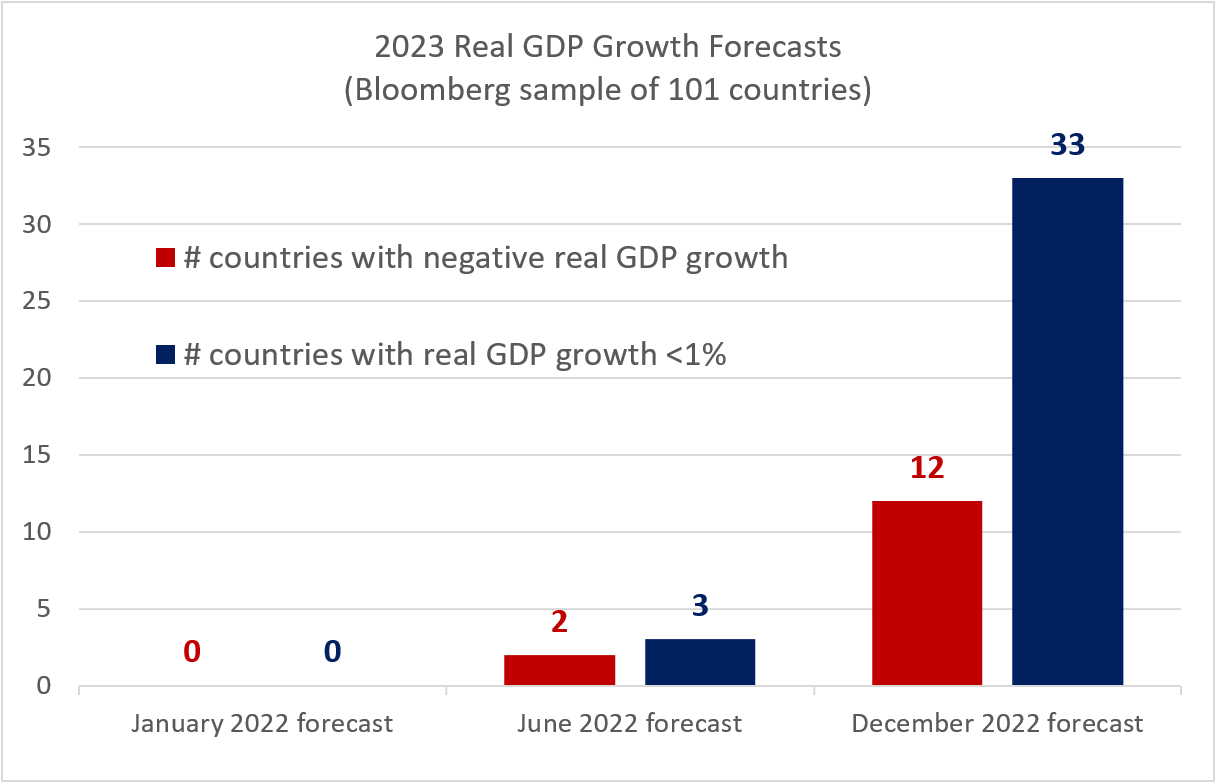
The consensus global growth outlook is quite bleak – according to the Bloomberg pool of forecasters, about 1/3 of countries will grow by less than 1% next year (see chart below). This is a very big increase from only three countries back in June. Elevated recession risks are one of the reasons why the market is not fully convinced about the extent of additional policy tightening in developed markets (DM) – despite major central banks’ hawkish messaging. The U.S. peak policy rate implied by Fed Funds Futures is still below 5%, and even though the implied ECB peak rate went up after this week’s meeting, it is still well below the previous high of 3.65%. Today’s preliminary activity gauges in Europe signaled that the slowdown might be milder than expected, but the U.S. PMIs (Purchasing Managers Indices) surprised significantly to the downside, moving deeper into the contraction zone and weighing on the rates expectations.
EM Tightening Cycles
The growth outlook for most emerging markets (EMs) is not amazing either, but disinflation is getting more entrenched, and this should allow to safely slow the pace rate hikes and possibly open room for rate cuts in order to prop up growth going forward. Some central banks are better positioned to do this than others – they started tightening earlier and government policies (especially fiscal) are less problematic. The Mexican central bank delivered a smaller 50bps hike yesterday, and the local swap curve now prices in only 85bps of additional tightening before reaching the peak rate in Q1-2023. The Colombian central bank, however, is under more pressure to keep frontload rate hikes due to higher inflation risks (headline inflation accelerated more than expected in November to 12.53% year-on-year), questionable policy signals from the government, and a large “twin” deficit (a sum of fiscal and current account balances). The consensus sees another 100bps hike in Colombia this afternoon.
EM Disinflation
The inflation/growth policy trade-off might be particularly difficult in Central Europe. Poland, Hungary, and the Czech Republic are likely to grow by less than 1% next year, but headline inflation is still in double digits. An additional complication is that core price pressures – which should be less dependent on external shocks - are also quite persistent. Poland’s core inflation exceeds expectations once again in November, accelerating to 11.4% year-on-year. The market continues to believe that all three central banks will be able to stay on hold, avoiding “emergency” hikes. The question is whether local bonds – which staged a nice comeback in Q4 – will agree with this narrative. Stay tuned!
Chart at a Glance: More Countries Growing By Less Than 1% Next Year
Source: Bloomberg LP
Related Insights

IMPORTANT DEFINITIONS & DISCLOSURES
This material may only be used outside of the United States.
This is not an offer to buy or sell, or a recommendation of any offer to buy or sell any of the securities mentioned herein. Fund holdings will vary. For a complete list of holdings in VanEck Mutual Funds and VanEck ETFs, please visit our website at www.vaneck.com.
The information presented does not involve the rendering of personalized investment, financial, legal, or tax advice. Certain statements contained herein may constitute projections, forecasts and other forward looking statements, which do not reflect actual results. Information provided by third-party sources are believed to be reliable and have not been independently verified for accuracy or completeness and cannot be guaranteed. Any opinions, projections, forecasts, and forward-looking statements presented herein are valid as of the date of this communication and are subject to change without notice. The information herein represents the opinion of the author(s), but not necessarily those of VanEck.
The views contained herein are not to be taken as advice or a recommendation to buy or sell any investment in any jurisdiction, nor is it a commitment from Van Eck Associates Corporation or its subsidiaries to participate in any transactions in any companies mentioned herein. This content is published in the United States. Investors are subject to securities and tax regulations within their applicable jurisdictions that are not addressed herein.
All investing is subject to risk, including the possible loss of the money you invest. As with any investment strategy, there is no guarantee that investment objectives will be met and investors may lose money. Diversification does not ensure a profit or protect against a loss in a declining market. Past performance is no guarantee of future results.