Markets and Mandates
19 December 2022
Read Time 2 MIN
EM Local Debt and Politics
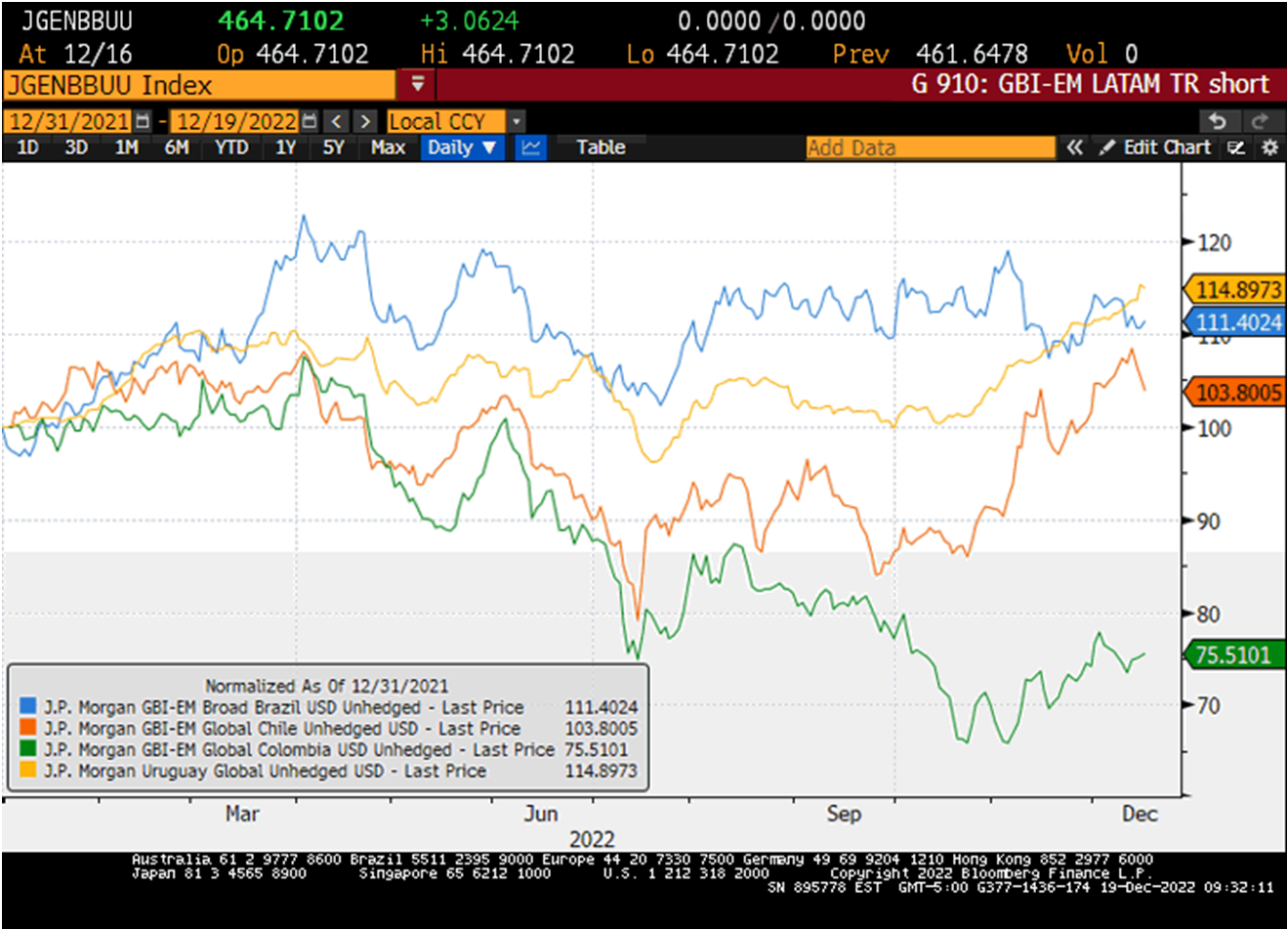
Policy agendas can separate winners from losers in financial markets – and not just in emerging markets (EM) (August-September mini-crisis in the U.K. is a good example). Investors’ perceptions about the shifting policy direction played a big role in LATAM’s Fixed Income space this year – including Chile’s rebound after the benign referendum outcome, Brazil’s pause after the presidential runoff, and Colombia’s failure to recover after the elections and massive underperformance vs. the rest of the region (see chart below). And the latest news flow raises a lot of questions about the 2023 outlook. In Brazil, President-elect’s spending plans and cabinet appointments led to a significant widening of the 2023 consensus budget deficit forecast (to 8.3% of GDP), which can lead to higher bond issuance and less room for central banks’ rate cuts. Peru’s never-ending government reshuffles distract from key structural reforms, putting more pressure on the central bank to act as the only adult in the room.
EM Debt Sustainability
Not all “policy mandate” stories are glum. The South African rand staged a nice rally in the morning trade, following President Cyril Ramaphosa’s re-election as the African National Congress (ANC) leader. The fact that Ramaphosa’s victory margin was broader than expected led to suggestions about a stronger reform mandate going forward. This would be a much-needed development, as the market is still uncertain about the pace of fiscal adjustment and debt sustainability – the consensus sees very limited improvement in the 2023 budget deficit, and this can weigh on South Africa’s local debt performance, despite its high yield.
China Reopening, Policy Stimulus
China’s zero-COVID/real estate policy U-turn also did not go unnoticed by the market – J.P. Morgan’s CEMBI High Yield+ China Index returned 66% since November 3. The key message from the Central Economic Work Conference was encouraging, especially as regards regulations (pro-growth) and on-going policy support. We also keep an eye on efforts to prop up domestic demand and consumption – these were mentioned, but a sustained turnaround would be condition on successful reopening. China’s activity gauges for December should give us the first “taste” of the economy’s response to lifting the COVID restrictions. Stay tuned!
Chart at a Glance: LATAM Fixed Income - Diverging Performance
Source: Bloomberg LP
Related Insights

IMPORTANT DEFINITIONS & DISCLOSURES
This material may only be used outside of the United States.
This is not an offer to buy or sell, or a recommendation of any offer to buy or sell any of the securities mentioned herein. Fund holdings will vary. For a complete list of holdings in VanEck Mutual Funds and VanEck ETFs, please visit our website at www.vaneck.com.
The information presented does not involve the rendering of personalized investment, financial, legal, or tax advice. Certain statements contained herein may constitute projections, forecasts and other forward looking statements, which do not reflect actual results. Information provided by third-party sources are believed to be reliable and have not been independently verified for accuracy or completeness and cannot be guaranteed. Any opinions, projections, forecasts, and forward-looking statements presented herein are valid as of the date of this communication and are subject to change without notice. The information herein represents the opinion of the author(s), but not necessarily those of VanEck.
The views contained herein are not to be taken as advice or a recommendation to buy or sell any investment in any jurisdiction, nor is it a commitment from Van Eck Associates Corporation or its subsidiaries to participate in any transactions in any companies mentioned herein. This content is published in the United States. Investors are subject to securities and tax regulations within their applicable jurisdictions that are not addressed herein.
All investing is subject to risk, including the possible loss of the money you invest. As with any investment strategy, there is no guarantee that investment objectives will be met and investors may lose money. Diversification does not ensure a profit or protect against a loss in a declining market. Past performance is no guarantee of future results.