Welcome to VanEck
Select Investor Type
20 July 2026
When VanEck launched the VanEck Quantum Computing UCITS ETF (QNTM), Europe's first quantum computing UCITS ETF, a little over a year ago in May 2025, listed quantum computing was still a narrow field with only a handful of investable names. One year on, it looks rather different. Over the past twelve months the sector passed its first major revenue threshold, drew direct government backing, and, most visibly, saw a wave of companies move from private funding rounds onto public exchanges. Quantum computing has not become a finished technology, and its commercial success remains uncertain. But it has started to behave less like a research programme and more like an emerging industry. As the opportunity set has broadened, the fund has grown to above $850 million in assets, though fund size can rise or fall and is not an indicator of performance1.
21 May 2025 – 30 Jun 2026. Past performance is no indication for future performance
| 1 MO* | 3 MO* | YTD* | 1 YR (1 Jul 2025 – 30 Jun 2026) | Since Inception (21 May 2025 – 30 Jun 2026) | |
| VanEck Quantum Computing UCITS ETF | -9.07% | 36.33% | 22.21% | 43.70% | 50.39% |
Source: VanEck, as of June 30th 2026. Past performance is no indication for future performance. Investing is subject to risk, including the possible loss of principal. You must read the Prospectus and KID before investing, which are available at the Document section of the fund on www.vaneck.com.
Commercial signals arrived through the year, with aggregate revenue across quantum computing companies crossing the $1 billion mark for the first time, indicating a gradual shift from exploration toward paid, commercial work2. Governments moved in the same direction: in May 2026 the U.S. Department of Commerce announced it would take equity stakes across nine quantum companies as part of a roughly $2 billion package, placing quantum alongside semiconductors as a declared strategic priority3. Neither development proves the technology has fully arrived, but together they confirm who is funding it: private customers and public institutions are continuing to commit capital to quantum.
The most visible change for investors, though, has been on the exchanges themselves. A year ago, listed pure-play quantum exposure meant a short list of names. Over the past twelve months, QNTM's roster of pure-play holdings has more than doubled from five to eleven, as a wave of companies came to the public markets. What matters is not only the number but the spread. Neutral-atom specialist Infleqtion listed on the NYSE in February 2026, photonic company Xanadu on the Nasdaq and Toronto exchanges in March, and quantum-software firm Horizon Quantum on the Nasdaq in the same month. And in a sign the trend is not solely American, Creotech Quantum was spun off onto the Warsaw Stock Exchange in April4. A small and concentrated set of listed names has become a broad cross-section of the field, spanning trapped ions, superconducting circuits, neutral atoms, photonics, software and post-quantum security. All four were added to QNTM at the Q2 2026 index review in June, increasing the fund's exposure to dedicated quantum operators.
The pace has continued beyond the fund. Two of the sector's most significant listings arrived after the cut-off for the most recent index review and so are not yet held in the ETF: Honeywell-backed Quantinuum completed the first traditional quantum IPO to date on the Nasdaq in June 2026, raising roughly $1.68 billion, and Finland's IQM became the first European quantum company to list on a major U.S. exchange in early July, with a parallel listing in Helsinki5. Others are in the pipeline, with Pasqal and Seeqc both having filed for U.S. listings6. Like many other index-based funds, QNTM adds constituents only at scheduled reviews and according to published eligibility rules, so newly listed companies become candidates for future consideration rather than entering on debut. That measured cadence is itself a discipline, allowing sharp price swings to settle before a stock is considered. The broader point is that the investable universe is widening, and doing so across more than one continent. A larger listed field is also a more competitive one, with more companies now competing both for technological leadership and for investor funding. That competition can support the theme's development, but it can also weigh on individual companies, whose revenues, margins and valuations may come under pressure.
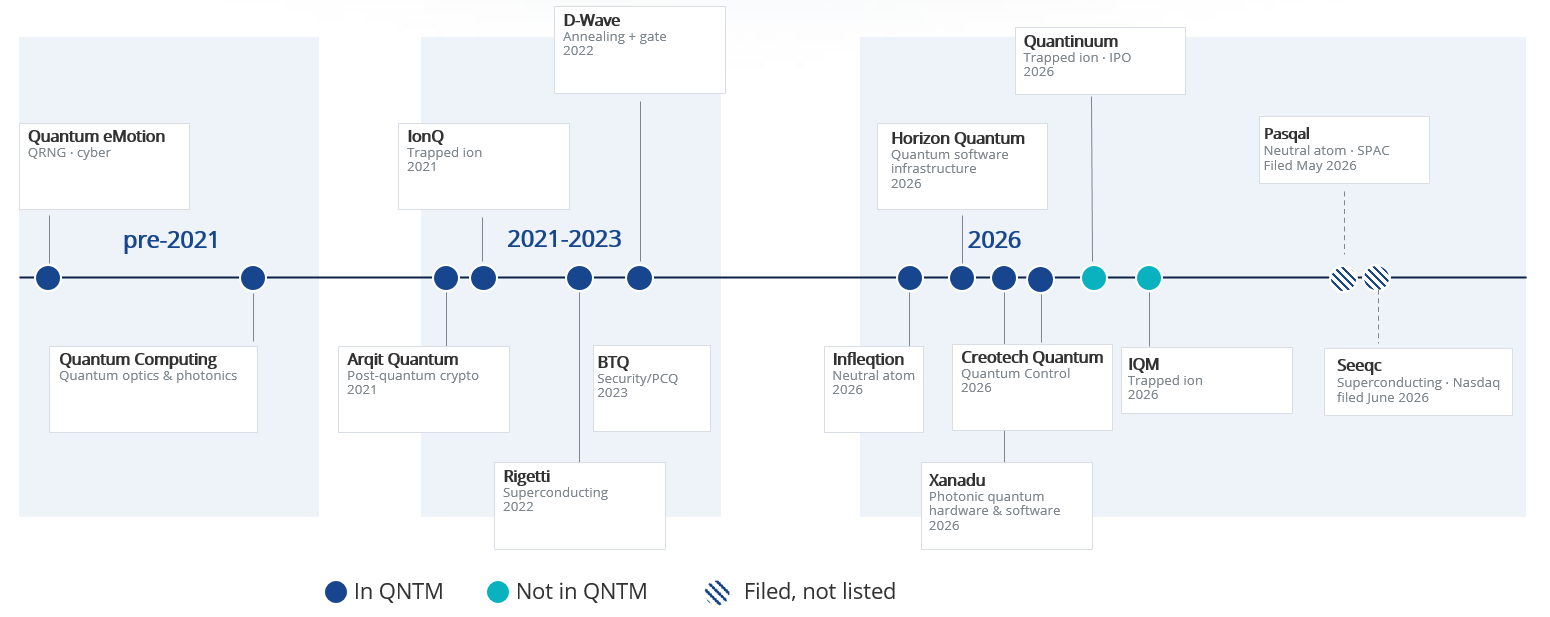
Source: VanEck analysis on IPO & company filings, as at July 2026. For illustrative purposes only.
Quantinuum, IQM, Pasqal and Seeqc are referenced for illustrative purposes only to describe developments in the quantum computing sector. These companies were not held by QNTM at the time of writing. References to specific companies do not constitute a recommendation to buy or sell any security.
For all the market activity, quantum computing remains at its core a scientific endeavour, and its commercial success remains uncertain. The theme's foundations were reinforced in October 2025, when the Nobel Prize in Physics was awarded for the discovery of macroscopic quantum mechanical tunnelling and energy quantisation in an electric circuit, the physics that underpins today's superconducting qubits7. A recognition of that kind speaks to something more durable: the science is advancing, even if the economics are not yet proven. That combination is the essence of an early-stage growth theme, and it is why the associated risks remain high. Most of these companies are lossmaking, their valuations reflect expectations rather than earnings, and their shares have proven highly volatile, capable of large moves on individual headlines.
This helps explain why, beyond the pure-play specialists, established technology leaders anchor quantum research at scale. These are diversified businesses for which quantum is one strand among many, yet which run some of the deepest research programmes in the field: IBM, which began delivering its next-generation Nighthawk processor in early 2026 and is targeting verified quantum advantage by 2026 and fault-tolerant computing by 2029, and Alphabet, whose Willow chip demonstrated what Google described in October 2025 as the first "verifiable" quantum advantage8,9. Looking beyond the pure-players also reflects a practical reality: much of today's progress is funded from the balance sheets of companies that can afford to invest through a long and uncertain development cycle. Milestones and roadmap dates such as IBM's 2026 and 2029 targets are, however, company goals rather than forecasts, and they may be delayed or missed.
What a year of listings changed, then, is less the risk than the visibility. A theme once accessed mainly through private markets and a few proxies is now represented by a broader, more liquid and more transparent set of public companies, spanning focused specialists and deep-pocketed incumbents, and subject to the disclosure that public markets require. That is what starting to grow up looks like: not a theme that has arrived, but one that has become investable in a more considered way. The universe is widening, the science continues to advance, and the story, on the evidence of this year, is still in its early chapters.
1 VanEck. Fund assets and performance as at 30 June 2026; inception 21 May 2025. Performance shown on a NAV basis, in base currency. Past performance is not a reliable indicator of future results.
2 McKinsey & Company. (2026). Quantum Technology Monitor 2026.
3 CNBC. (2026, 21 May). Quantum stocks soar as U.S. plans $2 billion in funding and equity stakes.
4 Company Announcements: Infleqtion. (2026, 17 February), Xanadu Quantum Technologies. (2026, 26 March), Horizon Quantum. (2026, 20 March), Creotech Instruments. (2026, 17 April)
5 Quantinuum. (2026, 4 June), IQM (2026, 2 July)
6 Pasqal/Seeqc. (May & June 2026)
7 The Royal Swedish Academy of Sciences / NobelPrize.org. (2025). The Nobel Prize in Physics 2025.
8 Google Quantum AI. (2025, October 22). Our Quantum Echoes algorithm is a big step toward real-world applications for quantum computing
9 IBM. (2025, 12 November). Quantum Developer Conference. IBM Newsroom
IMPORTANT INFORMATION
This is marketing communication.
This information originates from VanEck (Europe) GmbH, which is authorized as an EEA investment firm under the Markets in Financial Instruments Directive (“MiFiD”). VanEck (Europe) GmbH has its registered address at Kreuznacher Str. 30, 60486 Frankfurt, Germany, and has been appointed as distributor of VanEck products in Europe by the Management Company, VanEck Asset Management B.V.(“ManCo”), which is incorporated under Dutch law and registered with the Dutch Authority for the Financial Markets (AFM).
This material is only intended for general and preliminary information and does not constitute an investment, legal or tax advice. No representation or warranty is made as to the accuracy or completeness of the information and no liability is accepted to the fullest extent permitted by law.
The views and opinions expressed are those of the author(s) but not necessarily those of VanEck. Opinions are current as of the publication date and are subject to change with market conditions. Information provided by third party sources is believed to be reliable and has not been independently verified for accuracy or completeness and cannot be guaranteed.
Please refer to the Prospectus – in English language - and the KID/KIID - in local language - before making any final investment decisions and for full information on risks. These documents can be obtained free of charge at www.vaneck.com, from the ManCo or from the appointed facility agent.
VanEck Quantum Computing UCITS ETF ("ETF") is a sub-fund of VanEck UCITS ETFs plc, a UCITS umbrella investment company, registered with the Central Bank of Ireland, passively managed and tracking an equity index.
The value of the ETF may fluctuate significantly as a result of the investment strategy. The ETF´s holdings are disclosed on each dealing day on www.vaneck.com under the ETF´s Holdings section and as per PCF under the Documents section and published via one or more market data suppliers. The indicative net asset value (iNAV) of the ETF is available on Bloomberg. For details on the regulated markets where the ETF is listed, please refer to the Trading Information section on the ETF page at www.vaneck.com. Investors must buy and sell units of the UCITS on the secondary market via an intermediary (e.g. a broker) and cannot usually be sold directly back to the UCITS. Brokerage fees may incur. The buying price may exceed, or the selling price may be lower than the current net asset value. The portfolio holdings are also regularly published on the website. Investing in the ETF should be interpreted as acquiring shares of the ETF and not the underlying assets. Tax treatment depends on the personal circumstances of each investor and may vary over time. The ManCo may terminate the marketing of the ETF in one or more jurisdictions. The summary of the investor rights is available in English at: summary-of-investor-rights.pdf.
The MarketVector™ Global Quantum Leaders Index is the exclusive property of MarketVector Indexes GmbH (a wholly owned subsidiary of Van Eck Associates Corporation), which has contracted with Solactive AG to maintain and calculate the Index. Solactive AG uses its best efforts to ensure that the Index is calculated correctly. Irrespective of its obligations towards MarketVector Indexes GmbH (“MarketVector”), Solactive AG has no obligation to point out errors in the Index to third parties. VanEck’s ETF is not sponsored, endorsed, sold or promoted by MarketVector and MarketVector makes no representation regarding the advisability of investing in the ETF. It is not possible to invest directly in an index.
Source: VanEck. Performance quoted represents past performance. Current performance may be lower or higher than average annual returns shown. Performance data for the Irish domiciled ETFs is displayed on a Net Asset Value basis, in Base Currency terms, with net income reinvested, net of fees. Returns may increase or decrease as a result of currency fluctuations. Performance should be assessed over a medium- to long-term.
Investing is subject to risk, including the possible loss of principal. For any unfamiliar technical terms, please refer to ETF Glossary | VanEck.
No part of this material may be reproduced in any form, or referred to in any other publication, without express written permission of VanEck.
© VanEck (Europe) GmbH
This is a marketing communication. Please refer to the prospectus of the UCITS and to the KID before making any final investment decisions.
This information originates from VanEck (Europe) GmbH, which has been appointed as distributor of VanEck products in Europe by the Management Company VanEck Asset Management B.V., incorporated under Dutch law and registered with the Dutch Authority for the Financial Markets (AFM). VanEck (Europe) GmbH with registered address at Kreuznacher Str. 30, 60486 Frankfurt, Germany, is a financial services provider regulated by the Federal Financial Supervisory Authority in Germany (BaFin).
The information is intended only to provide general and preliminary information to investors and shall not be construed as investment, legal or tax advice VanEck (Europe) GmbH, VanEck Switzerland AG, VanEck Securities UK Limited and their associated and affiliated companies (together “VanEck”) assume no liability with regards to any investment, divestment or retention decision taken by the investor on the basis of this information. The views and opinions expressed are those of the author(s) but not necessarily those of VanEck. Opinions are current as of the publication date and are subject to change with market conditions. Certain statements contained herein may constitute projections, forecasts and other forward-looking statements, which do not reflect actual results. Information provided by third party sources is believed to be reliable and have not been independently verified for accuracy or completeness and cannot be guaranteed. Brokerage or transaction fees may apply.
All performance information is based on historical data and does not predict future returns. Investing is subject to risk, including the possible loss of principal.
No part of this material may be reproduced in any form, or referred to in any other publication, without express written permission of VanEck.
© VanEck (Europe) GmbH / VanEck Asset Management B.V.