Welcome to VanEck
Select Investor Type
26 October 2026
Many semiconductor allocations today are concentrated in US and Taiwanese companies, capturing the design and fabrication layers of the global supply chain. But a separate semiconductor ecosystem is taking shape in China, and conventional allocations may be missing it.
Driven by sovereign capital and structural forces that have strengthened over the past several years, China is building a domestic semiconductor industry spanning chip design, manufacturing, equipment and packaging. For investors, that may mean exposure to companies that are largely absent from traditional semiconductor allocations.
The VanEck China Semiconductor UCITS ETF (SMHC) is designed to access that opportunity directly. It tracks the MarketVector China Semiconductor 10% Capped Screened Index (MVSMCC), which targets 25 of the largest and most liquid Chinese companies across the semiconductor value chain, from design and manufacturing to advanced packaging. These companies carry limited weight in conventional semiconductor and broad China equity strategies, which gives this exposure a distinct profile relative to many portfolios.
The scale of this ambition is perhaps best illustrated by Huawei. Despite being added to the US Entity List in 20191, Huawei has continued to develop its own semiconductor capabilities through its HiSilicon chip design unit. Huawei is privately held and not directly investable. However, its trajectory may reflect the broader push across China’s semiconductor industry, and the companies supplying that industry are publicly traded.
The investment case rests on three reinforcing forces: the scale of China’s domestic semiconductor build-out, the push for localization that US export controls may have created, and the sovereign capital backing the effort. Together they may make this a multi-year build-out rather than a passing cycle. However, the theme could prove also short-lived as the success depends on how execution, valuation and geopolitical risks materialize.
Semiconductors are the foundational building blocks of every electronic device, from smartphones to data centers to cars, and China sits at the center of this global industry both as a consumer and, increasingly, as a producer.
In 2025, China was the world’s single largest spender on semiconductor manufacturing equipment, at $49.3 billion or roughly 36% of the global total of $135.1 billion2. This reflects how much fabs are spending on the physical tools used to build chips, including lithography systems, etch tools and deposition equipment. It is a measure of where the industry’s infrastructure is being constructed, and the largest share is in China.
China Leads 2025 Spend on Semiconductor Manufacturing Equipment
Source: SEMI (2026). Worldwide semiconductor equipment market statistics, full-year 2025, as of April 2026. Chart for illustrative purposes only. Not intended as a forecast or prediction of future results.
That level of investment points to a deliberate national priority. China sits at the center of the global industry as the world’s consumer electronics hub, with about one-third of all semiconductor devices used in electronics systems assembled there3, but its domestic production has historically fallen well short of that demand. Closing that gap has become a strategic priority as policy makers seek to reduce reliance on foreign technology.
Understanding how the U.S. and Chinese semiconductor ecosystems differ structurally helps illustrate why this opportunity is distinct from existing semiconductor allocations.
The U.S. model is built around design concentration and manufacturing outsourcing. A small number of dominant fabless companies, including Nvidia, Qualcomm, Broadcom, and AMD, design the world’s most advanced chips and outsource their fabrication to foundries in Taiwan, primarily TSMC. The equipment those foundries use comes largely from U.S. and European suppliers, while packaging and testing happens across Asia. The U.S. captures significant value in the design layer but is structurally dependent on foreign manufacturing for everything downstream4.
China is building something different. Rather than specializing in one layer of the stack, China is constructing every layer simultaneously and domestically, covering fabless design, foundry capacity, manufacturing equipment and advanced packaging4. The goal, as articulated through state policy, is greater self-sufficiency across the semiconductor supply chain5. That goal remains distant, and execution risk is significant.
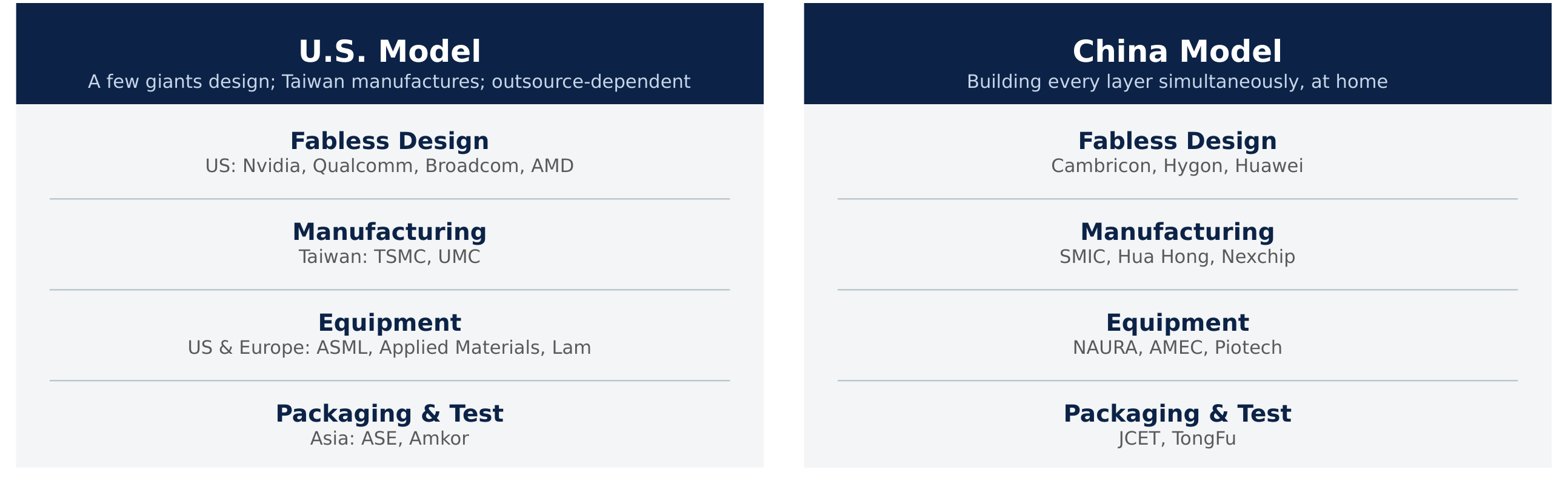
Source: TrendForce. (2026); TechInsights. (2026). China semiconductor value-chain analysis. Company names illustrate each value-chain layer and are not recommendations. Holdings may vary. Huawei is privately held and not investable.
The practical implication is that these are two largely separate groups of companies. An investor who holds conventional semiconductor exposure may hold few or none of the Chinese companies capturing this domestic build-out.
The relationship between US export controls and China’s semiconductor investment is one of the more counterintuitive dynamics in markets today. The conventional expectation would be that restrictions slow China’s development. The data so far point in a different direction.
Since 2019, the U.S. has progressively tightened controls on the technology China can access, including adding Huawei and SMIC to the Entity List1. This expanded in October 2022 with sweeping controls on advanced chip exports and semiconductor manufacturing equipment. The U.S. then coordinated with the Netherlands and Japan to restrict ASML and Tokyo Electron equipment sales in 2023, before expanding controls further in 2024 and 2025. Over the same period, China’s equipment spending rose from about $13 billion in 2019 to about $49 billion in 20252. The path was not linear, as spending dipped slightly in 2022 and was flat in 2025. The data may suggest that restrictions increased the incentive for Chinese companies to localize the supply chain.
China’s Equipment Spending Grew as Export Controls Expanded
China’s semiconductor-equipment spending, 2019-2025 (US$ bn)
Source: Spending data: SEMI (2026). Export-control timeline: U.S. Bureau of Industry and Security. (2022-2025). Export-control rules on advanced computing and semiconductor items. U.S. Department of Commerce; Center for Strategic and International Studies. (2025); Congressional Research Service. (2025). For illustrative purposes only.
Terms: BIS (Bureau of Industry and Security) is the US export control authority. HBM (High Bandwidth Memory) is a type of fast memory used in AI chips. FDPR (Foreign Direct Product Rule) is a US rule that applies export controls to certain foreign-made products that use US technology.
The mechanism is straightforward. Each restriction may create a procurement incentive that could benefit a local provider. Chinese fabs that can no longer source etch and deposition tools from Applied Materials or Lam Research may source from NAURA. Chinese data centers that cannot purchase Nvidia GPUs may source from Huawei or Cambricon. Every foreign supplier locked out of the Chinese market may create a potential customer for a domestic Chinese company. It is important to highlight that potential changes in restrictions create uncertainty for investors, and may also influence demand for domestic Chinese suppliers.
Foreign Supplier Restrictions Create Domestic Beneficiaries
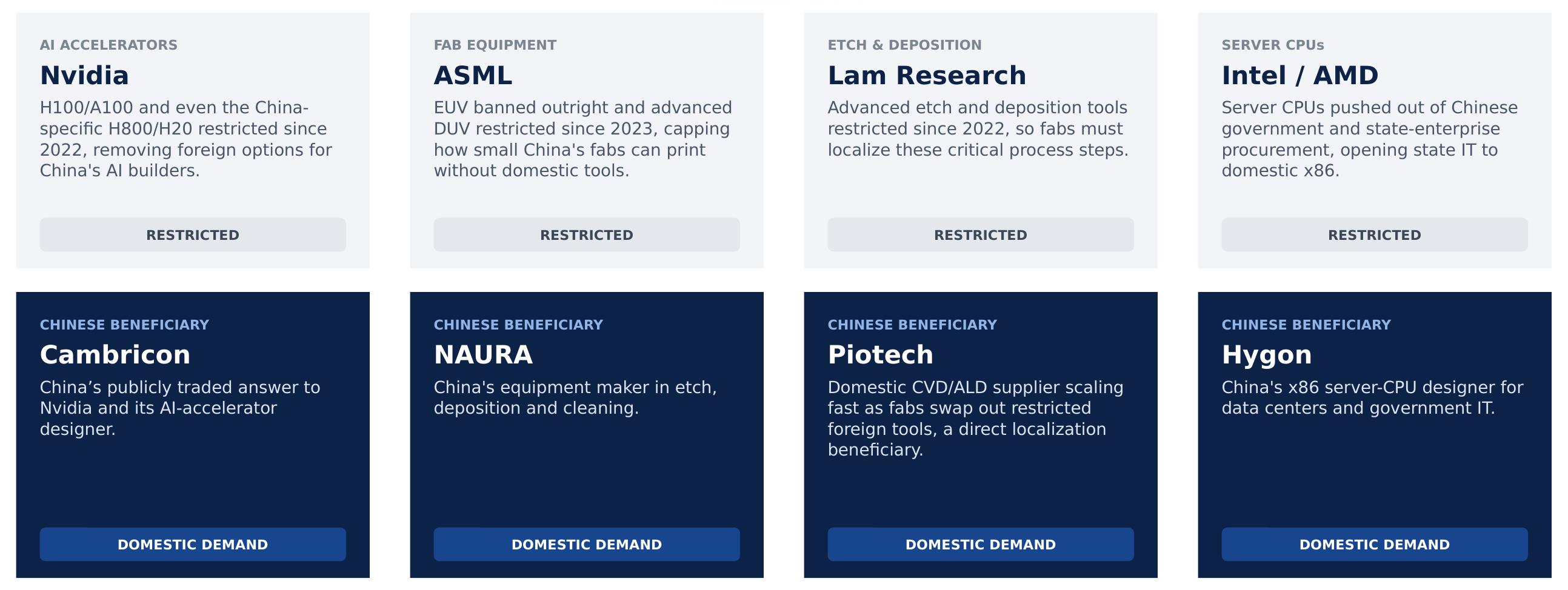
Source: Company annual reports (FY2024-FY2025); U.S. Bureau of Industry and Security. (2022-2025). For illustrative purposes only. Companies shown are examples only. Business models and export controls may change. Not recommendations to buy or sell any security.
Terms: EUV (Extreme Ultraviolet lithography) is the most advanced technology for printing the smallest chip circuits. DUV (Deep Ultraviolet lithography) is an older printing technology that can reach small circuits only with extra process steps. CVD/ALD (Chemical Vapor Deposition and Atomic Layer Deposition) are processes that apply ultra-thin layers of material onto chips.
Underpinning China’s build-out is a level of state financial commitment that stands out in scale compared with Western industrial policy.
China’s National IC Fund has committed approximately $98 billion of registered capital across three phases since 2014 (converted at each phase’s exchange rate), including $47.5 billion for Phase III, registered in May 20245. That capital is deployed through directed procurement, subsidized fab construction, and preferential financing from state banks. The scale is significant, but so are the structural risks. State-directed investment at this magnitude can lead to overcapacity and boom-bust cycles, and below-market financing can sustain uneconomic capacity over time.
The contrast with U.S. industrial policy is meaningful. The CHIPS Act appropriated $52.7 billion in 2022, of which $39 billion was earmarked for manufacturing incentives. Direct funding was expected to cover 5 to 15% of a project’s capital expenditures, and total incentives, including loans, were not expected to exceed 35%, so awardees must fund the remainder privately6. Funds are disbursed as projects reach agreed milestones, and Commerce may demand recovery if a project is not completed by an agreed date. As of July 15, 2026, Commerce had awarded approximately $31.7 billion in direct funding across 49 projects, and about $13.1 billion had been disbursed as of April 20267.
The two approaches differ in scale, structure, and risk profile. China’s capital is larger and faster-moving, while the U.S. model is more conditional and slower to deploy. Both carry real tradeoffs.
SMHC tracks the MarketVector China Semiconductor 10% Capped Screened Index (MVSMCC), a rules-based index designed to provide pure-play exposure to the Chinese semiconductor industry.
Eligibility begins with a revenue purity screen. Companies must be headquartered or incorporated in China or Hong Kong and derive at least 50% of their revenues from semiconductors or semiconductor equipment (25% for current constituents). This is intended to ensure that every constituent is a meaningful participant, rather than a diversified technology conglomerate with incidental chip exposure.
From this universe, 25 companies are selected based on a combination of scale and liquidity, to help keep the portfolio investable. Constituents are weighted using a modified free-float market capitalization approach, with a 10% cap to balance exposure to the largest names with representation across the broader opportunity set. The index is reconstituted semi-annually, in March and September, and rebalanced quarterly.
The index also applies exclusion screens. These cover sanctioned companies, norm-based research, controversial weapons and revenue thresholds for sectors such as tobacco, gambling, military equipment and fossil fuels. The Fund does not have sustainable investment as its investment objective. It applies screenings as defined in the index methodology. Please refer to the sustainability-related disclosures in the Prospectus and KID.
For investors looking for access to China’s domestic semiconductor build-out, the VanEck China Semiconductor UCITS ETF (SMHC) may offer a means of accessing a theme that remains largely absent from traditional semiconductor allocations.
Investing in the ETF involves risk, including the possible loss of principal. The main risks are described below.
Further details on these and other risks are available in the Prospectus and the Key Information Document (KID).
Sources
1 U.S. Bureau of Industry and Security. (2019-2025). Export-control rules on advanced computing and semiconductor items. U.S. Department of Commerce; Center for Strategic and International Studies. (2025); Congressional Research Service. (2025).
2 SEMI. (2026, April). Worldwide Semiconductor Equipment Market Statistics (WWSEMS), full-year 2025.
3 Yole Group. (2025, November). Semiconductor Industry 2025: Worldwide Dynamics and China’s Strategic Rise Unveiled.
4 TrendForce. (2026); TechInsights. (2026). China semiconductor value-chain analysis.
5 State Council of the People’s Republic of China. Guo Fa [2020] No. 8; SASAC. (2022). Document 79; Beijing Municipal Administration for Market Regulation. (2024, May 24). National IC Fund registry filings.
6 CHIPS and Science Act of 2022 (Public Law 117-167); U.S. Department of Commerce Office of Inspector General. Status Report OIG-25-021-I. NIST, CHIPS for America Notice of Funding Opportunity (February 28, 2023).
7 U.S. Government Accountability Office. (2026, August). Semiconductors: Commerce Needs Plan to Meet CHIPS for America R&D Requirements (GAO-26-109121).
IMPORTANT INFORMATION
This is marketing communication.
This information originates from VanEck (Europe) GmbH, which is authorized as an EEA investment firm under the Markets in Financial Instruments Directive (“MiFiD”). VanEck (Europe) GmbH has its registered address at Kreuznacher Str. 30, 60486 Frankfurt, Germany, and has been appointed as distributor of VanEck products in Europe by the Management Company, VanEck Asset Management B.V.(“ManCo”), which is incorporated under Dutch law and registered with the Dutch Authority for the Financial Markets (AFM).
This material is only intended for general and preliminary information and does not constitute an investment, legal or tax advice. No representation or warranty is made as to the accuracy or completeness of the information and no liability is accepted to the fullest extent permitted by law.
The views and opinions expressed are those of the author(s) but not necessarily those of VanEck. Opinions are current as of the publication date and are subject to change with market conditions. Information provided by third party sources is believed to be reliable and has not been independently verified for accuracy or completeness and cannot be guaranteed.
Please refer to the Prospectus – in English language - and the KID/KIID - in local language - before making any final investment decisions and for full information on risks. These documents can be obtained free of charge at www.vaneck.com, from the ManCo or from the appointed facility agent.
VanEck China Semiconductor UCITS ETF (“ETF”) is a sub-fund of VanEck UCITS ETFs plc, a UCITS (a type of EU-regulated investment fund that can be sold to retail investors across the EU) umbrella investment company with limited liability between sub-funds. The ETF is registered with the Central Bank of Ireland, passively managed and tracking an equity index.
The value of the ETF may fluctuate significantly as a result of the investment strategy. The ETF´s holdings are disclosed on each dealing day on www.vaneck.com under the ETF´s Holdings section and as per PCF under the Documents section and published via one or more market data suppliers. The indicative net asset value (iNAV) of the ETF is available on Bloomberg. For details on the regulated markets where the ETF is listed, please refer to the Trading Information section on the ETF page at www.vaneck.com. Investors must buy and sell units of the UCITS on the secondary market via an intermediary (e.g. a broker) and cannot usually be sold directly back to the UCITS. Brokerage fees may incur. The buying price may exceed, or the selling price may be lower than the current net asset value. Investing in the ETF should be interpreted as acquiring shares of the ETF and not the underlying assets. Tax treatment depends on the personal circumstances of each investor and may vary over time. The ManCo may terminate the marketing of the ETF in one or more jurisdictions. The summary of the investor rights is available in English at: summary-of-investor-rights.pdf.
The MarketVector™ China Semiconductor 10% Capped Screened Index is the exclusive property of MarketVector Indexes GmbH (a wholly owned subsidiary of Van Eck Associates Corporation), which has contracted with Solactive AG to maintain and calculate the Index. Solactive AG uses its best efforts to ensure that the Index is calculated correctly. Irrespective of its obligations towards MarketVector Indexes GmbH (“MarketVector”), Solactive AG has no obligation to point out errors in the Index to third parties. VanEck’s ETF is not sponsored, endorsed, sold or promoted by MarketVector and MarketVector makes no representation regarding the advisability of investing in the ETF. It is not possible to invest directly in an index.
Investing is subject to risk, including the possible loss of principal. For any unfamiliar technical terms, please refer to ETF Glossary | VanEck.
No part of this material may be reproduced in any form, or referred to in any other publication, without express written permission of VanEck.
© VanEck (Europe) GmbH
This is a marketing communication. Please refer to the prospectus of the UCITS and to the KID before making any final investment decisions.
This information originates from VanEck (Europe) GmbH, which has been appointed as distributor of VanEck products in Europe by the Management Company VanEck Asset Management B.V., incorporated under Dutch law and registered with the Dutch Authority for the Financial Markets (AFM). VanEck (Europe) GmbH with registered address at Kreuznacher Str. 30, 60486 Frankfurt, Germany, is a financial services provider regulated by the Federal Financial Supervisory Authority in Germany (BaFin).
The information is intended only to provide general and preliminary information to investors and shall not be construed as investment, legal or tax advice VanEck (Europe) GmbH, VanEck Switzerland AG, VanEck Securities UK Limited and their associated and affiliated companies (together “VanEck”) assume no liability with regards to any investment, divestment or retention decision taken by the investor on the basis of this information. The views and opinions expressed are those of the author(s) but not necessarily those of VanEck. Opinions are current as of the publication date and are subject to change with market conditions. Certain statements contained herein may constitute projections, forecasts and other forward-looking statements, which do not reflect actual results. Information provided by third party sources is believed to be reliable and have not been independently verified for accuracy or completeness and cannot be guaranteed. Brokerage or transaction fees may apply.
All performance information is based on historical data and does not predict future returns. Investing is subject to risk, including the possible loss of principal.
No part of this material may be reproduced in any form, or referred to in any other publication, without express written permission of VanEck.
© VanEck (Europe) GmbH / VanEck Asset Management B.V.

25 October 2026
25 October 2026