


The Basics of ETFs
ETFs (exchange-traded funds) offer a diversified investment approach, allowing individuals to access the types of investments once reserved for institutional investors, such as pension funds. Most ETFs are designed to replicate the performance of a market index. This section covers the fundamentals of ETFs.
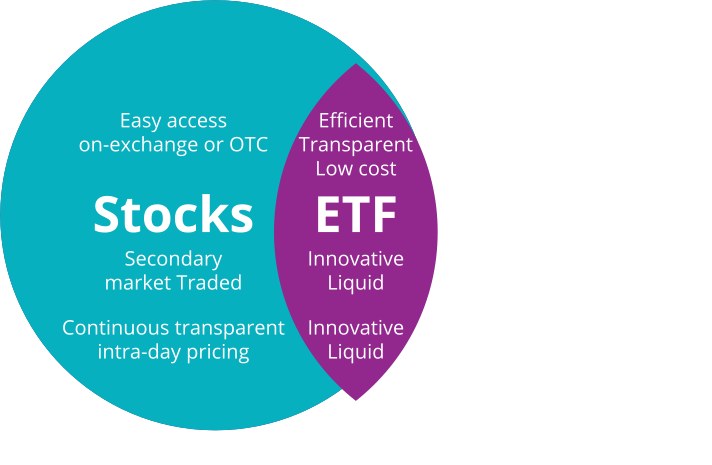
- ETFs - modern investment vehicles: ETFs provide exposure to a diversified portfolio across various indexes and asset classes in a single transaction, regardless of investment size.
- Cost efficiency: ETFs generally have lower management fees than mutual funds, making them cost-effective for investors.
- Liquidity and flexibility: Traded on stock exchanges, ETFs can be bought and sold throughout the trading day, unlike mutual funds, which are typically restricted to end-of-day transactions. This provides flexibility to adapt to market movements in real-time.
- Transparency: ETFs disclose their holdings on a daily basis, ensuring clarity for investors, which helps align investments with personal goals. They also offer full transparency on expenses.
Core Features of Investment Options
Source: VanEck.
The History of ETFs
How ETFs Have Revolutionized the Investment Landscape
Introduced in 1993 in the US, ETFs provide a straightforward way for investors to track indices and achieve diversified exposure. Initially focused on equities, ETFs have expanded to include fixed income, commodities, and even cryptocurrencies like Bitcoin. Since their inception, ETFs have democratized investing, including for younger investors seeking long-term wealth accumulation.
The evolution of ETFs from 1993 to 2024, highlighting key milestones in their development
1993
Launch of the First U.S. ETF
The first U.S. ETF was launched on the American stock market, tracking the S&P 500 index.
1999
UCITS Regulation Introduced
The UCITS framework in Europe set regulatory standards for ETFs across the EU, facilitating cross-border distribution of ETFs.
2000
Launch of the First European ETFs
The first European ETF launched by iShares, marking the entry of ETFs into European markets.
2004
Introduction of the First Commodity ETF
Launched in the U.S., this was the first ETF that offered investors exposure to physical gold through securities.
2005
Launch of the First European Commodity ETF
ETF Securities launched the first commodity ETFs in Europe, offering investors direct access to commodity price movements.
2007
Launch of the First Global Emerging Markets ETF
This ETF gave global investors access to a broad range of emerging markets across multiple continents.
2010
Introduction of Low-Cost ETFs in Europe
Vanguard introduced ETFs to the European market, offering a low-cost global equity exposure.
2014
Launch of the First European Smart Beta ETF
The first European smart beta ETF launched, allowing investors to gain exposure to low-volatility stocks with the potential for better risk-adjusted returns.
2017
Thematic ETFs in Europe
Focus on emerging sectors such as robotics and AI, demonstrating how thematic ETFs gained traction in European markets.
2021
Launch of Crypto Futures ETFs in Europe
One of the first European-listed Bitcoin ETPs, offering exposure to Bitcoin via a regulated product listed on the Swiss SIX Exchange.
2021
Launch of U.S. Crypto Futures ETF
The first U.S.-listed Bitcoin Futures ETF launched, marking a milestone in cryptocurrency ETF offerings.
2023
European Green Bond ETFs Grow
With increasing demand for ESG-focused investments, green bond ETFs become more prominent in Europe.
2024
Expansion of Thematic ETFs in Europe
Thematic ETFs focused on sectors like semiconductors, healthcare innovation, and AI continue to grow in popularity in Europe.
Source: VanEck.
Market Share and Growth
The ETF market has experienced impressive growth since its inception, with global assets under management (AUM) in ETFs surpassing $10 trillion by the early 2020s. ETFs have captured significant market share, largely due to their cost-effectiveness, liquidity, and transparency.
The Rise of ETFs in Global Investment Markets
Source: ETFGI, Bloomberg, Morningstar.
ETFs: A Revolutionary Investment Tool
An ETF is an investment fund that trades on stock exchanges similarly to individual stocks. ETFs marked a significant advance in investment accessibility and convenience. For the first time, investors could purchase a diversified portfolio in a single transaction on stock exchanges, fundamentally transforming how people invest by simplifying access to broader market exposure.
The Evolution of ETFs: Beyond Equities
Since their inception, ETFs have expanded well beyond their original focus on equity indices. Today, ETFs encompass a diverse range of asset classes, including fixed-income securities like government and corporate bonds, as well as commodities and sector-specific investments. This evolution enables investors to gain exposure to both developed and emerging markets via ETFs.
In early 2024, the ETF landscape saw further innovation with the introduction of Bitcoin ETFs in the US, providing a regulated way to invest directly in cryptocurrencies. While these crypto ETFs are currently only available in the US, European investors have alternative options like exchange-traded notes (ETNs) for direct exposure. Alternatively, ETFs exist that invest in listed companies linked to the cryptocurrency ecosystem.
How ETFs are Democratizing Investing
ETFs have played a crucial role in democratizing investment opportunities, making it easier and more affordable for individual investors to access diversified portfolios. With typically lower costs and increased accessibility, ETFs have grown especially popular among younger investors who see them as a pathway for long-term gradual wealth accumulation. US investors have led this trend, with other regions increasingly incorporating ETFs into various savings and investment plans, extending this accessibility to a broader audience.
How the ETF Market Operates: Primary and Secondary Market Dynamics
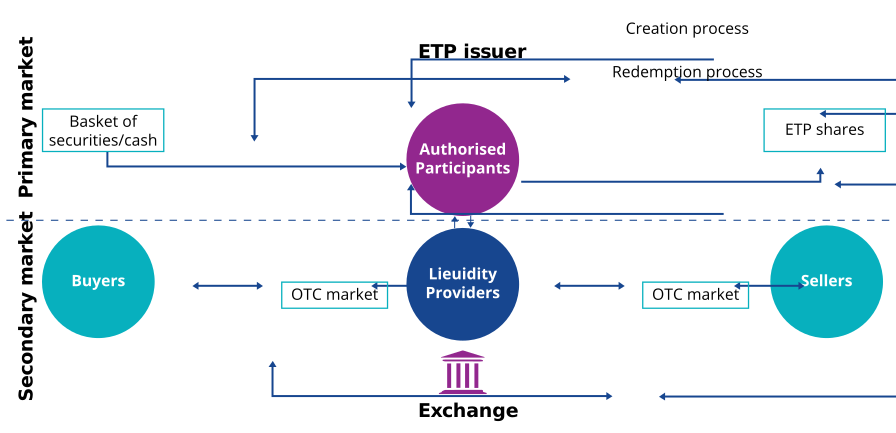
The ETF market operates through two interconnected tiers: the Primary Market and the Secondary Market. In the Primary Market, Authorized Participants (APs) work with ETF issuers to create or redeem ETF shares by exchanging baskets of securities or cash. This process ensures the alignment between the ETF's market price and the value of its underlying assets. In the Secondary Market, ETF shares are traded among buyers and sellers on stock exchanges or via Over-the-Counter (OTC) markets, with Liquidity Providers facilitating smooth transactions and price stability. This system ensures continuous liquidity, efficient price discovery, and broad accessibility for investors. The graph below “Understanding the Mechanics of the ETF Market”, visually demonstrates these processes, showing the flow of ETF shares, securities, and cash between key participants.
Understanding the Mechanics of the ETF Market
Source: VanEck.
How Do ETFs Perform?
Comparing ETF Performance to the Underlying Index
ETFs are designed to closely track the performance of the underlying index they replicate. This section explores how well ETFs mirror their benchmark indices, providing insights into tracking accuracy and the concept of tracking difference. This refers to the slight variations that can occur between an ETF's performance and that of its underlying index.
Understanding tracking difference: Tracking difference is the gap between an ETF's return and the return of its benchmark index. Ideally, an ETF will match its index’s performance, but minor deviations can occur due to several factors:
Management Fees
ETFs often have lower fees than mutual funds, but any fees can slightly reduce the ETF's performance relative to the index

Rebalancing and Trading Costs
When ETFs adjust their holdings to reflect changes in the index, they may incur trading costs. This is a particular issue in rapidly changing or volatile markets
Dividend Timing
If an ETF holds stocks that pay dividends, the timing of dividend distributions may impact performance temporarily

Replication Strategy
Some ETFs use full replication (holding all securities in the index) while others use sampling (holding a subset of securities). Sampling can lead to slight differences in performance.
Performance Comparison of an ETF and the Underlying Index
The accompanying chart illustrates the concept of tracking difference by comparing the performance of a Sustainable Equal Weight ETF against its underlying index. This visual comparison helps to highlight how tracking difference manifests over time, showing periods when the ETF’s performance closely mirrors the index and periods when slight deviations occur.
Past performance does not predict future returns. Investing is subject to risk, including the possible loss of principal.
Source: Bloomberg, VanEck Semiconductor UCITS ETF and its underlying index.
Why are ETFs So Popular?

Easy access
to international markets, asset classes, and investment strategies previously available only to institutional investors.
Transparency
With exchange-traded funds, you know which stocks or other assets are in the fund and how they are selected for inclusion.
Helps reduce risk
Because your investment in an ETF is spread across a number of stocks or other assets, it is considered less risky because you are not dependent on the growth of any company or asset.

You don't need a lot of money to invest in ETFs
ETFs are a way to invest small amounts of money in multiple companies or other assets.
Lower costs
Management fees for index-based ETFs are typically lower than investing in the same exposure to individually purchased companies.

Liquidity
ETFs can be traded throughout the market’s trading day, offering high liquidity. Unlike mutual funds, which only transact at day’s end, ETFs provide real-time trading, making them adaptable to market movements.
ETFs vs Mutual Funds
Understanding the Key Differences
Both ETFs and mutual funds pool investors’ money into diversified portfolios, but ETFs offer several notable advantages that make them an attractive choice for investors. Below is an in-depth look at how ETFs compare to mutual funds and individual stocks, providing insights into what makes ETFs distinct.
Key Differences Between Investing Options
| ETFs | Mutual Funds | Individual Stocks | |
| Diversification | High | High | Low |
| Transparency | High | Low | High |
| Costs | Low | High | Low |
| Tradable | All day | Max 1x per day | All day |
Source: VanEck.
Key Advantages of ETFs over Mutual Funds:
- ETFs are typically cheaper than mutual funds, as they generally follow a passive strategy to track an index. Actively managed mutual funds have higher costs due to research needs and, potentially, higher portfolio turnover.
- Impact on returns: For investors, the cumulative impact of lower fees in ETFs can lead to significantly better returns over time as compounding works more effectively with reduced cost drag.
ETFs within the European Union’s UCITS (Undertakings for Collective Investment in Transferable Securities) investment fund structure offer greater transparency than mutual funds. They provide detailed, daily information on costs, holdings, risk profiles, and historical performance. In contrast, mutual funds, especially actively managed ones, sometimes have opaque fee structures and disclose holdings less frequently, making it harder for investors to assess them.
ETFs have low minimum investment requirements and generally don’t charge entry or exit fees, making them accessible to investors. Especially the less expensive share classes of mutual funds often have higher minimums and may charge entry or exit fees.
- ETFs trade on stock exchanges, meaning investors can buy and sell them throughout the trading day at market prices, similar to individual stocks. This real-time trading provides clarity into the exact price, with visible bid and ask prices determined by market supply and demand.
- Mutual funds typically process transactions only at the end of the trading day when their net asset value (NAV) is calculated. As a result, investors won’t know the exact transaction price until the market closes, which can lead to additional market risk.
- Sometimes closed-end mutual funds trade on exchanges but may trade at a premium or discount to their NAV due to supply and demand imbalances, adding complexity for investors.


Types of ETFs
A Gateway to Diversification and Resilience
ETFs are reshaping the investment landscape by providing cost-effective access to diversified portfolios. They enable exposure to a broad range of asset classes—such as stocks, bonds, and commodities—that were once primarily available to institutional investors. Today, ETFs offer opportunities in emerging sectors like artificial intelligence and renewable energy, allowing investors to capitalize on trends while maintaining portfolio flexibility.
Below is an overview of some of the main types of ETFs available to build a diversified portfolio, with choices spanning asset classes, sectors and investment styles:
Equity ETFs focus on stocks, have historically shown significant growth potential over the long term. The first ETF was based on an equity index. Since then, the range of equity ETFs has expanded significantly, delivering exposure to a variety of strategies, from broad market coverage to targeted sectors or themes.
Types of Equity ETFs:
- Core market ETFs: Track broad indices like the S&P 500, MSCI World or Solactive Sustainable World Equity Index offering diversified exposure across sectors and regions. These ETFs aim to offer a solid foundation for long-term portfolios.
- Sector ETFs: Focus on specific sectors like technology, healthcare, or consumer goods, allowing investors to take advantage on sector trends.
- Dividend ETFs: Target companies which usually pay dividends, potentially offering income alongside capital appreciation.
- Regional ETFs: Provide exposure to specific countries or regions, such as emerging markets, developed markets like Europe, or a specific country like Japan.
Example: VanEck World Equal Weight Screened UCITS ETF
This ETF tracks a global index which incorporates specific ESG screenings , with equal weighting given to each constituent. Investors should note that investing in ETF is subject to risk including equity market and liquidity risk which could result in the loss of principal and must refer to ETFs documents. The decision to invest in the ETF should take into account all the characteristics or objectives of the ETF as described in the KID, the prospectus and the sustainability related disclosure, or related documents before making an investment decision.
Real Estate ETFs invest in listed real estate companies such as real estate investment trusts (REITs), providing investors with exposure to the real estate market without having to directly own physical properties. These ETFs can target both commercial and residential real estate companies, as well as various sectors like office buildings, shopping malls and industrial properties.
Real estate ETFs are appealing for investors seeking income generation through dividends and the potential for long-term capital appreciation. They also offer diversification within the real estate asset class.
Example: VanEck Global Real Estate UCITS ETF
This ETF provides exposure to listed companies involved in the real estate sector which seek a diverse set of global investment opportunities, including residential, commercial, and industrial properties across various regions. Nonetheless, investors should note that investing in ETF is subject to risk including industry or sector concentration risk and foreign currency risk which ultimately could result in the loss of principal and must refer to ETFs documents. The decision to invest in the ETF should take into account all the characteristics or objectives of the ETF as described in the KID, the prospectus and the sustainability related disclosure or related documents before making an investment decision.
Fixed-Income ETFs provide exposure to bonds, covering a wide variety of regions, issuers, and credit ratings. These ETFs can invest in e.g., government, corporate, or municipal bonds.They can be an attractive choice for investors seeking regular income with lower volatility.
Types of Fixed-Income ETFs:
- Government bond ETFs: Focus on bonds issued by national governments, such as US Treasuries or European government bonds.
- Corporate bond ETFs: Target bonds issued by corporations, varying in terms of risk and yield depending on the issuer’s credit rating.
- High-yield bond ETFs: Invest in bonds from issuers with lower credit ratings, offering higher yields but with increased risk.
Example: VanEck iBoxx EUR Corporates UCITS ETF
This ETF provides exposure to a broad selection of corporate bonds denominated in euros, offering investors access to the European credit market with a focus on investment-grade companies. Nonetheless, investors should note that investing in ETF is subject to risk including industry or sector concentration risk and foreign currency risk which ultimately could result in the loss of principal and must refer to ETFs documents. The decision to invest in the ETF should take into account all the characteristics or objectives of the ETF as described in the KID, the prospectus and the sustainability related disclosure or related documents before making an investment decision.
Thematic ETFs typically are equity ETFs which focus on specific investment themes or trends, such as technology, renewable energy, or healthcare innovation. These ETFs allow investors to target high-growth areas or sectors that align with their interests or vision on long-term economic trends. Thematic ETFs enable investors to capitalize on emerging sectors and potential shifts in the global economy.
Some types of thematic ETFs:
- Technology ETFs: These ETFs focus on technology-driven sectors such as artificial intelligence, cybersecurity, robotics, cloud computing, and 5G. Investors can gain exposure to the tech companies at the forefront of innovation, capitalizing on the digital transformation of industries.
- Healthcare ETFs: Target e.g., biotech, pharmaceuticals, healthcare innovation, and medical device companies. Healthcare ETFs invest in firms that are leading in cutting-edge medical treatments, diagnostics and advancements in wellness technologies, which can be especially relevant in the context of an ageing population.
- ESG (environmental, social, governance) ETFs: These ETFs focus on companies that meet specific ESG criteria. They combine targeting financial returns with a commitment to positive environmental, social, and governance outcomesand might particularly appeal to socially conscious investors.
On the other hand, one common risks associated with thematic ETFs is industry and sector concentration. Economic, political or other conditions that have a negative effect on the relevant sectors or industries will negatively impact the ETF's performance.
Example: VanEck Semiconductor UCITS ETF
This ETF provides exposure to the semiconductor industry, a key component of technological innovation in sectors like electronics and renewable energy. Nonetheless, investors should note that investing in ETF is subject to risk including industry and sector concentration risk, liquidity risk and equity market risk which could result in the loss of principal and must refer to ETFs documents. The decision to invest in the ETF should take into account all the characteristics or objectives of the ETF as described in the KID, the prospectus and the sustainability related disclosure or related documents before making an investment decision.
Smart Beta ETFs use a rules-based strategy to emphasize specific factors such as market capitalization, value, growth, volatility, or financial metrics like return on equity. These ETFs combine the benefits of passive investing with an active management approach, offering a more nuanced way to capture market returns by targeting factors believed to outperform the market over time.
Types of Smart Beta ETFs:
- Factor-based ETFs: Target factors like value (low price-to-earnings ratio), growth (high earnings growth), low volatility (investing in more stable companies), or quality ETFs (companies with strong fundamentals, such as consistent earnings growth and low debt levels).
- Equal-weight ETFs: Instead of tracking a market-capitalization-weighted index, these ETFs allocate equal weights to all constituents, which can provide different risk and return profiles.
Example: VanEck Morningstar US ESG Wide Moat UCITS ETF
This ETF invests in high quality companies with a sustainable competitive advantage, as identified by Morningstar’s proprietary "wide moat" methodology. Nonetheless, investors should note that investing in ETF is subject to risk including limited diversification concentration risk and equity market risk which could result in the loss of principal and must refer to ETFs documents. The decision to invest in the ETF should take into account all the characteristics or objectives of the ETF as described in the KID, the prospectus and the sustainability related disclosure or related documents before making an investment decision.
Exchange Traded Products (ETPs)
Combining ETFs, ETCs and ETNs
The term exchange-traded product (ETP) encompasses
ETFs (Exchange-traded funds)

ETCs (Exchange-traded commodities)
ETNs (Exchange-traded notes)
While all three are commonly traded on stock exchanges and can often be bought via authorized banks and brokers, they each have unique structures, advantages and risks. This makes it crucial for investors to understand how each product works and how they align with their investment goals.
Global ETF & ETP Assets Under Management (AUM): Growth and Trends
Source: ETFGI, Bloomberg, Morningstar.
- Overview:
ETFs are investment funds traded on exchanges, offering exposure to asset classes like stocks, bonds and commodities. They track specific indices or sectors, providing diversified exposure with a single security.
- UCITS regulation:
ETFs are classified under the UCITS (Undertakings for Collective Investment in Transferable Securities) framework, which is a European Union regulation designed to provide a high level of investor protection. Under UCITS rules, ETFs cannot directly invest in physical commodities like iron, oil, or gold. Instead, they may invest in companies involved in the production, processing, or trading of these commodities. This ensures that ETFs remain compliant with UCITS regulations while still providing indirect exposure to commodities.
- UCITS diversification rules:
UCITS regulations impose strict diversification requirements to mitigate investment risk. According to the UCITS guidelines, passive funds (such as ETFs) must adhere to the 20/35 rule. This rule dictates that an ETF cannot invest more than 20% of its assets in any single issuer or asset class. In exceptional circumstances, the limit can be raised to 35% of the assets, but this is only allowed for diversified indices and must meet specific regulatory conditions.
Example:
An ETF focused on the mining sector, such as the VanEck Global Mining UCITS ETF, provides indirect exposure to commodities like metals by investing in mining companies whose performance is correlated with commodity prices. While the ETF does not hold physical commodities directly, it tracks the performance of companies that extract, process, or trade these commodities, offering a way to gain exposure to the price movements of metals like gold, silver, and copper. Investors should note that investing in ETF is subject to risk including limited diversification concentration risk and equity market risk which could result in the loss of principal and must refer to ETFs documents before making an investment decision.
- Overview:
ETCs provide exposure to commodities, often through derivatives like futures contracts, instead of owning physical assets.
- Key features:
- Exposure to commodities: ETCs are designed to track the price movements of a specific commodity or a group of commodities, making them an effective tool for gaining exposure to the commodity markets.
- Derivative-based tracking: Some ETCs replicate the price movement of the underlying commodities through futures contracts, swaps, or forwards. This structure allows for price exposure without the need to physically own or store the commodities, but it may introduce additional complexities such as tracking errors, rollover costs and liquidity issues.
- Commodity types: Some ETCs focus on single commodities, like precious metals (gold, silver), energy (crude oil, natural gas), or agricultural products (corn, wheat). Others offer exposure to diversified baskets of commodities, providing broader exposure to multiple sectors within the commodity space.
- UCITS limitation:
Unlike ETFs, which are regulated under UCITS, ETCs are not subject to the same UCITS regulations. As a result, ETCs can directly invest in commodities.
- Risk considerations:
- Volatility: ETCs can be more volatile than ETFs because they are less diversified. If they rely on derivatives, the derivatives can experience price fluctuations that might not fully track the underlying commodity, especially during periods of high market volatility or low liquidity.
- Rollover risk: When an ETC holds futures contracts, it may need to roll over expiring contracts into new ones. If the price of the commodity is in contango (when futures prices are higher than the spot price), this can lead to roll costs, which might erode returns over time.
- Counterparty risk: derivative based ETCs are exposed to the risk of counterparty default, meaning that the entity providing the derivatives (such as a bank or exchange) could fail to meet its obligations. This risk is more pronounced in non-physical commodity investments, and investors should consider the financial stability of the counterparty involved.
- Liquidity: The liquidity of an ETC can vary depending on the underlying commodity and the nature of any derivative contracts used. Less liquid markets can lead to wider bid-ask spreads, impacting the cost of entry or exit from a position.
- Overview:
ETNs are debt securities, designed to track the performance of a specific index, asset class, commodity or currency. They promise to pay investors a return linked to the performance of the specified benchmark, minus fees. VanEck Europe has a range of ETNs that give exposure to the price movements of a range of digital assets. This allows investors to benefit from these price trends without the need to directly hold the digital assets, eliminating risks like losing private keys or storing them at unregulated entities such as crypto exchanges. The VanEck ETNs can be purchased via many banks and brokers and are traded on regulated exchanges.
- Risk Considerations:
- Credit risk: Some ETNs are unsecured debt securities, that means that their value is tied to the financial stability of the issuer. If the issuing institution defaults, investors may lose some or all of their investment, regardless of the performance of the underlying benchmark. The digital asset ETNs that are issued by VanEck are collateralized, meaning that the cash is invested in the underlying digital assets, which reduces the credit risk.
- Market volatility: ETN prices are influenced by market demand, liquidity and sentiment, which may result in price fluctuations. Digital assets have been known for extreme volatility.
- Liquidity risk: The liquidity of ETNs depends on both the underlying benchmark and the market demand for the specific note. Less liquid ETNs may have wider bid-ask spreads, making it more expensive to buy or sell the security.
- Fees and costs: ETNs often involve management fees and issuer-related costs, which can reduce overall returns over time. Investors should review the fee structure carefully before investing.
- Regulatory considerations: ETNs are not subject to UCITS regulations, which means they lack some of the investor protections provided to ETFs in Europe. This makes it particularly important for investors to assess the structure and creditworthiness of the issuer and understand the risks associated with the underlying benchmark.
- Example: The VanEck Bitcoin ETN is an example of an ETN that provides exposure to Bitcoin’s price movements. The ETN allows investors to have exposure to the performance of Bitcoin without directly owning or storing the cryptocurrency. However, as with all ETNs, the credit risk of the issuer and the volatility of Bitcoin's price movements are key considerations for investors.
Comparison of ETFs, ETCs and ETNs
Investors should carefully consider their investment goals and risk tolerance when choosing between ETFs, ETCs, and ETNs. ETFs can offer diversified exposure to asset classes, sectors, regions and themes, while ETCs and ETNs provide more direct exposure through individual commodities or niche markets, which is potentially riskier. Understanding the unique characteristics of each investment vehicle is essential for making informed decisions aligned with your financial objectives.
In a Nutshell…
ETFs have revolutionized individual investing by making sophisticated investment strategies accessible to everyone. Some of these were previously only available to professional investors. They offer a simple, cost-effective way to build a diversified portfolio with options ranging from equity to thematic funds. Investors can customize their portfolios based on specific needs and goals.
To learn more about how you can start investing in ETFs through VanEck, continue exploring our Academy course.