Welcome to VanEck
Select Investor Type
19 May 2026
Quantum computers don't just compute faster. They compute differently. And for the mathematical puzzles that secure nearly all digital communication, that difference is existential.
Classical computers process information in binary bits, each a 0 or a 1. Quantum computers use qubits, which can exist in multiple states simultaneously through a property called superposition. Combined with entanglement, where qubits become correlated regardless of distance, quantum machines can explore many solution paths at once, delivering exponential speedups on specific problem classes.
Two algorithms sit at the center of the quantum threat to cryptography. Shor's algorithm can factor large numbers and solve discrete logarithm problems in polynomial time, directly threatening RSA and elliptic curve cryptography (ECC). Grover's algorithm provides a quadratic speedup for brute-force search, weakening symmetric encryption and hash functions, though these can generally be defended by doubling key lengths.
Virtually everything that secures the modern internet, including HTTPS, TLS, SSH, VPNs, digital signatures, and software update verification, relies on ECC or RSA. A sufficiently powerful quantum computer running Shor's algorithm could derive private keys from public keys, forge certificates, intercept encrypted sessions and push malicious software updates signed with forged keys.
Crucially, the threat isn't limited to future communications. Nation-state actors are already engaged in bulk collection of encrypted traffic, including diplomatic cables, military communications, and corporate secrets, stockpiling it for the day quantum decryption arrives. Google recently published a warning that organizations should secure the quantum era with post-quantum cryptography no later than 2029.
Source: IBM Quantum Roadmap, Google AI Blog, Fujitsu/RIKEN, IonQ, Atom Computing, Quantinuum. Maximum qubit counts in flagship quantum processors, 2019–2026. IBM 2026 figure (4,158) represents three linked Kookaburra chips.
The pace of progress in 2026 has been extraordinary. In March, IBM demonstrated its Kookaburra processor, a 1,386-qubit multi-chip module that, when three chips are linked, forms a 4,158-qubit system. Fujitsu and RIKEN have committed to delivering a 1,000-qubit machine in 2026. Atom Computing's neutral-atom platform leads single-system count at 1,225, while QuEra achieved 96 logical qubits from 448 physical atoms in January 2026. Google's 105-qubit Willow chip was the first to demonstrate below-threshold quantum error suppression.
Not all quantum computers threaten cryptography. The industry focuses on a specific milestone: the Cryptographically Relevant Quantum Computer (CRQC), a machine that can run Shor's algorithm against real-world encryption for a sustained period with sufficiently low error rates.
The resource estimates for building such a machine have shifted dramatically. In 2022, researchers estimated that breaking RSA-2048 would require roughly 20 million physical qubits. By early 2026, three landmark papers reduced that number by an order of magnitude. A Google research team published a whitepaper showing that breaking the elliptic curve cryptography securing Bitcoin and Ethereum could require fewer than 500,000 physical qubits and could be accomplished in under nine minutes.
Estimated Qubits Required to Break Encryption
Source: Webber et al. (2022), Gidney (2025), Iceberg Quantum (2026), Google ECDLP-256 whitepaper (2026). Estimated physical qubits required to run Shor's algorithm against RSA-2048 and ECC-256, by year of estimate.
Expert surveys by the Global Risk Institute show a 17–34% probability of a CRQC by 2034, increasing to 79% by 2044. Nobel laureate John Martinis, who led Google's quantum supremacy experiment, has warned that Bitcoin could be among the earliest real-world targets, urging the community to begin planning now despite the network's slow governance. The U.S. has designated 2026 the "Year of Quantum Security." Federal agencies face an April 2026 deadline to submit post-quantum migration plans.
Bitcoin's quantum vulnerability is uniquely acute because of its architecture. The network relies on elliptic curve cryptography (ECDSA) to secure wallets and authorize transactions. A quantum computer running Shor's algorithm could derive a private key from an exposed public key, enabling theft. Researchers estimate between 4 and 6.5 million BTC sit in addresses where public keys have already been exposed, representing hundreds of billions of dollars.
Bitcoin's most significant quantum defense proposal is BIP-360, formally merged into the official BIP repository in February 2026. It introduces Pay-to-Merkle-Root (P2MR), which eliminates on-chain exposure of public keys. Instead of committing to a public key, P2MR commits exclusively to the Merkle root of a Tapscript tree. Because hash functions are generally quantum-resistant, this removes the primary attack surface for long-exposure quantum attacks.
In March 2026, BTQ Technologies launched the first working BIP-360 implementation on a testnet, with full P2MR consensus, Dilithium post-quantum signature opcodes, and end-to-end wallet tooling. A StarkWare researcher has also proposed Quantum Safe Bitcoin (QSB), a hash-based scheme that works within existing rules but costs $75–$200 per transaction, framed as a last-resort emergency tool.
Bitcoin's core challenge is governance speed. Major protocol changes like SegWit and Taproot took 7–8.5 years. Developer Jameson Lopp has warned that any meaningful quantum defense could take 5–10 years. The community is also debating what to do about vulnerable coins that will never voluntarily move, including options like forced burns, forced migration, or treasury fund creation.
Ethereum's approach has been notably more coordinated. In January 2026, the Ethereum Foundation established a dedicated Post-Quantum Security team, committing $2 million in research prizes. In February, Vitalik Buterin published a comprehensive quantum resistance roadmap as part of the "Strawmap" plan for approximately seven hard forks over four years.
Buterin identified four areas of vulnerability: consensus-layer BLS signatures, data availability (KZG commitments), EOA signatures (ECDSA), and application-layer ZK proofs. Each relies on elliptic curve cryptography vulnerable to Shor's algorithm.
A critical enabling upgrade is EIP-8141 (native account abstraction), which would allow wallets to adopt quantum-safe signature types without forcing all users to change wallets at once. This could arrive in the forthcoming Hegotá upgrade. The gas cost challenge is significant: current ECDSA verification costs ~3,000 gas, while quantum-resistant alternatives may require ~200,000 gas. Buterin's roadmap addresses this through recursive STARK proof aggregation.
Solana has partnered with Project Eleven to test quantum-resistant cryptography. Results surfaced a fundamental tradeoff: quantum-safe signatures are 20–40x larger, and in testing Solana ran ~90% slower. Developers have introduced optional "Winternitz Vaults" using hash-based one-time signatures as an interim solution.
Coinbase established an Independent Advisory Board on Quantum Computing in January 2026, including Scott Aaronson (UT Austin), Dan Boneh (Stanford), and Justin Drake (Ethereum Foundation). CEO Brian Armstrong called quantum computing "a very solvable issue."
NIST finalized its first three PQC standards in August 2024: ML-KEM (Kyber) for key encapsulation, ML-DSA (Dilithium) and SLH-DSA (SPHINCS+) for digital signatures. Additional standards including FN-DSA and HQC are in the pipeline.
Crypto Ecosystem Quantum Readiness
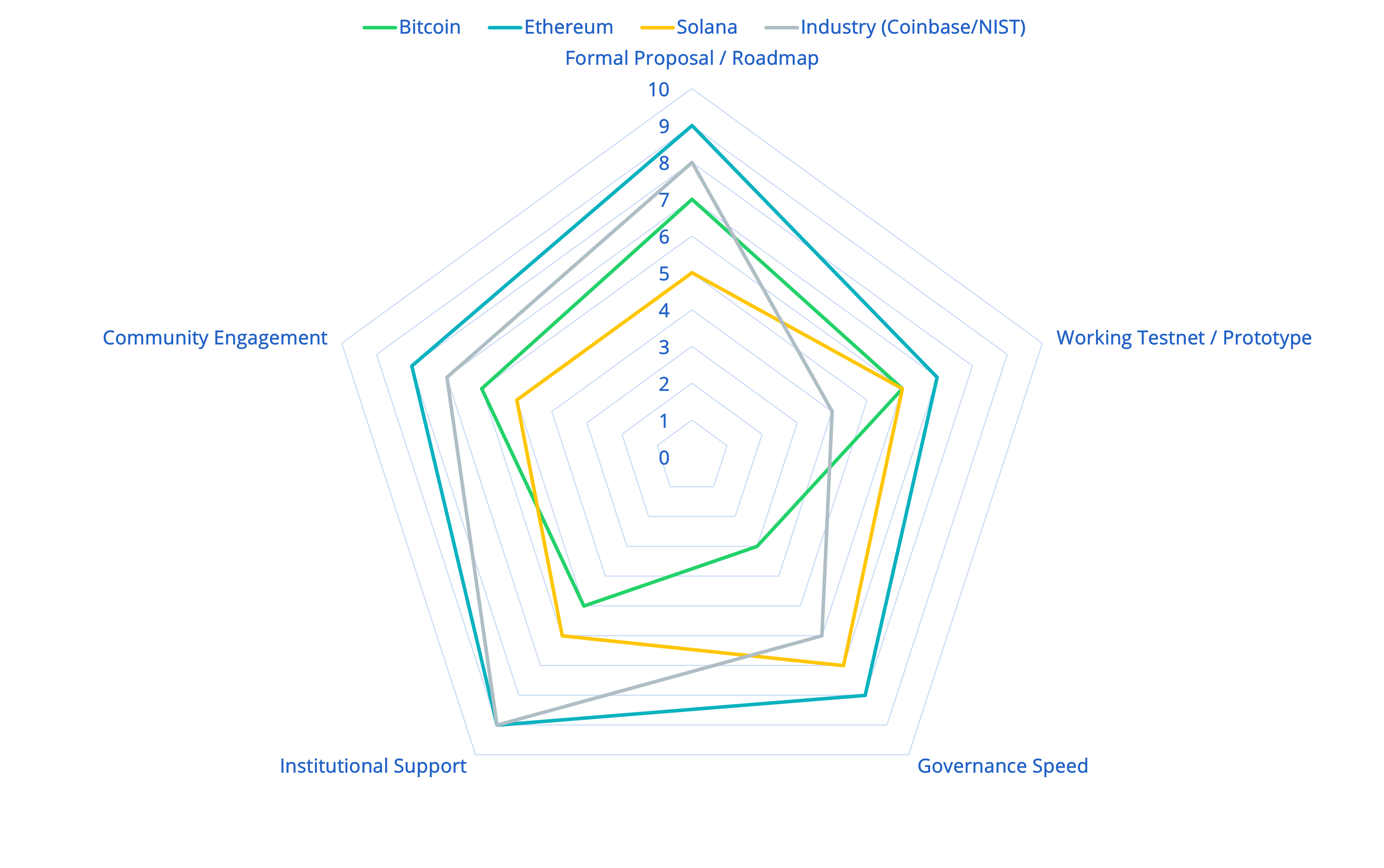
Source: based on publicly announced initiatives, testnet deployments, and institutional commitments as of April 2026. Relative progress across key dimensions of quantum preparedness. Scores are subjective (1–10)
The quantum threat is forcing the entire crypto industry to modernize its cryptographic foundations far earlier than it otherwise would. Projects that successfully navigate this transition will emerge with stronger, more future-proof security, potentially attracting institutional capital that previously hesitated due to long-term security concerns.
Quantum key distribution (QKD) and quantum random number generation could actually strengthen blockchain security. Truly random numbers are foundational to cryptographic key generation, and quantum hardware provides physically guaranteed randomness. Several startups are exploring quantum-enhanced consensus mechanisms and transaction privacy.
Quantum computing could enable more sophisticated financial modeling for DeFi protocols, optimizing yield strategies, pricing derivatives, and managing risk in ways that current hardware cannot practically compute. The convergence of quantum computation with on-chain finance could unlock entirely new categories of financial products.
Networks that move early on quantum resistance may capture a durable competitive advantage. If Bitcoin's community agrees to burn or forcibly migrate vulnerable coins, many of which are likely permanently lost, the resulting reduction in effective supply could be net positive for remaining holders, while simultaneously strengthening the network's security posture.
Conclusion: The quantum threat is real, but it is also a catalyst. The start of 2026 saw more coordinated quantum security action, including dedicated research teams, advisory boards, working testnets, and $2M+ in research prizes, than the previous several years combined. The window for orderly migration remains open. The question is whether the industry's historically slow governance can match the pace of quantum hardware development.
This is not financial research but the opinion of the author of the article. We publish this information to inform and educate about recent market developments and technological updates, not to give any recommendation for certain products or projects. The selection of articles should therefore not be understood as financial advice or recommendation for any specific product and/or digital asset. We may occasionally include analysis of past market, network performance expectations and/or on-chain performance. Historical performance is not indicative for future returns.
IMPORTANT INFORMATION
For informational and advertising purposes only.
This information originates from VanEck (Europe) GmbH, Kreuznacher Strasse 30, 60486 Frankfurt am Main, Deutschland and VanEck Switzerland AG, Genferstrasse 21, 8002 Zurich, Switzerland.
It is intended only to provide general and preliminary information to investors and shall not be construed as investment, legal or tax advice. VanEck (Europe) GmbH and its associated and affiliated companies (together “VanEck”) assume no liability with regards to any investment, divestment or retention decision taken by the investor on the basis of this information. Views and opinions expressed are current as of the date of this information and are subject to change with market conditions. Certain statements contained herein may constitute projections, forecasts and other forward looking statements, which do not reflect actual results. VanEck makes no representation or warranty, express or implied regarding the advisability of investing in securities or digital assets generally or in the product mentioned in this information (the “Product”) or the ability of the underlying Index to track the performance of the relevant digital assets market.
Investing is subject to risk, including the possible loss of principal up to the entire invested amount and the extreme volatility that ETNs experience. You must read the prospectus and KID before investing, in order to fully understand the potential risks and rewards associated with the decision to invest in the Product. The approved Prospectus is available at V. Please note that the approval of the prospectus should not be understood as an endorsement of the Products offered or admitted to trading on a regulated market.
The underlying Index is the exclusive property of MarketVector Indexes GmbH. MarketVector uses its best efforts to ensure that the Index is calculated correctly.
All indices are unmanaged and include the reinvestment of all returns but do not reflect the payment of transactions costs or expenses that are typically associated with digital assets portfolios. Indices were selected for illustrative purposes only and are not securities in which investments can be made. The returns of actual accounts investing in digital assets are likely to differ from the performance of each corresponding index. In addition, the returns of accounts will vary from the performance of the indices for a variety of reasons, including timing and individual account objectives and restrictions. Accordingly, there can be no assurance that the benefits and risk/return profile of the indices shown would be similar to those of actual accounts managed. Performance is shown for the stated time period only
Investing is subject to risk, including the possible loss of principal up to the entire invested amount and the extreme volatility that ETNs experience. You must read the prospectus and KID before investing, in order to fully understand the potential risks and rewards associated with the decision to invest in the Product. The approved Prospectus is available at www.vaneck.com. Please note that the approval of the prospectus should not be understood as an endorsement of the Products offered or admitted to trading on a regulated market.
Performance quoted represents past performance, which is no guarantee of future results and which may be lower or higher than current performance.
Current performance may be lower or higher than average annual returns shown. Performance shows 12 month performance to the most recent Quarter end for each of the last 5yrs where available. E.g. '1st year' shows the most recent of these 12-month periods and '2nd year' shows the previous 12 month period and so on. Performance data is displayed in Base Currency terms, with net income reinvested, net of fees. Brokerage or transaction fees will apply. Investment return and the principal value of an investment will fluctuate. Notes may be worth more or less than their original cost when redeemed.
Index returns are not ETN returns and do not reflect any management fees or brokerage expenses. An index’s performance is not illustrative of the ETN’s performance. Investors cannot invest directly in the Index. Indices are not securities in which investments can be made.No part of this material may be reproduced in any form, or referred to in any other publication, without express written permission of VanEck.
© VanEck (Europe) GmbH / © VanEck Switzerland AG
This is a marketing communication. Please refer to the prospectus of the UCITS and to the KID before making any final investment decisions.
This information originates from VanEck (Europe) GmbH, which has been appointed as distributor of VanEck products in Europe by the Management Company VanEck Asset Management B.V., incorporated under Dutch law and registered with the Dutch Authority for the Financial Markets (AFM). VanEck (Europe) GmbH with registered address at Kreuznacher Str. 30, 60486 Frankfurt, Germany, is a financial services provider regulated by the Federal Financial Supervisory Authority in Germany (BaFin).
The information is intended only to provide general and preliminary information to investors and shall not be construed as investment, legal or tax advice VanEck (Europe) GmbH, VanEck Switzerland AG, VanEck Securities UK Limited and their associated and affiliated companies (together “VanEck”) assume no liability with regards to any investment, divestment or retention decision taken by the investor on the basis of this information. The views and opinions expressed are those of the author(s) but not necessarily those of VanEck. Opinions are current as of the publication date and are subject to change with market conditions. Certain statements contained herein may constitute projections, forecasts and other forward-looking statements, which do not reflect actual results. Information provided by third party sources is believed to be reliable and have not been independently verified for accuracy or completeness and cannot be guaranteed. Brokerage or transaction fees may apply.
All performance information is based on historical data and does not predict future returns. Investing is subject to risk, including the possible loss of principal.
No part of this material may be reproduced in any form, or referred to in any other publication, without express written permission of VanEck.
© VanEck (Europe) GmbH / VanEck Asset Management B.V.
28 September 2026

24 September 2026
28 September 2026
24 September 2026