Bienvenue chez VanEck
Sélectionnez le type d’investisseur
21 January 2020
“Do you know the only thing that gives me pleasure? It's to see my dividends coming in.”
John D. Rockefeller, 1908.
In the current environment of ultra-low interest rates, investors are increasingly looking to equities for a source of income. However, high dividend strategies look attractive in today’s markets for a wide range of reasons.
When John D. Rockefeller, the world’s first billionaire and renowned philanthropist, remarked on his pleasure in receiving dividends from Standard Oil, he was inadvertently making the case for companies that pay high dividends. Not only do these stocks reward their investors with an attractive level of income, but their other qualities can translate into higher than average total returns.
Historically, higher dividend paying stocks have shown both higher returns and lower levels of risk (see figure 1 below).
S&P 500 portfolios, based on dividend yield
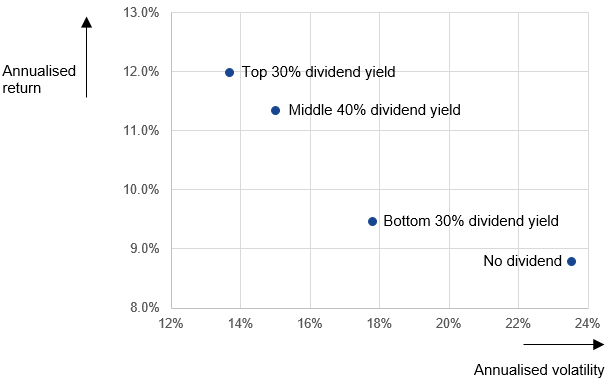
Source: VanEck analysis using data from Kenneth French. Data for the 50 years ending September 2019. Past performance is not a reliable indicator for future performance. This also holds for historical market data.
One reason given for high-dividend stocks’ superior risk-return characteristics is that a high level of dividend payout disciplines management. If a firm has too much free cash flow at its disposal, managers might be tempted to undertake value destroying projects, or spend on excessive salaries or perks. Another fact to consider is that, over the long term, dividends are the main driver of equity returns. In figure 2, we compare the performance of the US S&P 500 index including dividends and excluding dividends. It is clear that the former dwarfs the latter over time. Only a few companies have been able to generate above average long-term returns from share price increases alone.
S&P 500 return, including dividends and excluding dividends
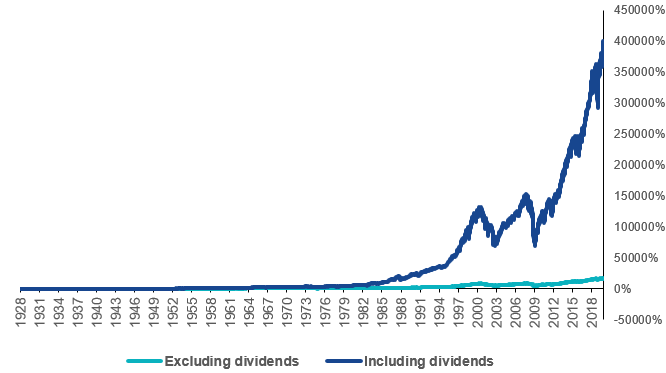
Source: Bloomberg, VanEck analysis. Data for the period 2 January 1928 – 28 November 2019. Past performance is not a reliable indicator for future performance. This also holds for historical market data.
Dividends have also proved to be a good hedge against inflation. As can be seen in figure 3, dividend payouts have historically walked in lockstep with inflation levels. The explanation is intuitive: in periods of inflation, most companies can raise the prices of their goods or services, and as such, increase nominal earnings. This then translates into higher dividends.
10-year annualised inflation versus 10-year annualised dividend growth, USA
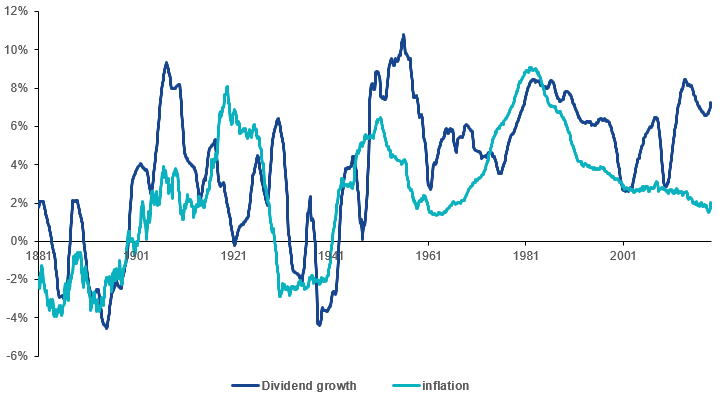
Source: VanEck analysis using data from Robert Shiller. Data for the period January 1871 – September 2019. Past performance is not a reliable indicator for future performance. This also holds for historical market data.
But beyond the long-term arguments, high dividend strategies seem particularly well suited for the current macro-economic environment.
A high dividend equity strategy can nowadays yield between 4% and 5% when investing in blue chip companies such as AT&T, HSBC, GlaxoSmithKline and IBM. In order to achieve such yields from Euro fixed income, one needs to make big sacrifices in both credit quality and duration.
Also, the fundamentals of high income strategies seem favorable. Currently, high dividend stocks are priced attractively, both in comparison to other stocks and to historical prices.
Price / earnings ratios
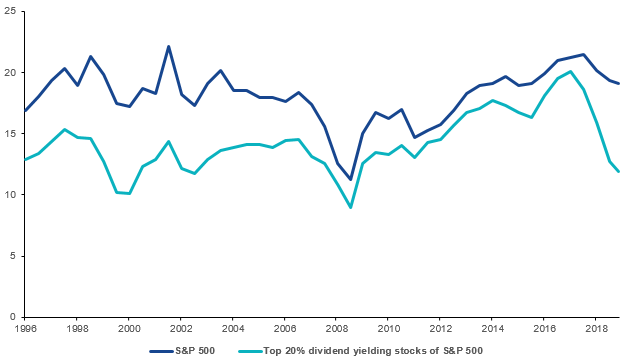
Source: Bloomberg, VanEck analysis. Past performance is not a reliable indicator for future performance. This also holds for historical market data.
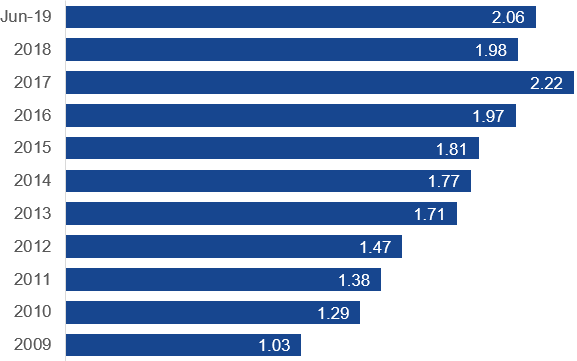
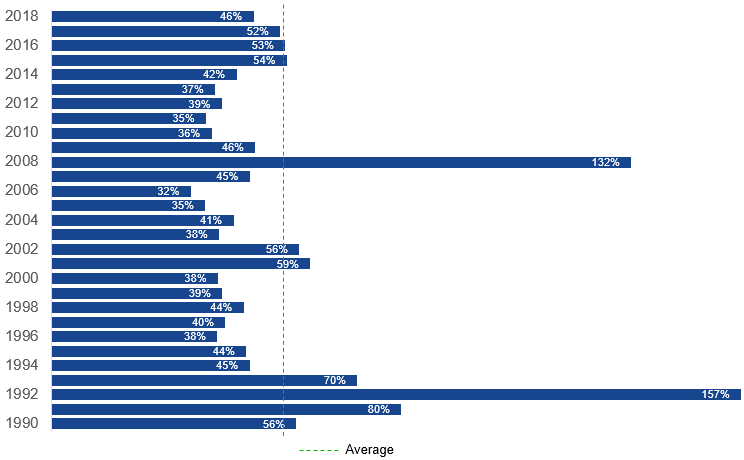
Investors can find further comfort from current high levels of cash on companies’ balance sheets, which compare well with historical norms (figure 5). This gives companies sufficient capacity to sustain dividend payouts, even if their earnings fall. Yet despite the stockpiling of cash, current payout levels are below historical averages, giving leeway for further increase dividend payouts, see figure 6.
Total cash and cash equivalents for S&P 500 firms, USD trillion
Source: Bloomberg, VanEck analysis.
Dividend payout ratio for S&P 500
Source: Bloomberg, VanEck analysis.
John D. Rockefeller may have extolled the virtues of high dividends over 110 years ago, but his sentiment has held true over the long term. Given today’s extraordinary economic environment of low or even below zero rates, the attraction of high dividends is stronger than ever.
À des fins d’information et de publicité uniquement.
Ces informations proviennent de VanEck (Europe) GmbH qui a été désignée comme distributeur des produits VanEck en Europe par la société de gestion VanEck Asset Management B.V., de droit néerlandais et enregistrée auprès de l’Autorité néerlandaise des marchés financiers (AFM). VanEck (Europe) GmbH, dont le siège social est situé Kreuznacher Str. 30, 60486 Francfort, Allemagne, est un prestataire de services financiers réglementé par l’Autorité fédérale de surveillance financière en Allemagne (BaFin). Les informations sont uniquement destinées à fournir des informations générales et préliminaires aux investisseurs et ne doivent pas être interprétées comme des conseils d’investissement, juridiques ou fiscaux. VanEck (Europe) GmbH et ses sociétés associées et affiliées (ensemble « VanEck ») n’assument aucune responsabilité en ce qui concerne toute décision d’investissement, de cession ou de rétention prise par l’investisseur sur la base de ces informations. Les points de vue et opinions exprimés sont ceux du ou des auteurs, mais pas nécessairement ceux de VanEck. Les avis sont à jour à la date de publication et sont susceptibles d’être modifiés en fonction des conditions du marché. Certains énoncés contenus dans les présentes peuvent constituer des projections, des prévisions et d’autres énoncés prospectifs qui ne reflètent pas les résultats réels. Les informations fournies par des sources tierces sont considérées comme fiables et n’ont pas été vérifiées de manière indépendante pour leur exactitude ou leur exhaustivité et ne peuvent être garanties. Tous les indices mentionnés sont des mesures des secteurs et des performances du marché commun. Il n’est pas possible d’investir directement dans un indice.
Toutes les informations sur le rendement sont historiques et ne garantissent pas les résultats futurs. L’investissement est soumis à des risques, y compris la perte possible du capital. Vous devez lire le Prospectus et le DICI avant d’investir.
Aucune partie de ce matériel ne peut être reproduite sous quelque forme que ce soit, ou mentionnée dans toute autre publication, sans l’autorisation écrite expresse de VanEck.
© VanEck (Europe) GmbH

26 octobre 2026

25 octobre 2026

19 octobre 2026

19 octobre 2026
26 octobre 2026
25 octobre 2026
19 octobre 2026
19 octobre 2026