Welcome to VanEck
Select Investor Type
20 April 2021
The VanEck Emerging Markets Bond UCITS Fund utilizes a flexible approach to emerging markets debt investing and invests in debt securities issued by governments, quasi-government entities or corporations in emerging markets countries. These securities may be denominated in any currency, including those of emerging markets. By investing in emerging markets debt securities, the Fund offers exposure to emerging markets fundamentals, generally characterized by lower debts and deficits, higher growth rates and independent central banks.
The Fund (I1 Inc) was down 1.89% in March, in line with its benchmark, which was down 2.02%. YTD/QTD, the Fund was down 3.28%, outperforming its benchmark by 232 bps. Our performance was driven mainly by outperformance vs the benchmark in Brazil and Russia, where owning none continued to be a winner and some underperformance from our overweight in Turkey, which we have since closed.
U.S. Treasuries still drove markets (the U.S. 10-year sold off by over 30 bps). But, importantly, emerging markets (EM) local currency outperformed EM hard currency debt (down around 1% and 3%, respectively). This hints that the local currency market has already absorbed a lot this year’s move in U.S. Treasuries. Investors went into 2021 expecting an EM debt, and especially EM local currency debt, rally. It didn’t happen in the first quarter: “Boo hoo”. What did happen is that EM debt went down—but, it went down almost precisely in line with the U.S. Treasury selloff. Credit spreads barely rose and EM currencies—other than Brazil and now Turkey—barely budged. In our framing, nothing has happened in the first quarter other than a Treasury selloff due to improving economic conditions.
If U.S. Treasuries are pausing or reversing, it’s a big deal for EM debt. First, it means that carry is back—sideways is obviously a winning scenario for higher-yielding EM debt. Second, interest rates rose due to higher U.S. growth prospects—this is bullish for EM debt fundamentals and thus means lower credit spreads and stronger currencies. Higher U.S. growth increases imports from EM, boosting commodity prices and improves financing conditions. EM debt (the benchmarks) carries at around 5% and we’ve shown in earlier pieces how this has historically translated into outperformance of higher-yielding debt in rising rate environments.
EMFX looks set up to potentially benefit from global reflation, as rising yields are being generated by “risk-on” economic conditions, not “taper tantrum” conditions, in our view. Commodity prices look set to continue their rise, consistent with our positioning. Note that U.S. front-end rates remain anchored—the 2-year yield barely rose in March. This should be negative for the USD. To reiterate—once the market has digested the “perhaps-stalling” Treasury selloff, the sharply improving global growth outlook should support EM debt. The magnitude of the U.S. expansion should not be underestimated, and it can have a dramatic adverse impact on the USD, as shown in the Exhibit below. The expansion impact is illustrated by the U.S. “twin deficits” or the fiscal and current account deficits.
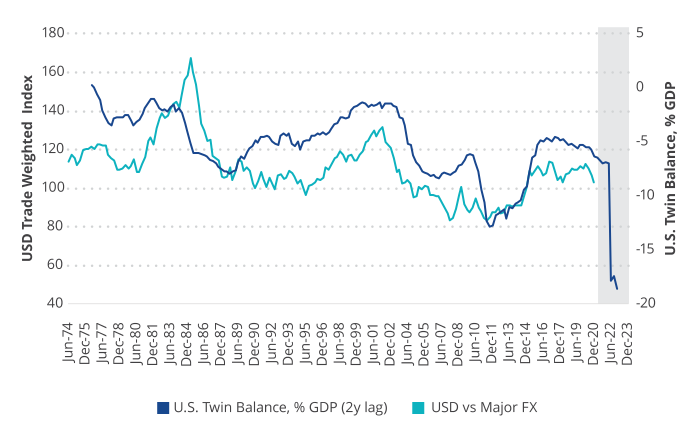
Source: VanEck Research; Bloomberg LP. Data as of 31 December, 2020.
We remain very attracted to EMFX, but we are no longer very averse to duration. U.S. rates have likely completed over half of what they’ll do in 2021 and the market could grind sideways for months, until the next big economic development starts driving markets (we reckon it will be the Infrastructure Bill in the U.S. in 2H2021). If the U.S. 10-year Treasury is returning to its pre-Covid yield of 2.75% (in the middle of its 2.5%-3.0% range), then we have another 100 bps to go from the current level of around 1.73%. But, the 10-year was at 0.5% just in the second half of 2020, and was at 0.9% at the end of 2020. This means that the 10-year has already sold 125 bps off of its low and 83 bps YTD—a lot has happened already! In addition, remember that YTD spreads didn’t widen significantly and EMFX was fine if you excluded big losers like Brazil and Turkey.
The Fund has duration of 5.8 and carry of 5.9%, with approximately 60% of our exposure still in local currency. We think that when the Treasury selloff stops, the rally in many risky assets related to the USD could be sharp and swift. Note that our duration is higher for the first time since December. We continue to like our local currency exposure, due to the generally positive global backdrop combined with a number of EM local currency bonds that pay high real yields and, we believe, will see improving fundamentals as a result of this backdrop. While EM local currency may not reflect improved growth prospects, duration and yield may already reflect them. The local currency EM debt benchmark is down YTD by approximately 1% more than the hard currency benchmark. But, it was stabilizing in March, and is still largely down due to weak outliers like Brazil and Turkey. (Not owning Brazil local currency in our fund has been a huge contributor to our outperformance. In addition, Turkey’s size was limited, even though it was an overweight position and it was not a long-lived view.)
Our “benchmark-in-line” performance in March was balanced by outperformance from Brazil and Russia (not owning their local currency helped especially) and underperformance from Turkey, where we had overweight exposure. We based this on our expectation of another 3-6 months of central bank hawkishness, which was undermined by President Erdogan’s recent replacement of the hawkish central bank head. We have since closed our exposure to Turkey, because we believe there’s serious risk of capital controls under the current policy path. Please find more details on these and other significant exposures below.
The changes to our top positions are summarized below. Our largest positions in March were: China, Mexico, South Africa, Colombia and Indonesia:
The VanEck Emerging Markets Bond UCITS Fund (I1 Inc) lost 1.89% in March compared to a loss of 2.02% for the 50/50 J.P. Morgan Government Bond Index-Emerging Markets Global Diversified (GBI-EM) local currency and the J.P. Morgan Emerging Markets Bond Index (EMBI) hard-currency index.
Turning to the market’s performance, GBI-EM’s biggest winner was Dominican Republic. Its biggest losers were Turkey, Poland and Thailand. The EMBI’s biggest winners were Sri Lanka, Iraq, and Oman. Its losers were Turkey, Russia and Egypt.
| 1 Mo† | 3 Mo† | YTD | 1 Yr | 5 Yr | Life | |
| USD R1 Inc (Inception 12/06/14) | -1.97 | -3.50 | -3.50 | 33.15 | 4.07 | 0.21 |
| USD I1 Inc (Inception 20/08/13) | -1.89 | -3.28 | -3.28 | 34.41 | 4.98 | 2.80 |
| USD I2 Inc (Inception 20/08/13) | -1.89 | -3.26 | -3.26 | 34.55 | 5.13 | 2.93 |
| EUR Hedged I1 Inc (Inception 06/10/15) | -2.01 | -3.54 | -3.54 | 32.62 | 2.60 | 3.06 |
| EUR Hedged I2 Inc (Inception 22/08/17) | -2.02 | -3.55 | -3.55 | 32.69 | - | 1.15 |
| 50 GBI-EM GD / 50% EMBI GD | -2.02 | -5.60 | -5.60 | 14.57 | 4.13 | 3.10 |
†Monthly returns are not annualized.
The tables above present past performance which is no guarantee of future results and which may be lower or higher than current performance. Returns reflect temporary contractual fee waivers and/or expense reimbursements. Had the Fund incurred all expenses and fees, investment returns would have been reduced. Investment returns and Fund share values will fluctuate so that investors’ shares, when redeemed, may be worth more or less than their original cost. Fund returns assume that dividends and capital gains distributions have been reinvested in the Fund at Net Asset Value (NAV). An index’s performance is not illustrative of the Fund’s performance. Certain indices may take into account withholding taxes. Index returns assume that dividends of the index constituents in the index have been reinvested. Investing involves risk, including loss of principal; please see disclaimers on next page. Please call 800.826.2333 or visit vaneck.com for performance current to the most recent month ended.
*Twin deficits refer to a country’s fiscal and current account deficits. A fiscal deficit is a budget shortfall while a current account deficit means a country is sending more money overseas for goods and services than it is receiving.
Source: VanEck, Bloomberg
Prior to 1 May 2020, the fund was known as the VanEck Unconstrained Emerging Markets Bond UCITS.
This is a marketing communication. Please refer to the prospectus of the UCITS and to the KID before making any final investment decisions.
This information originates from VanEck (Europe) GmbH, which has been appointed as distributor of VanEck products in Europe by the Management Company VanEck Asset Management B.V., incorporated under Dutch law and registered with the Dutch Authority for the Financial Markets (AFM). VanEck (Europe) GmbH with registered address at Kreuznacher Str. 30, 60486 Frankfurt, Germany, is a financial services provider regulated by the Federal Financial Supervisory Authority in Germany (BaFin).
The information is intended only to provide general and preliminary information to investors and shall not be construed as investment, legal or tax advice VanEck (Europe) GmbH, VanEck Switzerland AG, VanEck Securities UK Limited and their associated and affiliated companies (together “VanEck”) assume no liability with regards to any investment, divestment or retention decision taken by the investor on the basis of this information. The views and opinions expressed are those of the author(s) but not necessarily those of VanEck. Opinions are current as of the publication date and are subject to change with market conditions. Certain statements contained herein may constitute projections, forecasts and other forward-looking statements, which do not reflect actual results. Information provided by third party sources is believed to be reliable and have not been independently verified for accuracy or completeness and cannot be guaranteed. Brokerage or transaction fees may apply.
All performance information is based on historical data and does not predict future returns. Investing is subject to risk, including the possible loss of principal.
No part of this material may be reproduced in any form, or referred to in any other publication, without express written permission of VanEck.
© VanEck (Europe) GmbH / VanEck Asset Management B.V.

11 December 2025
11 December 2025