EM Rate Hikes – Success?
05 April 2023
Read Time 2 MIN
Case for EM Bonds
Emerging markets (EM) central banks’ independence and early (credible) responses to the post-pandemic inflation spike boosted EM real yields and carry, supporting the fundamental case for EM bonds and helping to shield them from recent market turbulence in developed markets (DM). EM’s disinflation progress keeps the pivot hopes alive, but for now most central banks prefer to stay vigilant. And often this means an extended pause – like in the case of the Chilean central bank yesterday (higher rates for longer), or Poland’s national bank this morning.
EM Disinflation
The latest inflation prints in Mexico, Colombia and the Philippines show why many central banks are cautious – even though headline inflation has clearly peaked, core price pressures are much more persistent. Mexico’s core inflation slowed less than expected in March – staying above 8% year-on-year – and services inflation continued to accelerate. Core inflation in Colombia and the Philippines was also in “lift-off” mode – the latter reached a new high since March 1999, leaving room for a small “farewell” rate hike. The market expects to have more clarity on these issues in three to six months, which explains the timing of priced-in “inaugural” EM rate cuts. A comment from Poland’s central bank Governor Adam Glapinski also drew attention to the disinflationary impact of stronger EM currencies, which might help to bring easing forward in some countries.
Global Growth Outlook
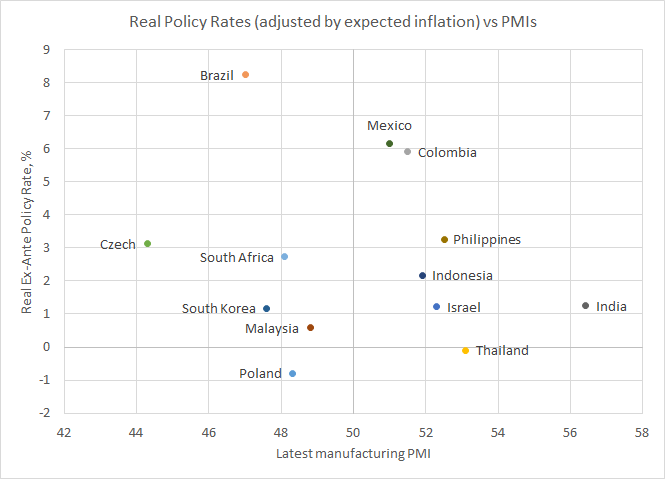
As more EMs are exiting their tightening cycle, the attention is shifting to the impact of high real interest rates on growth. The chart below plots real policy rates against the latest activity gauges – and it shows that bringing inflation down can come at a price, as domestic demand slows. The updated World Economic Outlook – released by the IMF this morning – reminded that there are additional considerations here, such as the increasingly complicated global backdrop. The report talks about the impact of geopolitical tensions and geo-economic fragmentations, which can “reshape the geography of foreign direct investments”, especially in strategic sectors. Some EMs will be winners in this brave new world – but some can become more vulnerable. Stay tuned!
Chart at a Glance: EM Rate Hikes and Domestic Activity Gauges
Source: Bloomberg LP.
Related Insights

Related Insights
10 febrero 2026
06 marzo 2025
20 febrero 2025
10 febrero 2026
La erosión del valor de la moneda vuelve a estar en el centro de atención. A continuación, analizamos qué lo está impulsando, qué podría revertirlo y cómo estamos posicionando las carteras en ambos escenarios.
07 abril 2025
Los aranceles de Trump avivan los temores de una guerra comercial, impulsando la volatilidad del mercado, el riesgo inflacionario y la amenaza de una recesión. Ante posibles represalias globales, el crecimiento a corto plazo corre un riesgo evidente.
06 marzo 2025
Los aranceles de Trump, la próxima fase de la IA y una posible revalorización del oro estadounidense podrían sacudir los mercados; los inversores que se adelanten a estas transiciones estarán mejor posicionados.
20 febrero 2025
El avance de la IA en China, la persistente inflación, el rendimiento superior del oro y el aumento de la demanda energética ponen de relieve un panorama de inversión cambiante.
16 enero 2025
En 2025, superar los problemas significa equilibrar la innovación tecnológica, las coberturas contra la inflación, los cambios energéticos y los riesgos derivados de los recortes del gasto y la inflación.