Welcome to VanEck
Select Investor Type
08 September 2026
Key Takeaways
Feeding the world is increasingly viewed as a significant economic and societal challenge.
A growing global population, shifting diets and increasing climate pressures are forcing agricultural systems to produce more with fewer resources and greater efficiency. At the same time, supply chain disruptions and geopolitical tensions have exposed just how fragile those systems can be.
For investors, this is not only a macroeconomic challenge. It may also represent an evolving opportunity across the global food supply chain and the broader agribusiness sector.
Agribusiness refers to the network of companies involved in producing, processing and distributing food and agricultural products. This includes everything from fertilizers, seeds and farm equipment to food processing, trading and distribution.
Rather than focusing solely on farming or commodities, agribusiness encompasses the full value chain that brings food from field to consumer.
The VanEck Agribusiness UCITS ETF offers comprehensive exposure to the agribusiness industry by seeking to replicate the MVIS® Global Agribusiness Index (MVMOOTR). The index comprises a globally diversified group of agribusiness companies, including those engaged in agri-chemicals, animal health and fertilizers, seeds and traits, irrigation equipment and farm machinery, aquaculture and fishing, livestock, cultivation and plantations, and trading of agricultural products.
The ETF targets businesses positioned within key areas of modern food systems. In these areas, factors such as scarcity, geopolitics and climate volatility may influence investment and, in some cases, pricing dynamics.
Recent years have underscored how vulnerable global food systems can be. Pandemic-related shutdowns, geopolitical tensions and climate-related disruptions have strained supply chains, from fertilizer shortages to transportation bottlenecks.
At the same time, food inflation has remained a key concern for both consumers and policymakers.
While these dynamics can present challenges, they may also reinforce the importance of agribusiness companies. Food demand is inherently inelastic, meaning consumption remains relatively stable across economic cycles. At the same time, many firms have the ability to pass higher input costs through the value chain over time. Supply disruptions can also tighten availability and support pricing for producers and processors.
In this context, agribusiness exposure may serve as a potential buffer during inflationary or supply-constrained environments, although outcomes may vary.
These structural pressures do not impact agriculture uniformly. Instead, they flow through different parts of the value chain in distinct ways.
To understand where these opportunities emerge, it helps to step back and look at the full agribusiness ecosystem: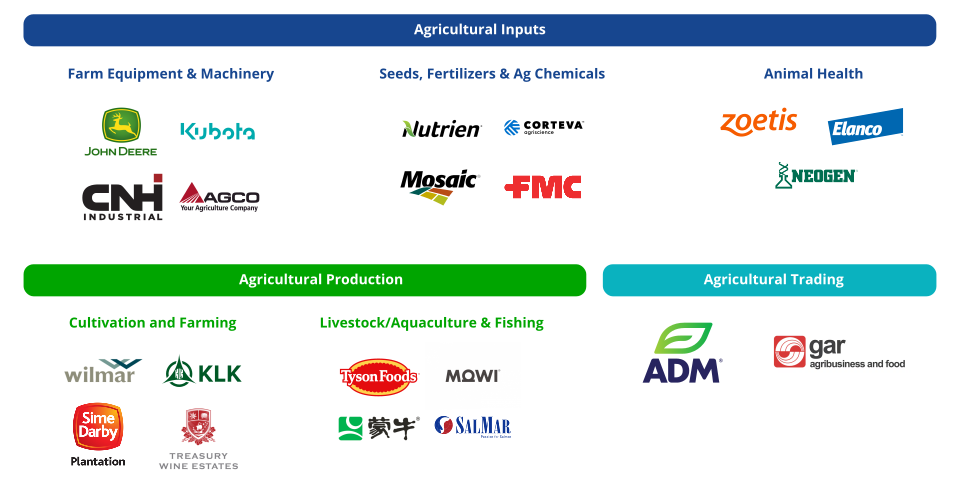
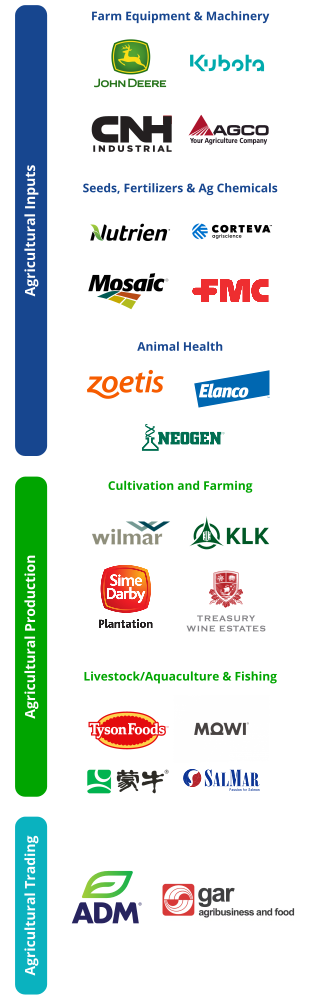
Source: VanEck. Chart for illustrative purposes only. This is not an offer to buy or sell, or recommendation to buy or sell any of the securities mentioned herein.
Each segment of the value chain responds differently to the same underlying pressures. This creates distinct drivers of growth, risk and return. The ETF captures this full ecosystem, offering diversified exposure across three key segments:
1. Agricultural Inputs (Upstream)
These companies provide the essential farming building blocks:
These businesses play an important role in improving crop yields and efficiency as arable land becomes more constrained.
Animal health, which is less directly tied to commodity cycles, has been a relatively resilient contributor within the portfolio. This may reflect the defensive characteristics of certain subsegments.
2. Equipment & Infrastructure (Midstream)
Mechanization and logistics are central to modern agriculture:
These firms may benefit from long-term trends such as precision agriculture and farm automation, while remaining sensitive to farm income cycles.
3. Processing, Trading & Food Production (Downstream)
This segment connects farms to consumers:
These companies play an important role in managing global supply chains by sourcing, storing and distributing food where it is needed most. During periods of volatility, their scale and network advantages may become more relevant.
Understanding how the ETF is constructed helps reinforce how it captures the agribusiness opportunity in practice.
| Ticker | Name | Weight % |
| DE UN | DEERE & CO | 8.77% |
| BAYN GY | BAYER AG | 8.60% |
| CTVA UN | CORTEVA INC | 8.35% |
| NTR UN | NUTRIEN LTD | 7.03% |
| ADM UN | ARCHER-DANIELS-MIDLAND CO | 5.07% |
| ZTS UN | ZOETIS INC | 4.95% |
| 6326 JT | KUBOTA CORP | 4.90% |
| CF UN | CF INDUSTRIES HOLDINGS INC | 4.86% |
| TSN UN | TYSON FOODS INC | 3.53% |
| BG UN | BUNGE LTD | 3.38% |
Source: VanEck and MarketVector Data as of 07/09/2026. This is not an offer to buy or sell, or recommendation to buy or sell any of the securities mentioned herein. Holdings are subject to change.
A snapshot of the ETF’s top holdings highlights exposure to leading global agribusiness companies across inputs, equipment and food production.
Takeaway: The fund is concentrated in established, globally recognized agribusiness companies that play important roles across the food supply chain.
Source: VanEck and MarketVector Data as of 07/09/2026. Chart for illustrative purposes only. Sector allocations are subject to change.
The ETF’s exposure spans key segments of the agricultural supply chain, reflecting the same value chain framework illustrated earlier. Based on the chart, allocations include approximately 25% to seeds, fertilizers and agricultural chemicals, 21% to farm equipment and machinery, 20% to livestock, aquaculture and fishing, 17% to animal health, 10% to agricultural trading and 6% to cultivation and farming.
Takeaway: The portfolio is diversified across multiple parts of the agribusiness value chain, with meaningful exposure to both inputs and downstream activities. This balance may help capture different drivers of performance across the global food supply chain.
Source: VanEck and MarketVector Data as of 07/09/2026. Chart for illustrative purposes only. Country exposures are subject to change.
The portfolio spans both developed and emerging markets, providing global exposure to companies operating across the agricultural value chain.
Takeaway: This global footprint reflects the international nature of food production and distribution, while providing diversified exposure across regions.
The ETF’s exposure reflects the real economy of food production:
This differentiation means the ETF may behave differently than traditional equity portfolios and may offer diversification benefits, particularly during periods of inflation or market stress.
Structural pressures are accelerating innovation across the system. Precision agriculture and automation are improving yields and reducing costs, while biological inputs and sustainable solutions are gaining traction amid environmental concerns. Companies are also investing in supply chain resilience, and innovation in protein production, including aquaculture, is expanding. These developments are reshaping the landscape for agriculture investing.
Inflation and supply disruptions can create short-term volatility, but they also reinforce long-term investment themes. Food security has become a priority for governments and corporations, while higher baseline prices can support revenues across the value chain. At the same time, innovation is accelerating as producers seek to improve efficiency and offset rising costs.
Agribusiness companies are not just exposed to these dynamics. They are also part of the solution.
Agribusiness sits at the intersection of cyclical and structural forces. In the short term, performance is influenced by:
Over the long term, key drivers include:
This cyclical nature can create entry points for long-term investors.
Agriculture is evolving rapidly, driven by technology, sustainability and global demand. The VanEck Agribusiness UCITS ETF provides a way to participate in this transformation through the companies enabling the future of food.
To receive more insights, sign up to our newsletter.
IMPORTANT INFORMATION
This is marketing communication.
This information originates from VanEck (Europe) GmbH, which is authorized as an EEA investment firm under the Markets in Financial Instruments Directive (“MiFiD”). VanEck (Europe) GmbH has its registered address at Kreuznacher Str. 30, 60486 Frankfurt, Germany, and has been appointed as distributor of VanEck products in Europe by the Management Company, VanEck Asset Management B.V.(“ManCo”), which is incorporated under Dutch law and registered with the Dutch Authority for the Financial Markets (AFM).
This material is only intended for general and preliminary information and does not constitute an investment, legal or tax advice. No representation or warranty is made as to the accuracy or completeness of the information and no liability is accepted to the fullest extent permitted by law.
The views and opinions expressed are those of the author(s) but not necessarily those of VanEck. Opinions are current as of the publication date and are subject to change with market conditions. Information provided by third party sources is believed to be reliable and has not been independently verified for accuracy or completeness and cannot be guaranteed.
Please refer to the Prospectus – in English language - and the Key Information Document (“KID”) - in local language - before making any final investment decisions and for full information on risks. These documents can be obtained free of charge at www.vaneck.com, from the ManCo or from the appointed facility agent.
VanEck Agribusiness UCITS ETF ("ETF") is a sub-fund of VanEck UCITS ETFs plc, a UCITS umbrella investment company with limited liability between sub-funds. The ETF is registered with the Central Bank of Ireland, passively managed and tracking an equity index.
The value of the ETF may fluctuate significantly as a result of the investment strategy. The ETF´s holdings are disclosed on each dealing day on www.vaneck.com under the ETF´s Holdings section and as per PCF under the Documents section and published via one or more market data suppliers. The indicative net asset value (iNAV) of the ETF is available on Bloomberg. For details on the regulated markets where the ETF is listed, please refer to the Trading Information section on the ETF page at www.vaneck.com. Investors must buy and sell units of the UCITS on the secondary market via an intermediary (e.g. a broker) and cannot usually be sold directly back to the UCITS. Brokerage fees may incur. The buying price may exceed, or the selling price may be lower than the current net asset value. Investing in the ETF should be interpreted as acquiring shares of the ETF and not the underlying assets. Tax treatment depends on the personal circumstances of each investor and may vary over time. The ManCo may terminate the marketing of the ETF in one or more jurisdictions. The summary of the investor rights is available in English at: summary-of-investor-rights.pdf.
The MarketVector™ Global Agribusiness Index is the exclusive property of MarketVector Indexes GmbH (a wholly owned subsidiary of Van Eck Associates Corporation), which has contracted with Solactive AG to maintain and calculate the Index. Solactive AG uses its best efforts to ensure that the Index is calculated correctly. Irrespective of its obligations towards MarketVector Indexes GmbH (“MarketVector”), Solactive AG has no obligation to point out errors in the Index to third parties. VanEck’s ETF is not sponsored, endorsed, sold or promoted by MarketVector and MarketVector makes no representation regarding the advisability of investing in the ETF. It is not possible to invest directly in an index.
Investing is subject to risk, including the possible loss of principal. For any unfamiliar technical terms, please refer to ETF Glossary | VanEck.
No part of this material may be reproduced in any form, or referred to in any other publication, without express written permission of VanEck.
© VanEck (Europe) GmbH
This is a marketing communication. Please refer to the prospectus of the UCITS and to the KID before making any final investment decisions.
This information originates from VanEck (Europe) GmbH, which has been appointed as distributor of VanEck products in Europe by the Management Company VanEck Asset Management B.V., incorporated under Dutch law and registered with the Dutch Authority for the Financial Markets (AFM). VanEck (Europe) GmbH with registered address at Kreuznacher Str. 30, 60486 Frankfurt, Germany, is a financial services provider regulated by the Federal Financial Supervisory Authority in Germany (BaFin).
The information is intended only to provide general and preliminary information to investors and shall not be construed as investment, legal or tax advice VanEck (Europe) GmbH, VanEck Switzerland AG, VanEck Securities UK Limited and their associated and affiliated companies (together “VanEck”) assume no liability with regards to any investment, divestment or retention decision taken by the investor on the basis of this information. The views and opinions expressed are those of the author(s) but not necessarily those of VanEck. Opinions are current as of the publication date and are subject to change with market conditions. Certain statements contained herein may constitute projections, forecasts and other forward-looking statements, which do not reflect actual results. Information provided by third party sources is believed to be reliable and have not been independently verified for accuracy or completeness and cannot be guaranteed. Brokerage or transaction fees may apply.
All performance information is based on historical data and does not predict future returns. Investing is subject to risk, including the possible loss of principal.
No part of this material may be reproduced in any form, or referred to in any other publication, without express written permission of VanEck.
© VanEck (Europe) GmbH / VanEck Asset Management B.V.
15 October 2026
15 October 2026