As Gold Soars, Opportunity Lies in ‘Better, Not Bigger’ Mining Acquisitions
09 December 2025
Read Time 7 MIN
Monthly gold market and economic insights from Imaru Casanova, Portfolio Manager, featuring her unique views on mining and gold’s portfolio benefits.
Key Takeaways:
- Gold broke above $4,200 in November as markets rapidly shifted rate expectations.
- Record prices are driving more mining sector deal activity, with discipline outweighing scale.
- The most compelling opportunities lie in focused, regional consolidation, not large, complex acquisitions.
Gold Surges as Markets Reprice Fed Expectations
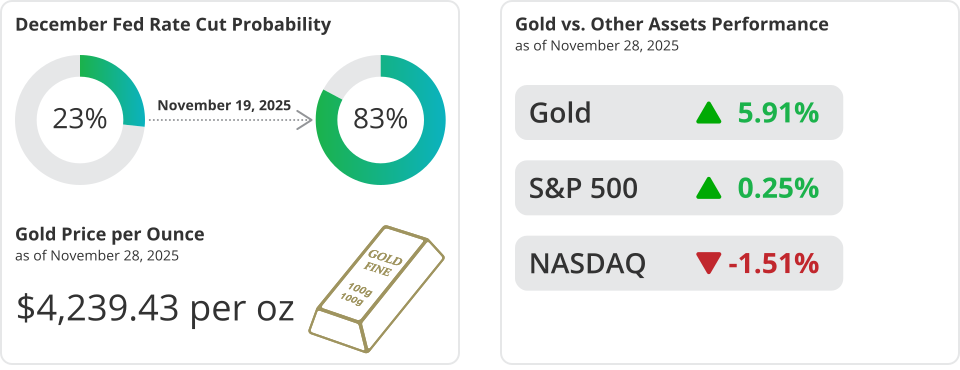
Gold spent November comfortably hovering around the $4,000 mark, even as the odds of a December Fed rate cut declined early in the month. But once markets began actively pricing in a cut, gold took off. The implied probability of a December rate cut jumped from 23% on November 19 to 83% by month-end and gold responded exactly as historical patterns would suggest. Lower rates reduce the opportunity cost of holding gold, allowing its safe-haven appeal to shine a little brighter.
By November 28, gold closed at $4,239.43 per ounce, a gain of $236.52, or 5.91%, for the month. And while equity markets and alternative assets attempted to rebound from their lows, none kept pace. The S&P 5001 finished roughly flat at 0.25%, the NASDAQ2 slipped 1.51%, and bitcoin3 fell 17%. Meanwhile, gold ended the month just $117 shy of its all-time high of $4,356, and gold equities rallied right alongside it, as both the GDMNTR4 and MVGDXTR5 Index jumped 15%.
Rate Cut Hopes Fuel a Gold Rally in November
Record Prices Fuel Rising Transaction Activity
Record gold prices are driving greater deal activity across the mining sector. Strong cash flow generation and improved valuations are giving companies more flexibility to expand and optimize their portfolios. In 2025, the industry saw an uptick in asset sales and purchases, minority equity investments in earlier-stage companies and a rise in corporate-level mergers and acquisitions.
Senior producers have generally focused on portfolio rationalization, using strong gold and silver prices to divest non-core assets at attractive valuations. Rather than pursuing large-scale acquisitions, many are choosing to make smaller, entry-level equity investments in earlier-stage companies to strengthen their longer-term project pipelines. The preference across the industry is clear: funding internally generated, prudently phased growth with operating cash flow rather than higher-risk acquisitions that often require issuing equity, particularly at a time when many companies’ shares still trade at historically low valuations. As a result, companies of all sizes across the sector are taking a disciplined and rigorous approach to M&A.
Why Scale Alone Doesn’t Create Value
Bigger is not always better in the gold mining industry, becoming too large has often created more challenges than benefits. Companies are not looking to grow for growth’s sake. They aim to create value by lowering costs, extending mine life, improving returns on invested capital and reducing operational risk. Achieving all of this is no small task. Miners struggle to find assets of sufficient size and quality to justify the substantial acquisition premiums sellers expect in a strong gold-price environment. This reality helps explain why M&A activity has not accelerated as much as many expected during this cycle.
As shareholders, we welcome this discipline. There are ample opportunities around the world for meaningful regional consolidation, and these tend to be the types of transactions that make the most strategic sense. Mining operations can benefit significantly from synergies created when multiple assets operate as a single district, hub or complex—sharing critical infrastructure, equipment, labor, leadership and technical talent, supply chains and in-country or regional expertise, among other advantages.
Integration Risks: Lessons From Past Consolidations
Even the most obvious consolidation opportunities carry meaningful risks. Consider the challenges Barrick Mining (5.97% of Strategy assets) faced integrating its Nevada assets with Newmont’s (8.44% of Strategy assets) to create the Nevada Gold Mines joint venture, the largest gold mining complex in the world. This combination was clearly necessary, yet it still took years to fully integrate, optimize and fine-tune operations. These assets were not far-flung: they were in the same country, the same state, and in close proximity—mature operations run by the two largest gold mining companies in the world when the JV was formed in 2019.
Integration challenges are amplified when operations differ in geology, mining and processing methods. These challenges grow further when operations are spread across countries or continents that vary in language, levels of government and community involvement, mining codes, regulatory environments, labor laws and operating and safety cultures. Layer onto that the complexity of proper due diligence and the risks compound quickly. Is the deposit’s size and quality truly what the seller claims? Was the feasibility study underpinning the valuation conducted with sufficient technical and economic rigor? Have years of underinvestment or mismanagement compromised operations, infrastructure or community relationships? The list goes on.
Buying a mining asset is nothing like acquiring a factory that simply produces more of what a company already makes, it brings far greater challenges. That’s why companies must carefully evaluate each transaction and weigh these well-known risks against the synergies and improvements they expect to achieve. Reviewing the most common sources of merger and acquisition synergies highlights just how complex it can be to estimate potential value gains.
Types of Synergies and Why They’re Hard to Capture
Operational Synergies
- Economies of scale: Spreading fixed costs, improving bargaining power with suppliers and reducing per-unit operating costs.
- Economies of scope: Sharing infrastructure, technical expertise and equipment.
- Elimination of duplication: Consolidating overlapping functions (HR, finance, IT), reducing overhead and excess capacity in plants or logistics.
Financial Synergies
- Lower cost of capital: Larger, more diversified balance sheets often secure cheaper debt and better financing terms.
- Tax advantages: Using loss carryforwards, asset revaluations and structural tax efficiencies.
- Optimized capital allocation: Surplus cash from one business can be redeployed into other higher-return opportunities.
Strategic Synergies
- Increased market power: Greater market cap, liquidity, broader investor base and the ability to compete in larger transactions.
- Diversification benefits: Revenues generated from multiple mines, allowing more flexibility in meeting companywide targets.
- Enhanced innovation: Combined R&D teams, shared IP and unified technology platforms drive productivity improvements and exploration success.
- Talent lift: Stronger portfolio and improved ability to attract, retain and develop talent.
While these examples may sound compelling, and often appear straightforward on paper, many transactions ultimately fall short of delivering their promised synergies. Common pitfalls include overestimated cost savings or productivity gains, unrealistic integration or development timelines, cultural misalignment, loss of key personnel, complex systems and process integration challenges, and regulatory, labor or community obstacles.
When Breaking Up Creates More Value
Breaking up a company, through a spin-off, split, or divestiture, is often the mirror image of a merger. The premise is that the costs of complexity outweigh the benefits of keeping assets together. A simplified structure can deliver several advantages:
- Sharper management focus on a core portfolio of assets, unlocking new optimization opportunities.
- Better alignment of leadership skills with the specific needs of each business.
- Greater transparency and clarity in setting performance targets, along with stronger ownership and accountability for achieving them.
- More efficient allocation of capital and technical expertise directed where it creates the most value.
- Improved valuation transparency, as investors can more easily assess the business model and risk profile of a streamlined entity.
- Potential market re-rating, with higher-quality assets no longer weighed down by weaker, riskier or underperforming segments.
- A broader investor base, as the newly independent company may meet the criteria of a larger pool of investors.
- Enhanced growth prospects, as a more focused company can pursue a concentrated set of opportunities with greater impact on overall performance.
Most companies promise substantial synergies and value creation when announcing transactions, yet only a few track or disclose the actual gains in the years that follow. This lack of transparency makes it difficult for the market to assess the true economic impact of a merger or breakup, and understandably fuels skepticism.
Our Perspective as Shareholders
As shareholders, we evaluate each transaction closely, assessing both the potential synergies and the likelihood of realizing them. Do the expected benefits truly outweigh the risks? Are we being adequately compensated for any additional risk, or are we leaving value on the table? We then monitor the financial, operational and stock-price performance of the pro forma entities to gauge how successful these transactions ultimately are.
We believe strongly in the need for consolidation in the gold mining sector. The industry remains highly fragmented, yet only a limited number of groups worldwide have the proven capability to find, develop, build and operate mines at the highest standards. In such a complex business, the scarcity of top-tier management is a real structural risk; poor leadership destroys value at every stage of the mining cycle.
From an equity investor’s perspective, placing more assets in the best hands expands our investable universe. This is most effectively achieved in the small-cap and mid-tier space, where opportunities to capture synergies, particularly among geographically proximate operations, are most compelling.
We also see natural limits to scalability in this industry. Even exceptional teams can lose focus as organizations grow too large and talent becomes stretched, ultimately eroding performance. In mining, bigger isn’t always better, but stronger certainly is. The sector faces a wide and constantly shifting range of risks, and long-term value creation largely depends on management’s ability to eliminate, reduce or manage those risks from discovery through production.
Related Insights

Related Insights
10 March 2026
Gold miners are generating record margins and free cash flow as prices remain elevated. With disciplined capital allocation and costs below $2,000 per ounce, the sector appears well positioned for 2026.
10 February 2026
Gold price swings in January highlighted volatility, not weakness. Strong demand, central bank buying and improving miner fundamentals continue to support a durable long-term bull market in 2026.
14 January 2026
Gold hit record highs in 2025 as central banks and investors boosted demand. Mining stocks outpaced bullion, and despite sharp gains, attractive valuations and strong margins point to more upside in 2026.
18 December 2025
Get your portfolio ready for 2026 with detailed insights from VanEck’s investment team about the factors driving risk and returns in their respective asset classes.
18 November 2025
Gold’s rally above $4,000 shows strength amid tight supply and steady demand. Miners remain undervalued, offering potential opportunities if current market trends persist.