Geopolitical Shock Tests Moat Strategies as Energy Surges
10 April 2026
Read Time 8 MIN
Key Takeaways:
- Moat Index fell 9.55%, lagging as zero energy exposure hurt during the sector’s rally.
- Fortinet and Palo Alto outperformed, showing resilience despite broader tech weakness.
- SMID Moat Index, declining 5.40%, kept pace with mid-cap benchmarks, supported by energy and materials exposure.
- SMID Moat leaders included CF Industries, Devon Energy, and EOG, boosted by rising commodity prices.
Index performance is not illustrative of fund performance. It is not possible to invest directly in an index. Past performance is no guarantee of future results.
Fair value estimates and price targets referenced herein are those of Morningstar's equity research team, are subject to change without notice, and do not constitute recommendations or investment advice.
U.S. equity markets suffered a sharp, broad-based decline in March as the escalation of the U.S.-Iran conflict upended what had been a constructive start to the year. The initiation of U.S. and Israeli military strikes on Iran in late February and Iran’s subsequent disruption of oil flows through the Strait of Hormuz sent energy prices surging. Brent crude rose above $100 per barrel during the month. The S&P 500 fell 4.98% in March, while the S&P 500 Equal Weight Index declined 5.97%, reflecting the pervasive nature of the selloff across market capitalizations and styles. Energy was the only positive sector during the month, gaining 10.28%, while industrials, consumer staples, and health care were among the hardest hit, each falling more than 8%. A late-month rally on hopes for a potential ceasefire helped indexes recover from their worst levels, but was not enough to offset a punishing month for equities.
The Morningstar Wide Moat Focus Index (the “Moat Index”) declined 9.55% in March, trailing the S&P 500 by roughly 4.5 percentage points. The Index reached its deepest drawdown around March 27, when cumulative month-to-date losses approached 12%, before a late-month recovery trimmed the gap modestly. Both sector allocation and stock selection weighed on relative performance. The strategy carries no allocation to energy, a reflection of the wide moat requirement for index inclusion, as commodity-oriented businesses rarely develop the durable competitive advantages that Morningstar looks for in assigning wide moat ratings. That absence proved especially costly in March, as energy was the month’s only positive sector. Sizable overweights to industrials and consumer staples, two of the worst-performing sectors, compounded the shortfall. For the first quarter, the Moat Index declined 6.49%, trailing the S&P 500’s 4.33% loss. Even the NASDAQ Composite fell nearly 7%, illustrating how broadly the geopolitical shock weighed on equities regardless of market capitalization or style.
The Morningstar US Small-Mid Cap Moat Focus Index (the “SMID Moat Index”) fell 5.40% in March, essentially matching the S&P MidCap 400’s 5.39% decline while trailing the S&P SmallCap 600, which lost 4.07%. Small- and mid-cap stocks broadly declined alongside large-caps during the month, as the geopolitical uncertainty drove a correlated selloff that offered limited diversification benefit across capitalizations. Attribution was roughly neutral between allocation and selection. The strategy’s energy exposure, a byproduct of the SMID Moat Index’s inclusion of narrow moat companies that broadens the investable universe into sectors like energy where wide moats are scarce, providing a meaningful offset to weakness in consumer discretionary and consumer staples holdings. Materials holdings, led by CF Industries, were the standout positive contributor to relative performance. Through the first quarter, the SMID Moat Index and smaller-cap companies more broadly have fared better than large-cap benchmarks, as the diversified nature of small- and mid-cap exposure has provided a degree of resilience in an uncertain environment.
Geopolitical Shock Pressures Equities in March
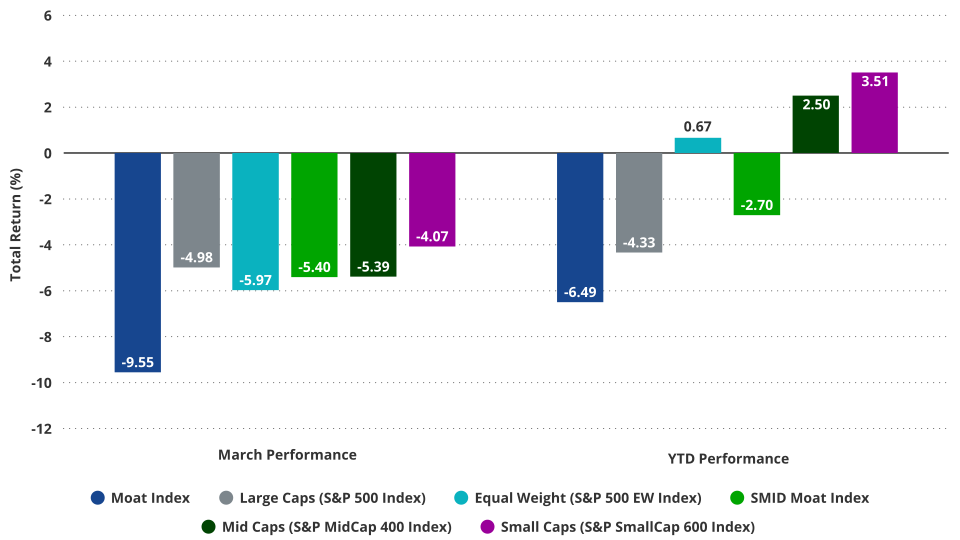
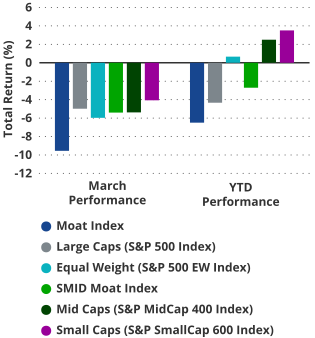
Source: Morningstar. Data as of 3/31/2026. Past performance is no guarantee of future results. Index performance is not representative of fund performance. It is not possible to invest directly in an index. Please see index definitions and other important disclosures at the end of this content. Fund performance current to the most recent month end is available by visiting vaneck.com or by calling 800.826.2333.
Moat Index Leans Into Tech Opportunities at Quarterly Review
Both the Moat and SMID Moat Indexes underwent quarterly reviews on March 20, 2026. Each quarter, Morningstar’s equity research analysts systematically target the most attractively priced, high quality U.S. companies within their respective universes. At the March review, the Moat strategies capitalized on technology dislocations driven by AI uncertainty and geopolitical volatility, adding semiconductor leaders NVIDIA and Broadcom alongside newcomers Palo Alto Networks, Blackstone, and Datadog at attractive valuations. See our blog covering the recent review for additional context and key takeaways. Full results of the quarterly reviews are also available here: Moat Index and SMID Moat Index.
Moat Index Highlights: Cybersecurity Strength in a Difficult Month
March was a challenging month for the Moat Index from a relative performance standpoint, with both sector allocation and stock selection contributing to the shortfall versus the S&P 500. The strategy’s zero exposure to the surging energy sector was a notable headwind, while overweights to industrials and consumer staples, two sectors that bore the brunt of war-related economic concerns, amplified the underperformance. Against this difficult backdrop, the top contributors were concentrated among technology names that managed to buck the broader decline.
Fortinet Inc. (FTNT) and Palo Alto Networks Inc. (PANW) were the leading contributors to Moat Index performance during the month, with both names posting modest gains while the broader technology sector declined. Both are platform-based cybersecurity vendors whose shares held up well amid the market’s risk-off posture. Cybersecurity stocks experienced a brief selloff late in March following reports of a new AI model with advanced vulnerability-finding capabilities. However, Morningstar views the development as likely to expand the cybersecurity addressable market rather than diminish it, as more capable AI tools drive demand for both offensive and defensive security solutions. Morningstar assigns wide moat ratings to both Fortinet and Palo Alto, with Fortinet’s competitive position underpinned by customer switching costs and a reinforcing network effect derived from its expansive installed base, and Palo Alto’s wide moat supported by its entrenched position as a platform vendor with strong customer switching costs across network security, cloud security, and security operations. Both companies trade meaningfully below Morningstar’s fair value estimates.
Other notable contributors during the month included Blackstone Inc. (BX), an alternative asset manager that was added to the Index during the quarterly March reconstitution, and Fair Isaac Corp. (FICO), an analytics and decision management company.
Companies detracting the most from Moat Index performance reflected the broad-based nature of the month’s selloff. The Estee Lauder Companies Inc. (EL), a prestige beauty company, was the largest detractor, with shares falling roughly 34% amid ongoing operational challenges. Huntington Ingalls Industries Inc. (HII), a defense and shipbuilding company; Clorox Co. (CLX), a consumer products company; United Parcel Service Inc. (UPS), a global logistics provider; and Otis Worldwide Corp. (OTIS), an elevator and escalator manufacturer, also weighed meaningfully on results. The detractors were spread across consumer staples and industrials, the two sectors most heavily overweighted in the portfolio, reflecting the outsized impact those sector tilts had during a month when defensive and cyclical names alike were caught in the downdraft.
Moat Index Top Contributors and Detractors - March 2026
Contributors
| Company | Ticker | Sector | Avg. Weight (%) | Contribution (%) |
| Fortinet Inc. | FTNT | Technology | 2.57 | 0.08 |
| Blackstone Inc. | BX | Financials | 0.30 | 0.08 |
| Fair Isaac Corp. | FICO | Technology | 0.22 | 0.06 |
| Palo Alto Networks Inc. | PANW | Technology | 0.28 | 0.02 |
| Oracle Corp. | ORCL | Technology | 0.88 | 0.01 |
Detractors
| Company | Ticker | Sector | Avg. Weight (%) | Contribution (%) |
| The Estee Lauder | EL | Consumer Staples | 2.76 | -0.95 |
| Huntington Ingalls Industries | HII | Industrials | 3.55 | -0.52 |
| Clorox Co. | CLX | Consumer Staples | 2.75 | -0.51 |
| United Parcel Service Inc. | UPS | Industrials | 3.06 | -0.46 |
| Otis Worldwide Corp. | OTIS | Industrials | 2.54 | -0.42 |
Source: Morningstar. Past performance is no guarantee of future results. Index performance is not illustrative of fund performance. Not intended as a recommendation to buy or to sell any of the securities mentioned herein.
SMID Moat Index Highlights: Energy and Materials Offset Broad Weakness
The SMID Moat Index navigated the turbulent March environment more effectively on a relative basis, with allocation and selection effects roughly neutral versus benchmarks. The strategy’s exposure to energy and materials provided a meaningful counterweight to weakness elsewhere, helping the Index keep pace with the S&P MidCap 400 despite the challenging backdrop.
CF Industries Holdings Inc. (CF) was the standout contributor, with shares surging approximately 30% during the month. As the largest nitrogen fertilizer producer in North America, CF Industries is a direct beneficiary of the supply disruption caused by the U.S.-Iran conflict, which has curtailed Middle Eastern nitrogen exports and driven fertilizer prices sharply higher. Morningstar raised its fair value estimate for CF to $135 per share in mid-March, citing expectations that the conflict will support elevated nitrogen prices in the near term. Morningstar assigns CF a narrow moat rating based on the company’s cost-advantaged position, as over 90% of its nitrogen production uses low-cost North American natural gas as feedstock, placing it well below the marginal cost of global production.
Devon Energy Corp. (DVN) and EOG Resources Inc. (EOG) also contributed meaningfully, with each gaining roughly 16% during the month as rising oil prices lifted the domestic exploration and production sector broadly. Both companies are positioned at the low end of the U.S. shale cost curve, with Devon’s reconstituted portfolio anchored in the Delaware Basin and EOG’s multibasin approach emphasizing its highest-return drilling locations. Morningstar assigns both companies narrow moat ratings based on cost advantages derived from access to premier acreage with intrinsically low extraction costs.
Other notable contributors included Akamai Technologies Inc. (AKAM), a content delivery and cybersecurity company, and Marvell Technology Inc. (MRVL), a semiconductor firm.
Several of the SMID Moat Index’s largest detractors mirrored those seen in the Moat Index. The Estee Lauder Companies Inc. (EL) and Huntington Ingalls Industries Inc. (HII) were again among the weakest performers, while Carnival Corp. (CCL), a cruise line operator that suffered from rising fuel costs and travel disruption fears, also detracted. Otis Worldwide Corp. (OTIS) and GE HealthCare Technologies Inc. (GEHC), a medical technology company, rounded out the bottom five.
SMID Moat Index Top Contributors and Detractors - March 2026
Contributors
| Company | Ticker | Sector | Avg. Weight (%) | Contribution (%) |
| CF Industries Holdings Inc. | CF | Materials | 1.64 | 0.50 |
| Akamai Technologies Inc. | AKAM | Technology | 0.75 | 0.13 |
| Marvell Technology Inc. | MRVL | Technology | 0.58 | 0.12 |
| Devon Energy Corp. | DVN | Energy | 0.75 | 0.12 |
| EOG Resources Inc. | EOG | Energy | 0.73 | 0.12 |
Detractors
| Company | Ticker | Sector | Avg. Weight (%) | Contribution (%) |
| The Estee Lauder Companies Inc. | EL | Consumer Staples | 0.85 | -0.29 |
| Huntington Ingalls Industries Inc. | HII | Industrials | 1.99 | -0.29 |
| Carnival Corp. | CCL | Consumer Discretionary | 1.46 | -0.26 |
| Otis Worldwide Corp. | OTIS | Industrials | 1.42 | -0.24 |
| GE HealthCare Technologies Inc. | GEHC | Health Care | 1.41 | -0.22 |
Source: Morningstar. Past performance is no guarantee of future results. Index performance is not illustrative of fund performance. Not intended as a recommendation to buy or to sell any of the securities mentioned herein.
Choose Your Moat Strategy
VanEck’s suite of moat investing strategies is powered by Morningstar’s equity research team, which seeks quality companies trading at attractive valuations. The below ETFs offer access to US moat companies:
VanEck Morningstar Wide Moat ETF (MOAT): companies with a wide moat rating, which means Morningstar believes the company is likely to sustain its competitive advantage for at least the next 20 years.
VanEck Morningstar SMID Moat ETF (SMOT): small and mid-cap moat companies.
VanEck Morningstar Wide Moat Value ETF (MVAL): wide moat companies within Morningstar’s value style category.
Related Insights

Related Insights
30 March 2026
The Moat Index added NVIDIA, Broadcom and new names following its quarterly review, as tech dislocations created opportunity, while maintaining a value tilt and notable discount to fair value.
11 March 2026
Valuation discipline and sector allocation tilted exposure towards consumer staples, industrials and health care, supporting gains as software lagged.
12 January 2026
A strong December capped a year of resilience for moat strategies, as quality stock selection and renewed exposure to mega-caps position them for 2026.
23 December 2025
The 4Q 2025 reconstitution of the Morningstar® Wide Moat Focus Index saw selective additions to the Magnificent 7, including NVIDIA and Meta, as AI-driven volatility created valuation opportunities. Despite adding growth-oriented tech names, the Index remains contrarian.
09 December 2025
Market breadth improved in November, lifting both the Moat Index and SMID Moat Index, with health care and materials driving gains despite weakness in technology and consumer names.