Welcome to VanEck
Select Investor Type
13 July 2026
SpaceX, Virgin Galactic and Gogo are referenced for illustrative purposes only to describe structural developments in the space economy. These companies are not held by the VanEck Space Innovators UCITS ETF (JEDI) at the time of writing. References to specific companies do not constitute a recommendation to buy or sell any security. Past performance is not a reliable indicator of future results.
In June 2022, the commercial space economy sat at the edge of most investors’ maps. Launch costs were falling and a new generation of companies was emerging beyond the traditional aerospace giants – yet few vehicles existed to invest in the theme as a whole. VanEck saw a structural shift in the making and built one of Europe’s first ETFs dedicated to it. Four years later, space has moved from a niche curiosity to one of the most anticipated investable themes.
Thematic investing rests on a simple but demanding principle: recognize a structural shift before it becomes consensus and remain invested through the years it takes to unfold. Being early is only half of the discipline; the conviction to stay the course is what gives a long-term theme room to develop. As a pioneer in thematic and innovative investment since 1955, VanEck has built its reputation on opening access to ideas before they reach the mainstream, from gold and natural resources to semiconductors, defense, quantum computing, and now space.
That is what VanEck stands for: helping our clients access tomorrow’s market opportunities with carefully crafted products, and a long-term perspective rather than promises.
When the fund launched in June 2022, the commercial space economy still sat at the edge of most investors' maps. Launch costs had fallen sharply over the preceding decade, satellites were becoming far more capable, and a new generation of listed companies was emerging beyond the traditional aerospace giants.
For much of 2022 and 2023, progress was real but easy to overlook. The industry's growth appeared first in operational metrics rather than market valuations or headlines. Global orbital launches increased from 186 in 2022 to 259 in 20241. Over the same period, the number of active satellites in orbit surpassed 10,000 for the first time, driven primarily by the deployment of large low-Earth-orbit broadband constellations2. These were also years of laying the technological groundworks for the next steps: NASA's Artemis I mission flew an uncrewed Orion spacecraft around the Moon, the first step of NASA's program to return astronauts to the Moon3; and SpaceX conducted the first integrated flight tests of Starship, the most powerful launch system ever built4. Beneath the headlines, the investable universe continued to broaden as companies across launch, satellite manufacturing, communications and lunar exploration entered public markets. The industry was clearly advancing, even if investors' attention had not yet fully caught up.
Source: Space Stats. (2026). Orbital launches by year. Space Stats
From 2024, that began to change. Space increasingly became viewed as a strategic asset, not only for communications and navigation, but also for national security, resilience, and technological sovereignty. Several milestones reinforced this shift, including the successful validation of NASA's DART planetary-defense mission, which altered the orbit of an asteroid5. Most importantly from a commercial perspective, direct-to-device satellite communications moved from concept to reality: AST SpaceMobile completed the world's first voice call and later the first 5G broadband connection from space to an ordinary, unmodified smartphone6, while Starlink began testing direct-to-cell services with telecom partners7. These developments pointed to an industry maturing simultaneously across exploration, connectivity, and defense. As opportunities expanded into increasingly specialized niches, from orbital servicing and debris removal to synthetic-aperture radar and geospatial intelligence, external forecasts began reflecting the scale of the opportunity. The World Economic Forum and McKinsey estimate the global space economy could reach $1.8 trillion by 2035, thus tripling in the next decade8.
Through 2025, the different parts of the value chain began to reinforce one another. Satellite connectivity edged closer to commercial reality; Earth-observation data found new AI-driven uses, and steady government demand supported order books across satellite systems, robotics and communications infrastructure. Commercial momentum built alongside it: from NASA's funding of privately operated successors to the International Space Station9 to the rollout of new low-Earth-orbit broadband constellations10. Space was no longer just about reaching orbit, it was increasingly about what could be built, connected and understood from there.
The theme's move into the mainstream became unmistakable in 2026, when SpaceX completed the largest IPO in history (listing on the Nasdaq in June at a valuation above $2 trillion)11 set against a broader backdrop of ambition that included NASA's Artemis II, the first crewed mission back toward the Moon in more than half a century12. The intensity of that attention carried a lesson for investors in its own right: innovation-led themes rarely move in a straight line, and capital can rotate sharply between established names and new arrivals. That is precisely why JEDI's rules-based approach matters: a theme built on innovation will always throw up both leaders and laggards, and a disciplined methodology lets the portfolio evolve as the industry does. Four years on, the question is no longer whether space is investable, but how best to access it.
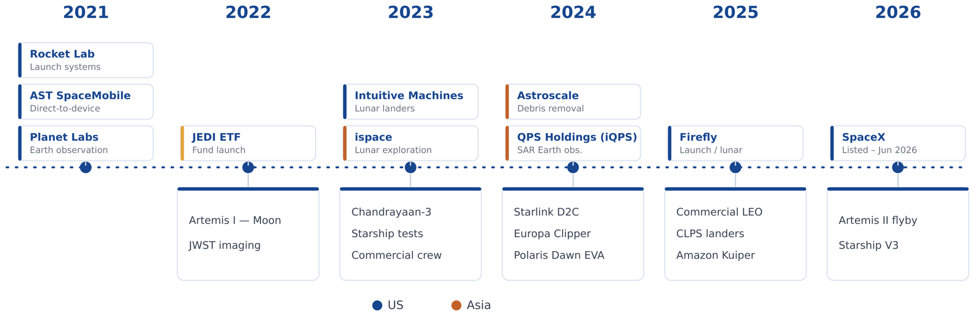
Source: VanEck analysis on IPO & company filings; NASA; ISRO
Being early is one discipline; being pure is another. Space exposure can be accessed in many ways, but much of it sits inside large aerospace, defense or telecom conglomerates, where space may represent only a fraction of revenue. JEDI was designed to avoid that dilution. It targets companies for which space is central to the business, and spreads exposure across the full value chain rather than concentrating on one or two high-profile names.
That breadth is important. The modern space economy is not a single industry but an ecosystem: launch providers, satellite manufacturers, communications networks, Earth-observation platforms, data-analytics specialists and infrastructure companies all play different roles. The OECD describes the sector as increasingly global, supported by more government space programs, more commercial actors and the maturing of new space systems13.
| Company | Role in the space value chain | Past return since ETF inception* | Weight |
| Rocket Lab | Launch & space systems — getting to orbit | +2,506% | 7.86% |
| AST SpaceMobile | Direct-to-device satellite broadband | +1,570% | 8.14% |
| Planet Labs | Earth observation & geospatial data | +578% | 6.90% |
Source: Morningstar Direct / VanEck; includes holdings since removed from the index. Data as of June 30 2026. Past performance is not a reliable indicator of future results.
The breadth is easiest to see company by company just looking at the top 3 contributors. These three companies illustrate how the commercial space economy has matured from infrastructure to services: Rocket Lab provides the launch and orbital hardware backbone, while AST SpaceMobile is building the direct-to-device connectivity layer. Planet Labs captures one of the most important shifts: that in the modern space economy, the greatest value is increasingly created not by reaching orbit, but by what you do with the data once you're there.
Together, these businesses trace the full arc of the modern space economy: reaching orbit, building infrastructure in orbit, connecting through orbit and transforming orbital data into commercial intelligence on Earth.
Crucially, not every part of the investment case has worked and that is equally instructive.
| Company | Role in the space value chain | Past return since ETF inception* | Weight |
| Virgin Galactic | Space tourism & suborbital human spaceflight | -95.29% | Excluded |
| Gogo Inc | In-flight broadband connectivity | -72.68% | Excluded |
| Eutelsat Communications | Satellite communications & connectivity | -58.91% | 1.94% |
Source: Morningstar Direct / VanEck; includes holdings since removed from the index. Data as of June 30 2026. Past performance is not a reliable indicator of future results.
Space tourism, once viewed as one of the defining commercial opportunities of the sector, remains far from achieving meaningful scale. Virgin Galactic, among the most widely recognized names in the industry at the start of the decade, lost more than 90% of its value during the fund's lifetime and was removed from the ETF in 202414.
The lesson is that technological feasibility and commercial success are not the same thing. Some of the sector's most heavily publicized concepts generated enormous attention but failed to develop sustainable business models. Over the fund's life, the gap between the strongest and weakest performers exceeded 2,600 percentage points, an unusually wide dispersion even by innovation-sector standards. Space remains a highly technical industry in which the dominant technologies, business models and competitive advantages are still being established. Predicting the long-term winners with confidence is exceptionally difficult, and history suggests that many of the companies investors focus on today may not be the ones defining the industry a decade from now.
Momentum across the space sector is strong today, but the more important point for investors is the long-term trajectory. Themes like this rarely move in a straight line – periods of enthusiasm can be followed by volatility, and short-term swings are part of investing in innovation. That is why JEDI follows a clear, rules-based index methodology and a balanced, diversified approach across the space value chain, rather than concentrated bets. The aim is durable exposure to a structural theme, not a forecast of where prices go next.
“We were among the first to give European investors a way to participate in the space economy – because that is what VanEck has always done: open the door to opportunities others overlook. Four years on, our belief in the space economy is only stronger – and we are as committed to that vision today as we were on day one.”
- Martijn Rozemuller, CEO, VanEck Europe
Four years on, JEDI has grown from an early idea into an established way to invest in the space economy. Its next chapters – deeper exploration, expanding satellite networks, AI-oriented use cases and the companies still to reach the public markets – are only beginning to unfold. For patient investors, the story is still in its opening chapters.
1 Space Stats . (2026). Orbital launches by year. Space Stats
2 European Space Agency. (2025). ESA space environment report 2025. ESA Space Debris Office.
3 NASA. (2022). Artemis I. National Aeronautics and Space Administration.
4 SpaceX. (2026). Starship. SpaceX.
5 NASA. (2022). DART: Double Asteroid Redirection Test. NASA Science.
6 AST SpaceMobile. (2023, April 25). AST SpaceMobile completes the first-ever space-based voice call using everyday, unmodified smartphones. AST SpaceMobile.
AST SpaceMobile. (2023, September 19). First-ever 5G connectivity from space to everyday smartphones. AST SpaceMob
7 T-Mobile. (2024). T-Mobile opens registration for Direct-to-Cell satellite service beta test with Starlink. T-Mobile Newsroom.
8 World Economic Forum & McKinsey & Company. (2024, April). Space: The $1.8 trillion opportunity for global economic growth. World Economic Forum.
9 NASA. (2025). Commercial space stations in low Earth orbit. National Aeronautics and Space Administration.
10 Amazon. (2026). Amazon Leo mission updates. About Amazon.
Space Intel Report. (2026). Europe's IRIS² constellation adds 66 early-delivery satellites. Space Intel Report
11 CNN. (2026, June 12). SpaceX shares debut after the biggest IPO in history. CNN Business.
12 NASA. (2026). Artemis II. National Aeronautics and Space Administration
13 OECD. (2023). The space economy in figures. OECD Publishing.
14 Morningstar Direct / VanEck. Data as of June 30 2026. Past performance is not a reliable indicator of future results.
IMPORTANT INFORMATION
This is marketing communication.
This information originates from VanEck Switzerland AG, which has been appointed as distributor of VanEck products in Switzerland by the Management Company, VanEck Asset Management B.V. (“ManCo”), incorporated under Dutch law and registered with the Dutch Authority for the Financial Markets (AFM). VanEck Switzerland AG’s registered address is at Genferstrasse 21, 8002 Zürich, Switzerland. The representative in Switzerland is Zeidler Regulatory Services (Switzerland) AG, Stadthausstrasse 14, CH-8400 Winterthur, Switzerland. Swiss paying agent: Helvetische Bank AG, Seefeldstrasse 215, CH-8008 Zürich.
This material is only intended for general and preliminary information and does not constitute an investment, legal or tax advice. VanEck Switzerland AG and its associated and affiliated companies (together “VanEck”) assume no liability with regards to any investment, divestment or retention decision on the basis of this information. All relevant documentation must be first consulted.
The views and opinions expressed are those of the author(s) but not necessarily those of VanEck. Opinions are current as of the publication date and are subject to change with market conditions. Information provided by third party sources is believed to be reliable and has not been independently verified for accuracy or completeness and cannot be guaranteed.
Please refer to the Prospectus – in English language - and the KID/KIID - in local language - before making any final investment decisions and for full information on risks. These documents can be obtained free of charge at www.vaneck.com, from the ManCo or from the appointed facility agent.
VanEck Space Innovators UCITS ETF ("ETF") is a sub-fund of VanEck UCITS ETFs plc, a UCITS umbrella investment company, registered with the Central Bank of Ireland, passively managed and tracking an equity index. The product described herein aligns to Article 8 Regulation (EU) 2019/2088 on sustainability-related disclosures in the financial services sector. Information on sustainability-related aspects pursuant to that regulation can be found on www.vaneck.com. Investors must consider all the fund's characteristics or objectives as detailed in the prospectus, in the sustainability-related disclosures or related documents before making an investment decision.
The value of the ETF may fluctuate significantly as a result of the investment strategy. The ETF´s holdings are disclosed on each dealing day on www.vaneck.com under the ETF´s Holdings section and as per PCF under the Documents section and published via one or more market data suppliers. The indicative net asset value (iNAV) of the ETF is available on Bloomberg. For details on the regulated markets where the ETF is listed, please refer to the Trading Information section on the ETF page at www.vaneck.com. Investors must buy and sell units of the UCITS on the secondary market via an intermediary (e.g. a broker) and cannot usually be sold directly back to the UCITS. Brokerage fees may incur. The buying price may exceed, or the selling price may be lower than the current net asset value. Investing in the ETF should be interpreted as acquiring shares of the ETF and not the underlying assets. Tax treatment depends on the personal circumstances of each investor and may vary over time. The ManCo may terminate the marketing of the ETF in one or more jurisdictions. The summary of the investor rights is available in English at: summary-of-investor-rights.pdf.
MarketVector Global Space Industry Screened Index is the exclusive property of MarketVector Indexes GmbH (a wholly owned subsidiary of Van Eck Associates Corporation), which has contracted with Solactive AG to maintain and calculate the Index. Solactive AG uses its best efforts to ensure that the Index is calculated correctly. Irrespective of its obligations towards MarketVector Indexes GmbH (“MarketVector”), Solactive AG has no obligation to point out errors in the Index to third parties. VanEck’s ETF is not sponsored, endorsed, sold or promoted by MarketVector and MarketVector makes no representation regarding the advisability of investing in the ETF. It is not possible to invest directly in an index.
Source: VanEck. Performance quoted represents past performance. Current performance may be lower or higher than average annual returns shown. Performance data for the Irish domiciled ETFs is displayed on a Net Asset Value basis, in Base Currency terms, with net income reinvested, net of fees. Returns may increase or decrease as a result of currency fluctuations. Performance should be assessed over a medium- to long-term.
Investing is subject to risk, including the possible loss of principal. For any unfamiliar technical terms, please refer to ETF Glossary | VanEck.
No part of this material may be reproduced in any form, or referred to in any other publication, without express written permission of VanEck.
© VanEck Switzerland AG
This is a marketing communication. Please refer to the prospectus of the UCITS and to the KID before making any final investment decisions.
This information originates from VanEck Switzerland AG which has been appointed as distributor of VanEck products in Switzerland by the Management Company VanEck Asset Management B.V., incorporated under Dutch law and registered with the Dutch Authority for the Financial Markets (AFM). VanEck Switzerland AG’s registered address is at Genferstrasse 21, 8002 Zürich, Switzerland.
The information is intended only to provide general and preliminary information to investors and shall not be construed as investment, legal or tax advice. VanEck Switzerland AG and its associated and affiliated companies (together “VanEck”) assume no liability with regards to any investment, divestment or retention decision taken by the investor on the basis of this information. The views and opinions expressed are those of the author(s) but not necessarily those of VanEck. Opinions are current as of the publication date and are subject to change with market conditions. Certain statements contained herein may constitute projections, forecasts and other forward-looking statements, which do not reflect actual results. Information provided by third party sources is believed to be reliable and have not been independently verified for accuracy or completeness and cannot be guaranteed. Brokerage or transaction fees may apply. A copy of the latest prospectus, the Articles, the Key Information Document, the annual report and semi-annual report can be found on our website www.vaneck.com or can be obtained free of charge from the representative in Switzerland: First Independent Fund Services Ltd, Feldeggstrasse 12, 8008 Zurich, Switzerland. Swiss paying agent: Helvetische Bank AG, Seefeldstrasse 215, CH-8008 Zürich.
All performance information is based on historical data and does not predict future returns. Investing is subject to risk, including the possible loss of principal.
No part of this material may be reproduced in any form, or referred to in any other publication, without express written permission of VanEck.
© VanEck Switzerland AG