Welcome to VanEck
Select Investor Type
26 May 2021
Negative headlines in Latin America (LatAm), and in particular Brazil, have undermined recent ESG-related progress that has been made in the region. Within LatAm, Brazil is leading in the ESG space, paving the way for sustainable investing across the region.
The portfolio companies in the VanEck Emerging Markets Equity Strategy are leaders, innovators and disruptors across sectors and industries in emerging markets countries around the world, Brazil included. ESG risks and opportunities are integrated into business models and decision making. Company engagement is the very core of the investment approach and two portfolio companies – VAMOS1 and Rumo SA2 – showcase our differentiated approach to collaborative engagements, the depth and breadth of our Research Team and alpha delivered over time.
There are abundant opportunities for companies to embrace ESG practices in Latin America as a result of the following factors: 1) 30% of global biodiversity is in the region; 2) most LatAm countries signed the Paris Agreement on Climate Change,3 with most committing to 20-30% in greenhouse gas reductions and Brazil, one of the most ambitious, committing to a 43% reduction by 2030; and 3) a blue (or maritime) economy is important for the region, as Brazil, Peru and Chile are among the world´s largest fish producers.4
From the ESG company engagement standpoint, it is trending upwards in the region. The number of the Principles for Responsible Investment (PRI) members grew seven times over the last couple of years, as outlined in the chart below.
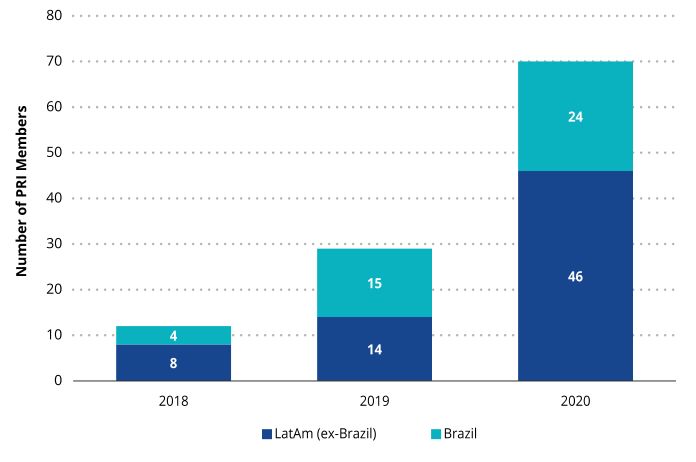
Source: BTG Pactual Global Research, PRI. Data as of 26 February 2021.
Brazil has been very exciting to watch, as it paves the way for sustainable investing in the region. It currently ranks #3 out of 24 countries according to the JPM ESG momentum score, a significant improvement to the country’s ESG scores. This rank is built from a bottom-up perspective, considering companies' positioning with regards to eight ESG factors, as highlighted below.5
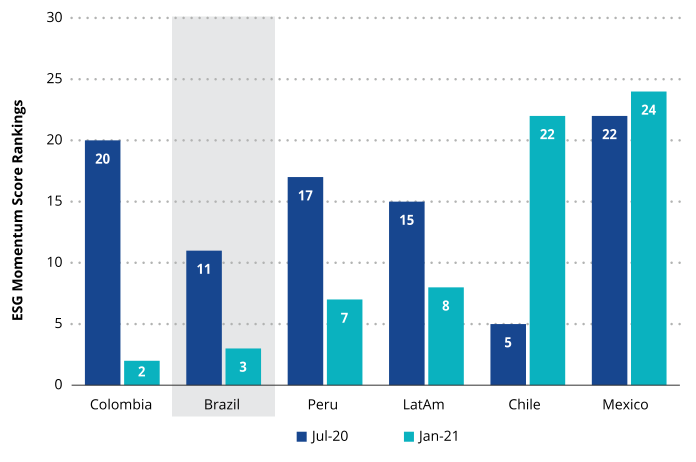
Please note, lower number is better, indicating a country’s improvement in ESG scores.
Source: J.P. Morgan. Data as of 4 February 2021.
| Environmental | ||
| Emissions & Waste |
|
|
| Environmental Policy |
|
|
| Resource Efficiency |
|
|
| Social | ||
| Human & Labor Rights |
|
|
| Customer & Community Satisfaction |
|
|
| Employment Policy |
|
|
| Governance | ||
| Risk & Controls |
|
|
| Capital Management |
|
|
Source: J.P. Morgan. Data as of 4 February 2021.
VAMOS (0.50% of Strategy assets) is the leader in the truck, machinery and equipment rental in Brazil. The company offers customized solutions to clients with long-term contracts (five years).
Our Structural Growth Thesis:
ESG Tilt:
VAMOS is fully committed to ESG from the company’s business model and decision-making perspective. The issuer has a dedicated Sustainability Committee responsible for working closely with the Board of Directors on the sustainability of the business, by means of (i) monitoring the implementation of policies, strategies, actions and projects related to the sustainable development of the business, including socio-environmental management and communication, and (ii) evaluating reports issued by regulating agencies, especially regarding sustainable development.
VAMOS ESG initiatives include the following:
Source: J.P. Morgan. Data as of 9 March 2021.
More recently (as of 29 April 2021), as the company is expanding its portfolio of products, VAMOS just announced its acquisition of BYD 436 electric forklift trucks, further reiterating its commitment to sustainability and alignment with ESG goals.9
Overall, we strongly believe that VAMOS is well positioned as a forward-looking, sustainable and structural growth company, fully equipped to capture sector growth and further expansion in Brazil, given its leadership position, platform and scale advantage and low industry penetration level. Its business model and company management are leading ESG standards in the space, naturally contributing to the reduction of polluting gases and to healthy, safe and efficient businesses.
Rumo SA – All Aboard Towards a Greener Future
Rumo SA (0.53% of Strategy assets) is the largest railway operator in Brazil, offering logistic services for rail transportation, port elevation and warehousing. The company owns and operates a large asset base, including a rail network consisting of five concessions with approximately 13,500 kilometers of lines, 1,200 locomotives and 33,000 wagons, as well as distribution centers and storage facilities.10
Our Structural Growth Thesis:
ESG Tilt:
Rumo is fully committed to ESG from the company’s business model and decision-making perspective. The company’s sustainability strategy can be summarized in two pillars:
Rumo’s ESG initiatives include the following:
The company is aligned with nine UN Sustainable Development Goals (SDGs), including three long-term goals related to CO2 emissions.
Source: Santander Research, Company Data. Data as of 5 January 2021.
Overall, we believe Rumo is well positioned as a forward-looking and sustainable company, fully equipped to deliver structural growth in Brazil, while contributing to the reduction of the hundreds of trucks on the road, thereby reducing carbon emissions and the number of accidents, improving traffic in cities and increasing the safety of its population.
The VanEck Emerging Markets Equity Strategy is a long-term investor in forward-looking, sustainable and structural growth companies across sectors and industries in emerging markets around the world, LatAm included. Within LatAm, Brazil is leading in the ESG space, paving the way for sustainable investing in the region which is of utmost importance, given the region’s footprint in the global ecosystem.
Given our bottom-up approach to investing, the VanEck Emerging Markets Equity Team strives to analyze all risks and opportunities, including ESG, as they pertain to an investment in an issuer.
One consequence of the Strategy’s investment philosophy, process and approach is that the Portfolio Manager and Investment Team seek to avoid exposure (direct or indirect) to a number of controversial sectors, for example, fossil fuel, weapons manufacturing and tobacco companies. (Their list of exclusions is consistent with that from Norges Bank used by our UCITS vehicle.)
In addition, since VanEck is both a signatory to the Principles for Responsible Investment (PRI) and in compliance with the most recent Sustainable Finance Disclosure Regulation (SFDR) in Europe, the VanEck Emerging Markets Equity Strategy’s ESG factors can often align with those of such important global initiatives as the UN Sustainable Development Goals (UN SDGs)15, the Task Force on Climate-Related Financial Disclosures (TCFD)16 and EU Taxonomy17, among others. Under the SFDR regulation effective as of 10 March 2021, the Strategy’s UCITS vehicle is categorized as “light green” or Article 8.
Emerging markets investing is for the long haul and we strongly believe that the Strategy is well positioned to capture the forward-looking, sustainable and structural growth in the EM space globally.
1 VAMOS is 0.50% of Strategy assets as of 31 March 2021.
2 Rumo SA is 0.53% of Strategy assets as of 31 March 2021.
3 The Paris Agreement on Climate Change is an agreement within the UN Framework on climate change mitigation, adaptation and finance. The agreement's language was negotiated by representatives of 196 state parties at the 21stConference of the Parties of the United Nations Framework Convention on Climate Change (UNFCCC) and adopted by consensus in 2015. As of March 2021, 191 members of the UNFCCC are parties to the agreement.
4 Source: BTG Pactual Global Research, PRI. Data as of 26 February 2021.
5 Source: J.P. Morgan. Data as of 4 February 2021.
6 B3, which stands for Brasil, Bolsa, Balcão, formerly BM&FBOVESPA, is a stock exchange located in São Paulo, Brazil, and the second oldest of the country.
7 In Brazil, B3 Novo Mercado is considered the highest standard of corporate governance, L1 and L2.
Source: BofA Global Research. Data as of 10 February 2021.
8 Source: Company Data. Data as of 31 March 2021.
9 Source: Banco Bradesco BBI S.A. Data as of 29 April 2021.
10 Source: Company Data, Framework and Overview. As of 31 March 2021.
11 Source: Company Data. As of 31 March 2021.
12 Railway improvements can be improvements from the raw material used to build and renovate the tracks to technology used to control locomotives. Source: Company Data, Framework and Overview. As of 31 March 2021.
13 Improvements of the quality of raw materials are aligned with the UN SDG 12 – Responsible Consumption and Production –it is directly correlated with positive impact with regards to safety and reliability of operations.
Source: Company Data, Framework and Overview. As of 31 March 2021.
14 Source: Company Data. As of 31 March 2021.
15 The Principles for Responsible Investment (PRI) provides research and education, and facilitates collaboration, to help investors align their responsible investment practices with the broader sustainable objectives of society – as currently best defined by the UN SDGs.
Norges Bank expectations of companies largely coincide with the UN SDGs as well.
The EU Sustainable Finance Disclosure Regulation (SFDR) – on 25 September 2015, the UN General Assembly adopted a new global sustainable development framework: the 2030 Agenda for Sustainable Development (the “2030 Agenda”), which has at its core the UN SDGs. The EU Commission Communication of 22 November 2016 on the next steps for a sustainable European future links the SDGs to the Union policy framework to ensure that all Union actions and policy initiatives, both within the Union and globally, take the SDGs on board at the outset. In its conclusions of 20 June 2017, the Council confirmed the commitment of the Union and its Member States to the implementation of the 2030 Agenda in a full, coherent, comprehensive, integrated and effective manner, and in close cooperation with partners and other stakeholders.
16 Task Force on Climate-Related Financial Disclosures (TCFD) are included in the PRI Reporting under climate-related risks, climate-related opportunities, physical climate risks and transition risks.
17 EU Taxonomy is a part of the SFDR Regulation mentioned above, scheduled to roll out in 2022 and 2023:
This is a marketing communication. Please refer to the prospectus of the UCITS and to the KID before making any final investment decisions.
This information originates from VanEck (Europe) GmbH, which has been appointed as distributor of VanEck products in Europe by the Management Company VanEck Asset Management B.V., incorporated under Dutch law and registered with the Dutch Authority for the Financial Markets (AFM). VanEck (Europe) GmbH with registered address at Kreuznacher Str. 30, 60486 Frankfurt, Germany, is a financial services provider regulated by the Federal Financial Supervisory Authority in Germany (BaFin).
The information is intended only to provide general and preliminary information to investors and shall not be construed as investment, legal or tax advice VanEck (Europe) GmbH, VanEck Switzerland AG, VanEck Securities UK Limited and their associated and affiliated companies (together “VanEck”) assume no liability with regards to any investment, divestment or retention decision taken by the investor on the basis of this information. The views and opinions expressed are those of the author(s) but not necessarily those of VanEck. Opinions are current as of the publication date and are subject to change with market conditions. Certain statements contained herein may constitute projections, forecasts and other forward-looking statements, which do not reflect actual results. Information provided by third party sources is believed to be reliable and have not been independently verified for accuracy or completeness and cannot be guaranteed. Brokerage or transaction fees may apply.
All performance information is based on historical data and does not predict future returns. Investing is subject to risk, including the possible loss of principal.
No part of this material may be reproduced in any form, or referred to in any other publication, without express written permission of VanEck.
© VanEck (Europe) GmbH / VanEck Asset Management B.V.

11 December 2025