Strategic Income Plays and Subsidiary Portfolio Ideas – CLOs and Floating Rate Notes
With rates expected to remain higher for longer, accessing yield and stability through a single ticker solution offers an attractive option for insurers.
Many of our recent conversations have revolved around finding attractive yield with lower standard deviations – either to boost yield over cash as a placeholder or for more long-term ideas for subsidiary / surplus accounts. With rates expected to remain higher for longer, accessing yield and stability through a single ticker solution—enhanced by an NAIC designation—offers an attractive option for insurers.
With corporate spreads near all-time tights and volatility introduced by U.S. Federal Reserve (Fed) announcements, economic indicator announcements and the U.S. fiscal deficit, we believe CLOs and floating rate notes remain excellent options for seeking yield and stability, making them a strong core holding in portfolios.
Consistent Spread Pickup Compared to Similarly Rated Bonds
Similar rated CLOs vs Corporate Bonds Spreads1 (in bps as of 12/31/2024)
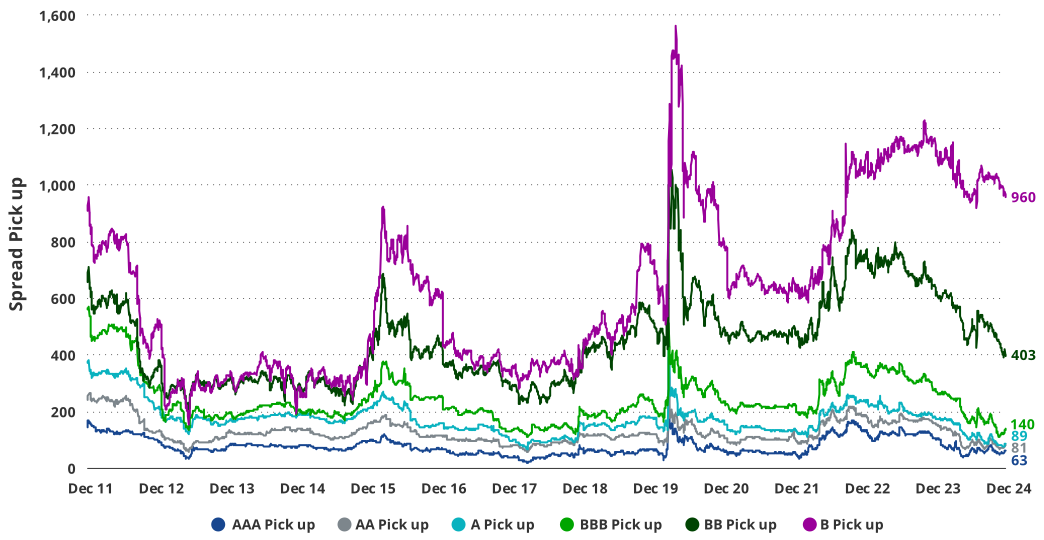
1Source: JP Morgan and ICE Data Services. Using OAS for corporate bonds and discount margins for CLOs. AAA Rated CLOs represented by J.P. Morgan CLO AAA Index, AA Rated CLOs represented by J.P. Morgan CLO AA Index, A Rated CLOs represented by J.P. Morgan CLO A Index, BBB Rated CLOs represented by J.P. Morgan CLO BBB Index, BB Rated CLOs represented by J.P. Morgan CLO BB Index, B Rated CLOs represented by J.P. Morgan CLO B Index AAA Rated Corps represented by the ICE BofA AAA US Corporate Index, AA Rated Corps represented by the ICE BofA AA US Corporate Index, A Rated Corps represented by the ICE BofA A US Corporate Index, BBB Rated Corps represented by the ICE BofA BBB US Corporate Index, BB Rated Corps represented by the ICE BofA BB US High Yield Index and B Rated Corps represented by the ICE BofA Single-B US High Yield Index. Index descriptions at the end of this presentation. Past performance is not indicative of future results. This is not an offer to buy or sell, or recommendation to buy or sell any of the securities mentioned herein.
Historically Higher Spreads
Floating Rate Spreads (9/30/2020 – 12/31/2024)
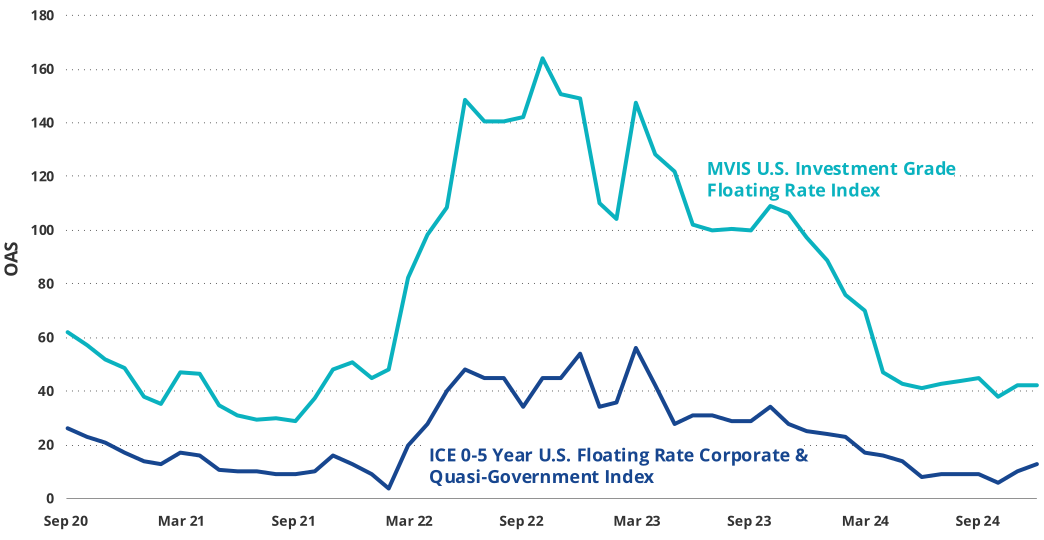
Source: ICE Data Services. All data is based on indices. Index performance is not illustrative of fund performance. Floating rate notes are subject to credit risk and interest rate risk. Floating rate notes are typically less sensitive to interest rate changes but may decline in value if their interest rates do not rise as much or as quickly as interest rates in general Fund performance current to the most recent month end is available by visiting vaneck.com. Past performance is no guarantee of future results. The ICE 0-5 Year US Floating Rate Corporate & Quasi-Government Index is not the underlying index for VanEck IG Floating Rate ETF, which seeks to track the MVIS US Investment Grade Floating Rate Index. See disclaimers and index definitions at the end of the presentation.
As CLOs and floating rate notes have shown less sensitivity to the afore-mentioned occurrences and continue to show both spread pick up and yield pick up over traditional corporates, we favor these solutions from a relative value asset class decision.
Ballast in a Volatile Rate Environment
Cumulative Total Return YTD (As of 12/31/2024)
Source: Morningstar. CLOs refers to the JP Morgan CLO Index, IG CLOs represented by the J.P. Morgan CLO IG Index, AAA Rated CLOs represented by J.P. Morgan CLO AAA Index and Core Bonds refers to the ICE BofA US Broad Market Index. Past performance is no guarantee of future results.
Finally, as you can certainly find different spread moves / ranges per tranche, in addition to some cracks in the underlying loan market in 2024, we favor an actively managed and flexible mandate that can invest beyond AAA CLOs.
Market Update
CLOs generated positive total returns across the capital stack in December, capping off a full calendar year of positive returns across all ratings categories and the 21st consecutive month of positive returns at the overall index level. As has been the case throughout the year, carry was the primary driver of returns given higher base rates. In a widely anticipated move, the Fed cut rates by 25 bps, its third consecutive meeting with a cut, bringing the Federal Funds rate to a target range of 4.25%-4.5%. However, the cut came alongside a hawkish tone, as inflation has held firm above the Fed’s target level and growth remained solid. Specifically Core CPI increased 0.3% in November, rising by the same stubbornly high margin for the fourth consecutive month. Following the announcement, many risk assets sold off sharply and Treasury yields rose dramatically. With 3Q earnings season coming to a close, issuer fundamentals have modestly deteriorated but remain strong overall.
Attractive Risk-Adjusted Returns vs Other Asset Classes
10 Years as of 12/31/2024
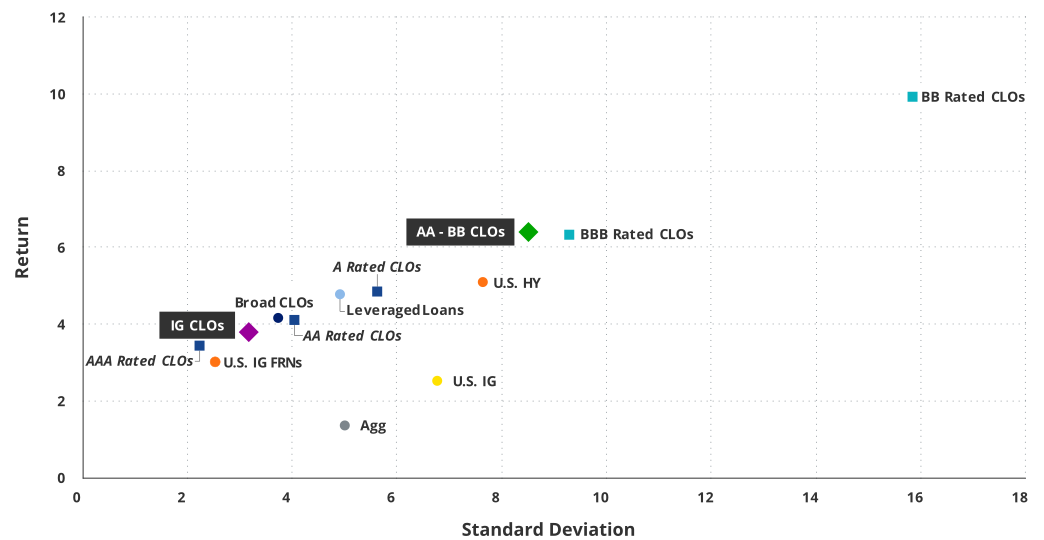
| Rating | Broad CLOs | IG CLOs | AA-BB CLOs | AAA Rated CLOs | AA Rated CLOs | A Rated CLOs | BBB Rated CLOs | BB Rated CLOs | US IG | US HY | Leveraged Loans | US IG FRNs | Agg |
| Return | 4.13 | 3.80 | 6.40 | 3.40 | 4.09 | 4.82 | 6.29 | 9.90 | 2.52 | 5.08 | 4.77 | 3.01 | 1.37 |
| Sharpe Ratio | 0.62 | 0.63 | 0.56 | 0.71 | 0.56 | 0.54 | 0.51 | 0.57 | 0.13 | 0.45 | 0.61 | 0.47 | -0.07 |
Source: Morningstar. Broad CLOs represented by J.P. Morgan CLO Index, IG CLOs represented by J.P Morgan CLO IG Index, AA-BB CLOs represented by the J.P. Morgan CLOIE Balanced Mezzanine Index, AAA Rated CLOs represented by J.P. Morgan CLO AAA Index, AA Rated CLOs represented by J.P. Morgan CLO AA Index, A Rated CLOs represented by J.P. Morgan CLO A Index, BBB Rated CLOs represented by J.P. Morgan CLO BBB Index, BB Rated CLOs represented by J.P. Morgan CLO BB Index, US IG represented by ICE BofA US Corporate Index, US HY represented by ICE BofA US High Yield Index, Agg is represented by the ICE BofA US Broad Market, US IG FRNs represented by MVIS US Investment Grade Floating Rate Note Index, Leveraged Loans represented by Morningstar LSTA US Leveraged Loan 100 Index. See index descriptions at the end of this presentation. Past performance is not indicative of future results. This is not an offer to buy or sell, or recommendation to buy or sell any of the securities mentioned herein.
Treasury rates increased in December, with 5- and 10-year Treasury rates trading 33bp and 40bp higher, respectively. As rates moved higher, floating rate CLOs and bank loans outperformed more duration sensitive investment grade credit and high yield bonds.
| Asset class | Q4 2024 Return (%) | 2024 Return (%) | Yield to Worst (%) | Spreads (bps) |
| CLOs | 1.83 | 8.31 | 5.71 | 142 |
| CLOs IG | 1.69 | 7.72 | 5.46 | 117 |
| CLOs Mezz | 2.58 | 12.03 | 7.13 | 280 |
| AAA | 1.59 | 7.06 | 5.25 | 97 |
| AA | 1.69 | 8.18 | 5.61 | 129 |
| A | 1.83 | 9.25 | 5.90 | 158 |
| BBB | 2.53 | 11.79 | 6.72 | 242 |
| BB | 4.31 | 19.16 | 10.27 | 589 |
| U.S. Agg | -3.06 | 1.47 | 4.93 | 36 |
| Investment Grade Corporates | -2.84 | 2.76 | 5.36 | 82 |
| High Yield Bonds | 0.16 | 8.20 | 7.47 | 292 |
| Leveraged Loans | 2.41 | 9.33 | 8.33 | 400 |
Source: JP Morgan and ICE Data Indices as of 12/31/2024. CLOs represented by J.P. Morgan Collateralized Loan Obligation Index, CLOs IG represented by J.P. Morgan Collateralized Loan Obligation IG Index, CLOs Mezz represented by J.P. Morgan Collateralized Loan Obligation Balanced Mezzanine Index, AAA Rated CLOs represented by J.P. Morgan CLO AAA Index, AA Rated CLOs represented by J.P. Morgan CLO AA Index, A Rated CLOs represented by J.P. Morgan CLO A Index, BBB Rated CLOs represented by J.P. Morgan CLO BBB Index, BB Rated CLOs represented by J.P. Morgan CLO BB Index, Investment Grade Corporates represented by ICE BofA US Corporate Index, US Agg is represented by the ICE BofA US Broad Market, Leveraged Loans represented by JP Morgan Leveraged Loan Index and High Yield Bonds represented by ICE BofA US High Yield Index. Past performance is no guarantee of future results. Index performance is not representative of fund performance. It is not possible to invest directly in an index.
CLO new issue supply decreased month-over-month, with $10.8bn pricing during the month, compared to $25.5bn in November, which was the highest volume month of the year and just trailed record issuance from November 2021. 2024 new issuance volume of $199.8bn ($163.6bn BSL, $36.2bn MM) set a new annual record, surpassing 2021 issuance, and was 72% higher than 2023. Refinancing and reset activity continued at a rapid pace in December and was the second highest level of the year, with $34.6bn pricing, after $34.3bn in November. Refinancing and reset activity for the year was $309.1bn ($279.6bn BSL, $29.6bn MM) compared to just $24.1bn in 2023 and is a new record. Total issuance of $508.9bn ($443.1bn BSL, $65.7bn MM) was 263% higher than 2023 levels.
In the secondary market, TRACE supply was roughly unchanged month-over-month at $13.0bn in December from $13.1bn in November. Investment grade volumes declined to $8.6bn from $8.9bn, while below investment grade volumes increased to $4.4bn from $4.2bn. Meanwhile, total BWIC volume decreased to $3.8bn from $4.6bn, as activity slowed during the holiday season.
Gross institutional loan issuance was $27.9bn in December, following $30.2bn in November. Retail loan funds saw net inflows of $1.8bn, the 14th inflow in the last 16 months. The average bid of the Morningstar LSTA Leveraged Loan Index increased 8bp to end the month at 97.33, the highest average bid price since April 2022. The percentage of loans pricing at par or above decreased to 62.6% from 65.3%; the percentage of loans pricing between 95 and par increased to 26.0% from 23.4%; the percentage of loans pricing below 90 increased to 7.4% from 6.4% and loans pricing below 80 decreased to 3.0% from 3.2%.
The trailing twelve-month default rate within the Morningstar US Leveraged Loan Index decreased 3bp month-over-month to 0.91%. In contrast, as measured by JP Morgan, the default rate including distressed exchanges increased to 4.49%. Activity has been elevated as borrowers with unsustainable capital structures endeavored to manage their liabilities and avoid the bankruptcy process through liability management exercises, keeping the “official” default rate lower than otherwise. We anticipate the default rate to remain below historical averages in the near term for the leveraged loan market as a result. Nonetheless, our expectations are that defaults, including distressed exchanges, will remain above the long-term historical average of 3%, but will be trending down from the current level of 4.49%.
CLO fundamentals were mixed month-over-month. U.S. CLO spreads were wider at the top of the capital stack and tighter for lower rated securities.
Despite rate cuts in 2024, the borrowing rate for leveraged loan companies remains high following rate increases from central banks in 2022 and 2023. Following the end of summer 2024, the Fed initiated the current rate-cutting cycle with a 50bp cut in September and another two 25bp cuts in November and December, as inflation approached the Fed’s target and the labor market remained resilient. However, following the release of economic data in December and January, demonstrating that inflation remains above the Fed’s target and growth remaining strong, the Fed has adopted a more hawkish tone increasing uncertainty around future rate cuts. Market expectations with respect to Fed easing have moved significantly lower, with the market now not expecting another rate cut until September 2025. Cuts will ultimately provide relief for more stressed borrowers, but the path and timing of more cuts remains an outstanding question.
CLO prices remain elevated following the significant rally in 2024 with the basis between higher and lower rated tranches continuing to tighten. The average AAA-BBB price ended December above par, as has been the case for most of the second half of the year, and BBs are trading above 97 for the first time since early December 2018. Against this backdrop, we continue to selectively purchase shorter spread-duration across the cap stack, but especially so for lower rated credits. If spreads were to widen, we maintain the ability to shift further into lower rated tranches given our overall portfolio positioning higher up the cap stack.
Primary and secondary spreads tightened throughout the year, with secondary AAA and AA spreads ended the year at the tightest levels since January 2022. However, buying in the primary market continues to allow for wider spreads on a relative basis, even when taking spread duration into account. CLO issuance has become more attractive as the arbitrage improved with lower liability costs, leading to the largest volume of BSL CLO primary issuance on record in 2024. Despite that, with high levels of amortization and call volumes this year, 2024 net AAA supply actually ended marginally negative.
Outlook
Our base case has been that we are entering a rare non-recessionary rate-cutting cycle that should support credit performance in 2025. The US election’s outcome is expected to add to pro-growth policies and further support risk assets from a fundamental perspective, while introducing potential headwinds outside the US amid more restrictive trade policies. With a second Trump administration forthcoming, concerns have turned toward how aggressively Trump will advance his campaign promises on immigration and trade. On immigration, it seems highly likely that Trump would quickly end the asylum programs established during the Biden administration. Over time, this could bring job growth back to pre-pandemic levels of about 100,000 jobs per month, which is expected to have a minimal inflationary impact. While large-scale deportations are a possibility, they would likely happen further down the road. The bigger uncertainty revolves around how swiftly and forcefully Trump will implement trade restrictions, including significantly higher tariffs on China. In the first Trump presidency, higher import prices led to only a modest rise in consumer prices and slightly slower economic growth. A looser regulatory environment may somewhat offset these concerns, leaving the overall growth outlook for next year relatively unchanged despite the shifting variables. Jobs data suggest that the base-case economic scenario is still leaning toward a soft landing.
We continue to believe that loan defaults will remain relatively stable. Fundamental strength in credit metrics appears to have peaked, but started at a high level and should remain strong. Solid growth and the potential for inflationary pressures in the United States could result in a less accommodative Fed tone. By contrast, the weaker economic outlook for Europe will allow the ECB to cut rates at a steady pace. The net outcome should be a stronger US dollar. Offsetting positive fundamentals are extremely tight valuations, which fully reflect hyper-bullish sentiment.
Despite limited net loan issuance, CLO new issuance reached a new annual record as managers take advantage of tighter liability spreads. We expect strong issuance again heading into 2025 as spreads remain at very tight levels. However, the pace from 2024 may be unsustainable moving forward unless M&A and LBO activity picks up. The election of Donald Trump and expectations around his policy agenda have given some hope that there will be increased activity moving forward. CLOs continue to see strong demand given high all-in yields, which we expect to remain the case into 2025. Despite the commencement of the Fed’s rate cutting cycle, recent comments from the central bank have led many to expect a pause through the first half of the year. While CLO valuations are tight, corporate valuations are tighter, which should be an additional boon for CLO demand in the short term. In addition to the traditional investor base of insurers, banks, and money managers (among others) – which have been a consistent source of demand given CLOs’ strong performance since the Covid period – the CLO market has also benefited from the growing presence of CLO exchange-traded funds. CLO ETFs experienced $16bn of inflows in 2024, a trend that has continued into early January, with CLO ETF AUM now 2-3% of the total CLO market. Refinancing and reset activity also set a new record in 2024 as portfolios constructed with purchases in the secondary market take advantage of higher loan prices and tighter CLO spreads, a trend we expect to continue coming into the new year. This has also bolstered demand for new paper and led to tighter spreads as investors put proceeds back to work. Should the loan and CLO markets continue to rally, we would expect to see more portfolios benefit from the significant redemption optionality in CLOs.
Amid the supportive technical environment, we anticipate CLO spreads to grind tighter. That said, we see spreads and yields attractive under most market scenarios over the next twelve months. Notwithstanding the shorter-term technical tailwinds, we believe expensive valuations and a fundamental picture bifurcated between vintages and, relatedly, between deals in and out of their reinvestment periods, calls for a robust bottom-up approach to security selection for long-term investors. Given the dispersion seen in the loan market and a moderation in Fed rate cut expectations, certain CLO portfolios holding weaker credits may eventually experience impairments to the lowest rated debt tranches. As a result, vintage, portfolio, and manager selection remains key.
Disclosures
Please note that VanEck may offer investments products that invest in the asset class(es) or industries included in this commentary.
This is not an offer to buy or sell, or a recommendation to buy or sell any of the securities, financial instruments or digital assets mentioned herein. The information presented does not involve the rendering of personalized investment, financial, legal, tax advice, or any call to action. Certain statements contained herein may constitute projections, forecasts and other forward-looking statements, which do not reflect actual results, are for illustrative purposes only, are valid as of the date of this communication, and are subject to change without notice. Actual future performance of any assets or industries mentioned are unknown. Information provided by third party sources are believed to be reliable and have not been independently verified for accuracy or completeness and cannot be guaranteed. VanEck does not guarantee the accuracy of third party data. The information herein represents the opinion of the speaker(s), but not necessarily those of VanEck or its other\employees.
CLO: J.P. Morgan Collateralized Loan Obligation Index (CLOIE) tracks broadly-syndicated, arbitrage US CLO debt.
AAA Rated CLOs represented by J.P. Morgan CLO AAA Index is a subset of the CLOIE index that only tracks the AAA rated CLO.
AA Rated CLOs represented by J.P. Morgan CLO AA Index is a subset of the CLOIE index that only tracks the AA rated CLO.
A Rated CLOs represented by J.P. Morgan CLO A Index is a subset of the CLOIE index that only tracks the A rated CLO.
BBB Rated CLOs represented by J.P. Morgan CLO BBB Index is a subset of the CLOIE index that only tracks the BB rated CLO.
BB Rated CLOs represented by J.P. Morgan CLO BB Index is a subset of the CLOIE index that only tracks the BB rated CLO.
B Rated CLOs represented by J.P. Morgan CLO B Index is a subset of the CLOIE index that only tracks the BB rated CLO.
IG CLOs represented by J.P. Morgan CLO IG Index is a subset of the CLOIE index that tracks AAA – BBB rated CLO.
HY CLOs represented by J.P. Morgan CLO HY Index is a subset of the CLOIE index that tracks below BBB rated CLO.
AA-BB CLOs represented by J.P. Morgan CLOIE Balanced Mezzanine Index which tracks broadly-syndicated, arbitrage US CLO debt rated AA to BB, comprised of 25% of each rating category.
US IG: ICE BofA US Corporate Index (C0A0) tracks the performance of US dollar denominated investment grade corporate debt publicly issued in the US domestic market.
AAA Rated Corps represented by the ICE BofA AAA US Corporate Index is a subset of the C0A0 index that only tracks the AAA rated corporate bonds.
AA Rated Corps represented by the ICE BofA AA US Corporate Index is a subset of the C0A0 index that only tracks the AA rated corporate bonds.
A Rated Corps represented by the ICE BofA A US Corporate Index is a subset of the C0A0 index that only tracks the A rated corporate bonds.
BBB Rated Corps represented by the ICE BofA BBB US Corporate Index is a subset of the C0A0 index that only tracks the BBB rated corporate bonds.
US HY: ICE BofA US High Yield Index (H0A0) tracks the performance of U.S. dollar-denominated below investment grade corporate debt publically issued in the U.S. domestic market.
Agg: ICE BofA US Broad Market (US00) tracks the performance of US dollar denominated investment grade debt publicly issued in the US domestic market, including US Treasury, quasi-government, corporate, securitized and collateralized securities.
Leveraged Loans: Morningstar LSTA US Leveraged Loan 100 Index seeks to mirror the market-weighted performance of the largest institutional leveraged loans as determined by criteria based upon market weightings, spreads, and interest payments.
ICE 0-5 Year US Floating Rate Corporate & Quasi-Government Index is a subset of ICE USD Floating Rate Corporate & Quasi-Government Index including all US domestic securities with a remaining term to final maturity less than five years. ICE USD Floating Rate Corporate & Quasi-Government Index tracks the performance of floating rate U.S. dollar denominated investment grade debt publicly issued in the U.S. domestic market, including U.S. agency, foreign government, supranational and corporate securities.
US IG FRN: MVIS US Investment Grade Floating Rate Index (MVFLTR) consists of U.S. dollar-denominated floating rate notes issued by corporate issuers and rated investment grade by at least one rating agency.
All investing is subject to risk, including the possible loss of the money you invest. As with any investment strategy, there is no guarantee that investment objectives will be met and investors may lose money. Diversification does not ensure a profit or protect against a loss in a declining market. Past performance is no guarantee of future results.
© Van Eck Associates Corporation.