Welkom bij VanEck
Selecteer beleggerscategorie
21 January 2020
“Do you know the only thing that gives me pleasure? It's to see my dividends coming in.”
John D. Rockefeller, 1908.
In the current environment of ultra-low interest rates, investors are increasingly looking to equities for a source of income. However, high dividend strategies look attractive in today’s markets for a wide range of reasons.
When John D. Rockefeller, the world’s first billionaire and renowned philanthropist, remarked on his pleasure in receiving dividends from Standard Oil, he was inadvertently making the case for companies that pay high dividends. Not only do these stocks reward their investors with an attractive level of income, but their other qualities can translate into higher than average total returns.
Historically, higher dividend paying stocks have shown both higher returns and lower levels of risk (see figure 1 below).
S&P 500 portfolios, based on dividend yield
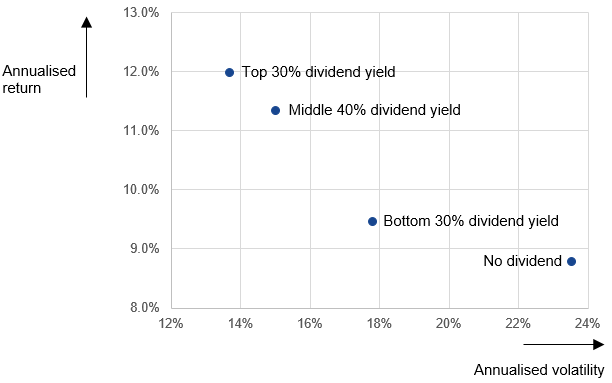
Source: VanEck analysis using data from Kenneth French. Data for the 50 years ending September 2019. Past performance is not a reliable indicator for future performance. This also holds for historical market data.
One reason given for high-dividend stocks’ superior risk-return characteristics is that a high level of dividend payout disciplines management. If a firm has too much free cash flow at its disposal, managers might be tempted to undertake value destroying projects, or spend on excessive salaries or perks. Another fact to consider is that, over the long term, dividends are the main driver of equity returns. In figure 2, we compare the performance of the US S&P 500 index including dividends and excluding dividends. It is clear that the former dwarfs the latter over time. Only a few companies have been able to generate above average long-term returns from share price increases alone.
S&P 500 return, including dividends and excluding dividends
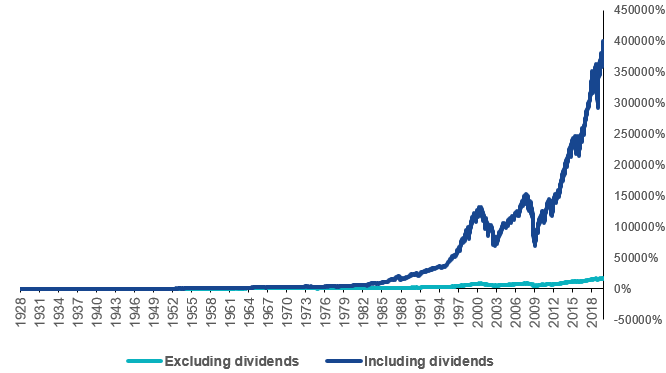
Source: Bloomberg, VanEck analysis. Data for the period 2 January 1928 – 28 November 2019. Past performance is not a reliable indicator for future performance. This also holds for historical market data.
Dividends have also proved to be a good hedge against inflation. As can be seen in figure 3, dividend payouts have historically walked in lockstep with inflation levels. The explanation is intuitive: in periods of inflation, most companies can raise the prices of their goods or services, and as such, increase nominal earnings. This then translates into higher dividends.
10-year annualised inflation versus 10-year annualised dividend growth, USA
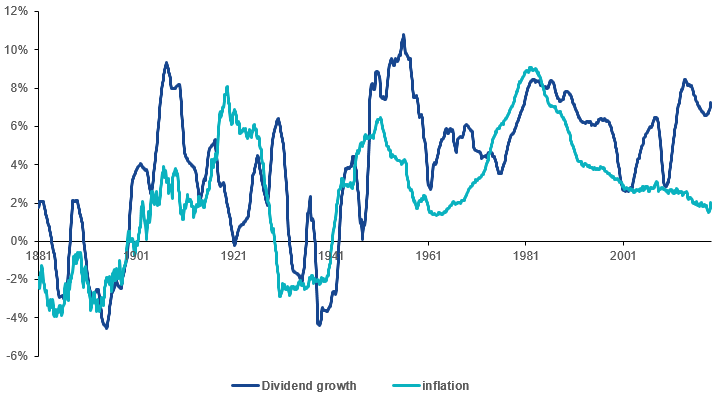
Source: VanEck analysis using data from Robert Shiller. Data for the period January 1871 – September 2019. Past performance is not a reliable indicator for future performance. This also holds for historical market data.
But beyond the long-term arguments, high dividend strategies seem particularly well suited for the current macro-economic environment.
A high dividend equity strategy can nowadays yield between 4% and 5% when investing in blue chip companies such as AT&T, HSBC, GlaxoSmithKline and IBM. In order to achieve such yields from Euro fixed income, one needs to make big sacrifices in both credit quality and duration.
Also, the fundamentals of high income strategies seem favorable. Currently, high dividend stocks are priced attractively, both in comparison to other stocks and to historical prices.
Price / earnings ratios
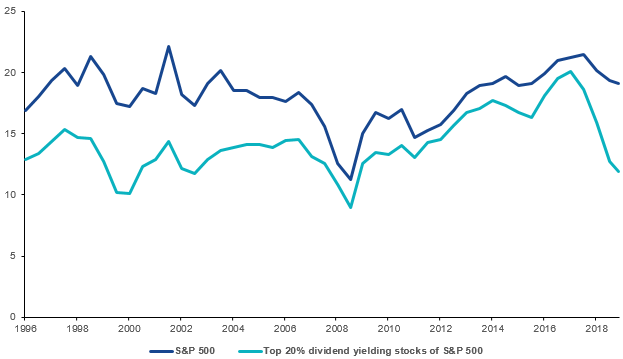
Source: Bloomberg, VanEck analysis. Past performance is not a reliable indicator for future performance. This also holds for historical market data.
Investors can find further comfort from current high levels of cash on companies’ balance sheets, which compare well with historical norms (figure 5). This gives companies sufficient capacity to sustain dividend payouts, even if their earnings fall. Yet despite the stockpiling of cash, current payout levels are below historical averages, giving leeway for further increase dividend payouts, see figure 6.
Total cash and cash equivalents for S&P 500 firms, USD trillion
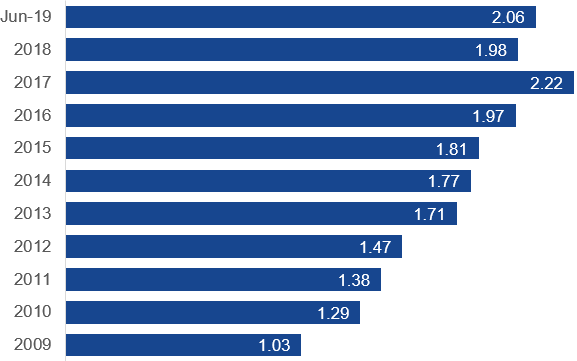
Source: Bloomberg, VanEck analysis.
Dividend payout ratio for S&P 500
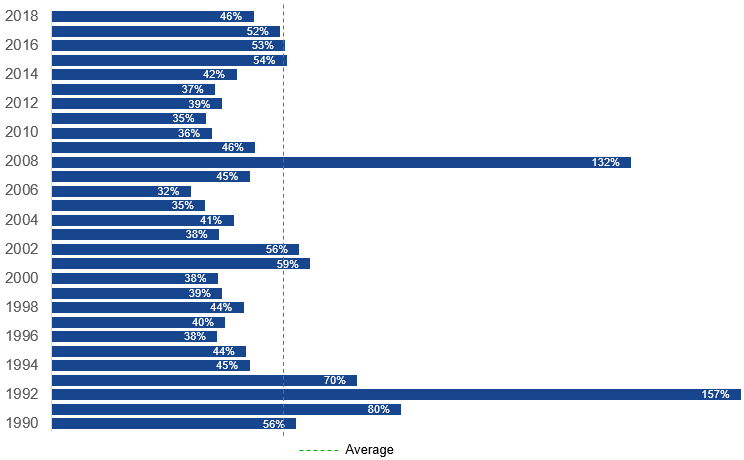
Source: Bloomberg, VanEck analysis.
John D. Rockefeller may have extolled the virtues of high dividends over 110 years ago, but his sentiment has held true over the long term. Given today’s extraordinary economic environment of low or even below zero rates, the attraction of high dividends is stronger than ever.
Learn more about our High Dividend ETF Strategy.Uitsluitend voor informatie- en advertentiedoeleinden.
Deze informatie is afkomstig van VanEck (Europe) GmbH. VanEck (Europe) GmbH is aangesteld als distributeur van VanEck-producten in Europa door VanEck Asset Management B.V., een beheermaatschappij onder Nederlands recht en geregistreerd bij de Nederlandse Autoriteit Financiële Markten (AFM). VanEck (Europe) GmbH, met als vestigingsadres Kreuznacher Str. 30, 60486 Frankfurt, Duitsland, is een financiële dienstverlener die onder toezicht staat van BaFin, de Duitse toezichthouder voor de financiële markten. De informatie is uitsluitend bedoeld om beleggers te voorzien van algemene en voorlopige informatie en mag niet worden opgevat als beleggings-, juridisch of fiscaal advies. VanEck (Europe) GmbH en de aan VanEck (Europe) GmbH verbonden en gelieerde bedrijven (samen "VanEck") wijzen elke aansprakelijkheid van de hand met betrekking tot beslissingen die de belegger op basis van deze informatie neemt ten aanzien van het kopen, verkopen of aanhouden van beleggingen. De visies en meningen die hier worden gegeven, zijn die van de auteur(s) en komen niet noodzakelijkerwijs overeen met die van VanEck. De meningen zijn actueel op de datum van publicatie en kunnen worden aangepast op basis van veranderende marktomstandigheden. Bepaalde verklaringen in deze bijdrage kunnen ramingen, voorspellingen en andere op de toekomst gerichte verklaringen zijn die niet overeenkomen met de werkelijkheid. Wij achten de informatie die afkomstig is van derden, betrouwbaar. Deze informatie is echter niet onafhankelijk gecontroleerd. De nauwkeurigheid en volledigheid ervan kunnen daarom niet worden gegarandeerd. Alle indices die worden vermeld, zijn maatstaven voor het vergelijken van algemene marktsectoren en rendementen. Het is niet mogelijk om rechtstreeks in een index te beleggen.
Alle rendementsgegevens hebben betrekking op het verleden en bieden geen garantie voor toekomstige resultaten. Beleggen brengt risico's met zich mee, waaronder mogelijk verlies van de hoofdsom. Lees het prospectus en de essentiële beleggersinformatie voordat u gaat beleggen.
Niets in dit materiaal mag in welke vorm dan ook worden verveelvoudigd en er mag ook niet naar worden verwezen in andere publicaties zonder de uitdrukkelijke schriftelijke toestemming van VanEck.
© VanEck (Europe) GmbH

15 oktober 2026
15 oktober 2026