
Welcome to VanEck
Select Investor Type
Ahmet Dagli
What is an ETF?
ETFs are the modern way to invest in a diversified manner. Individuals with small amounts of capital can benefit from features previously only enjoyed by large institutional investors, such as pension funds. Most ETFs are index funds. In the following sections, we'll go through the main aspects of ETFs, starting from the question, what an ETF is.
An ETF is a fund that trades on a stock exchange. The first ETF was introduced in 1993. It was a significant innovation in finance for the reasons below.
In a nutshell, the ETF is the simplest way to "buy the index," as someone can acquire an ETF in a single transaction on a stock exchange. It’s an innovation that democratizes investment; arguably, its full potential is yet to be appreciated.
Past performance is not a reliable indicator of future performance. Source: VanEck, Bloomberg.

to international markets, asset classes, and investment strategies previously available only to institutional investors.

With exchange-traded funds, you know which stocks or other assets are in the fund and how they are selected for inclusion.

Because your investment in an ETF is spread across a number of stocks or other assets, it is considered less risky because you are not dependent on the growth of any company or asset.

ETFs are a way to invest small amounts of money in multiple companies or other assets.

Management fees for index-based ETFs are typically lower than investing in the same exposure to individually purchased companies.
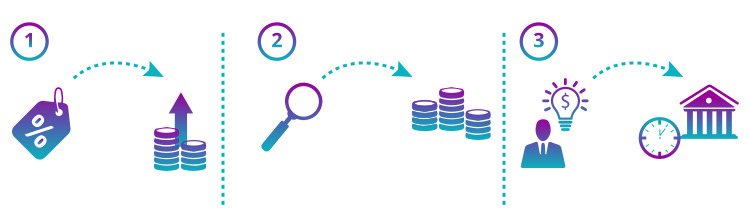
Explaining "what is an ETF?" and why ETFs have advantages over mutual funds can get complicated. Below are three main advantages:
Investors should consider risks, i.e., the risk of capital loss, before investing.
The following table summarizes the differences between ETFs, mutual funds, and individual stocks, thus perfectly addressing the question, "What is an ETF?" and how it stands out related to other asset classes.
| ETFs | Mutual funds | Individual stocks | |
| Diversification | High | High | Low |
| Transparency | High | Low | High |
| Costs | Low | High | Low |
| Tradable | All day | Max 1x per day | All day |
Source: VanEck.
ETFs are transforming the world of investing; more people are always getting to know and understand what an ETF is. It lets you create a well-diversified portfolio with minimal costs. Theoretically, the professional investor’s world is within reach of the private individual. Nowadays, ETFs cover all standard asset classes – from shares (stocks) to bonds and commodities. Beyond that, thematic ETFs allow investors to invest in an economic theme they believe is prospering, such as semiconductors for computing or renewable energy. Continue our Academy Course to learn more about ETFs and how can you invest in them through VanEck.
