Synchronized Tightening – On Your Mark!
June 07, 2022
Read Time 2 MIN
The ECB’s rate setting meeting will be closely watched after a hawkish surprise in Australia – the National Bank of Poland, however, will have to make its move a day before.
Global Tightening Cycle
The synchronized tightening narrative got an extra boost this morning, following Australia’s surprising 50bps rate hike. The European Central Bank (ECB) meeting on Thursday is the next big milestone - the market is still pretty cautious, seeing no change in June, a modest liftoff (+25bps) in July, and a more sizable hike (+42.5bps) only in September. A more decisive hawkish shift in the ECB can be challanging for central banks in emerging markets (EM) Europe, many of which want to slow down the pace of tightening, arguing that rate hikes can only affect domestic price pressures. Poland’s rate-setting meeting tomorrow will be an important case. The meeting takes place before the ECB – and against the backdrop of fairly “cloudy” guidance by Governor Adam Glapinski. The consensus believes the central bank will stick with +75bps – a smaller 50bps hike (with annual inflation running close to 14%) would be a major negative surprise.
Rate Hikes In LATAM and EM Asia
A smaller rate hike in Chile this afternoon should cause less market commotion – the expected 75bps move would come after the “oversized” 125bps hike in May, with the real policy rate adjusted by expected inflation already well in positive territory (unlike Poland). Chile’s steadfast and transparent monetary policy reaction function is one of the reasons why local bonds outperformed Poland’s so far this year (on multiple time horizons). A slower pace of tightening might no longer be an option in EM Asia, where inflation continues to catch up with EM peers in other regions. Philippine headline inflation accelerated sharply to 5.4% year-on-year in May – another big move after an earlier upside surprise in Thailand. And the incoming governor of the Philippine central bank is not taking any chances, signaling at least two more hikes this summer.
Higher Global Rates and Debt Service Costs
Synchronized tightening and higher global rates create a lot of problems for lower-income EMs, forcing them to spend more resources on debt service (see chart below) instead of development. This is one of the reasons why the IMF now argues that domestic debt “is likely to play a larger role in the resolution of future sovereign debt crises”. One observation (from the chart below) is that interest payments as a percentage of GDP in EM and developed markets (DM) are now expected to converge at a higher level vs. pre-pandemic – with QT and rate hikes erasing DM’s low debt costs advantage in the coming years.
Chart at a Glance: Interest Payments – Convergence
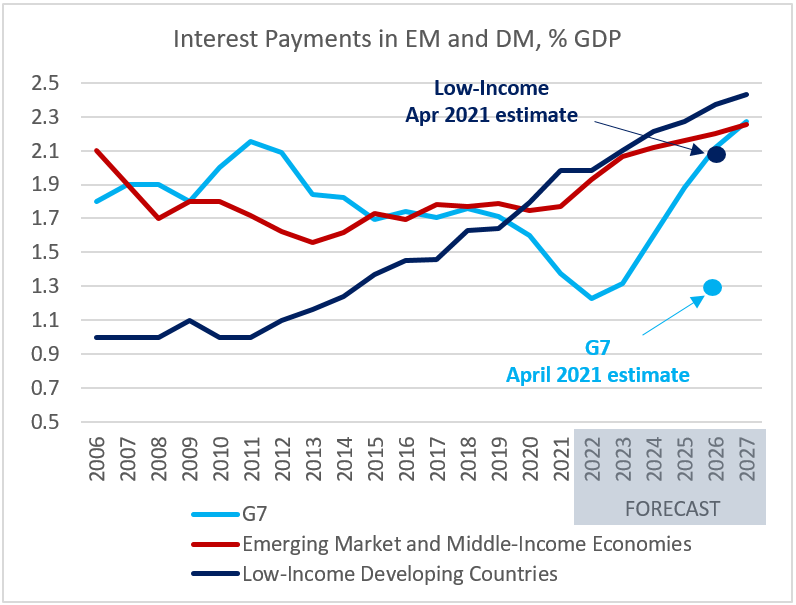
Source: International Monetary Fund, Fiscal Monitor (April 2022)

PMI – Purchasing Managers’ Index: economic indicators derived from monthly surveys of private sector companies. A reading above 50 indicates expansion, and a reading below 50 indicates contraction; ISM – Institute for Supply Management PMI: ISM releases an index based on more than 400 purchasing and supply managers surveys; both in the manufacturing and non-manufacturing industries; CPI – Consumer Price Index: an index of the variation in prices paid by typical consumers for retail goods and other items; PPI – Producer Price Index: a family of indexes that measures the average change in selling prices received by domestic producers of goods and services over time; PCE inflation – Personal Consumption Expenditures Price Index: one measure of U.S. inflation, tracking the change in prices of goods and services purchased by consumers throughout the economy; MSCI – Morgan Stanley Capital International: an American provider of equity, fixed income, hedge fund stock market indexes, and equity portfolio analysis tools; VIX – CBOE Volatility Index: an index created by the Chicago Board Options Exchange (CBOE), which shows the market's expectation of 30-day volatility. It is constructed using the implied volatilities on S&P 500 index options.; GBI-EM – JP Morgan’s Government Bond Index – Emerging Markets: comprehensive emerging market debt benchmarks that track local currency bonds issued by Emerging market governments; EMBI – JP Morgan’s Emerging Market Bond Index: JP Morgan's index of dollar-denominated sovereign bonds issued by a selection of emerging market countries; EMBIG - JP Morgan’s Emerging Market Bond Index Global: tracks total returns for traded external debt instruments in emerging markets.
The information presented does not involve the rendering of personalized investment, financial, legal, or tax advice. This is not an offer to buy or sell, or a solicitation of any offer to buy or sell any of the securities mentioned herein. Certain statements contained herein may constitute projections, forecasts and other forward looking statements, which do not reflect actual results. Certain information may be provided by third-party sources and, although believed to be reliable, it has not been independently verified and its accuracy or completeness cannot be guaranteed. Any opinions, projections, forecasts, and forward-looking statements presented herein are valid as the date of this communication and are subject to change. The information herein represents the opinion of the author(s), but not necessarily those of VanEck.
Investing in international markets carries risks such as currency fluctuation, regulatory risks, economic and political instability. Emerging markets involve heightened risks related to the same factors as well as increased volatility, lower trading volume, and less liquidity. Emerging markets can have greater custodial and operational risks, and less developed legal and accounting systems than developed markets.
All investing is subject to risk, including the possible loss of the money you invest. As with any investment strategy, there is no guarantee that investment objectives will be met and investors may lose money. Diversification does not ensure a profit or protect against a loss in a declining market. Past performance is no guarantee of future performance.
PMI – Purchasing Managers’ Index: economic indicators derived from monthly surveys of private sector companies. A reading above 50 indicates expansion, and a reading below 50 indicates contraction; ISM – Institute for Supply Management PMI: ISM releases an index based on more than 400 purchasing and supply managers surveys; both in the manufacturing and non-manufacturing industries; CPI – Consumer Price Index: an index of the variation in prices paid by typical consumers for retail goods and other items; PPI – Producer Price Index: a family of indexes that measures the average change in selling prices received by domestic producers of goods and services over time; PCE inflation – Personal Consumption Expenditures Price Index: one measure of U.S. inflation, tracking the change in prices of goods and services purchased by consumers throughout the economy; MSCI – Morgan Stanley Capital International: an American provider of equity, fixed income, hedge fund stock market indexes, and equity portfolio analysis tools; VIX – CBOE Volatility Index: an index created by the Chicago Board Options Exchange (CBOE), which shows the market's expectation of 30-day volatility. It is constructed using the implied volatilities on S&P 500 index options.; GBI-EM – JP Morgan’s Government Bond Index – Emerging Markets: comprehensive emerging market debt benchmarks that track local currency bonds issued by Emerging market governments; EMBI – JP Morgan’s Emerging Market Bond Index: JP Morgan's index of dollar-denominated sovereign bonds issued by a selection of emerging market countries; EMBIG - JP Morgan’s Emerging Market Bond Index Global: tracks total returns for traded external debt instruments in emerging markets.
The information presented does not involve the rendering of personalized investment, financial, legal, or tax advice. This is not an offer to buy or sell, or a solicitation of any offer to buy or sell any of the securities mentioned herein. Certain statements contained herein may constitute projections, forecasts and other forward looking statements, which do not reflect actual results. Certain information may be provided by third-party sources and, although believed to be reliable, it has not been independently verified and its accuracy or completeness cannot be guaranteed. Any opinions, projections, forecasts, and forward-looking statements presented herein are valid as the date of this communication and are subject to change. The information herein represents the opinion of the author(s), but not necessarily those of VanEck.
Investing in international markets carries risks such as currency fluctuation, regulatory risks, economic and political instability. Emerging markets involve heightened risks related to the same factors as well as increased volatility, lower trading volume, and less liquidity. Emerging markets can have greater custodial and operational risks, and less developed legal and accounting systems than developed markets.
All investing is subject to risk, including the possible loss of the money you invest. As with any investment strategy, there is no guarantee that investment objectives will be met and investors may lose money. Diversification does not ensure a profit or protect against a loss in a declining market. Past performance is no guarantee of future performance.