Turn Investment Ideas into Actions for the Second Half of 2026: Outlook Implementation Guide
September 02, 2026
Read Time 4 MIN
Key Takeaways:
- Semiconductors remain the backbone of the AI buildout: Chip stocks have historically rebounded strongly following pullbacks in the mid-teens to 20%. Opportunities include SMH for the full value chain; SMHX for targeting fabless disruptors; and the recently launched SMHC, which provides China semiconductor exposure with no overlap with SMH.
- Real assets are both a portfolio diversifier and an AI growth story: Natural resources and power generation are the primary bottleneck of the AI buildout; RAAX actively allocates across commodities, infrastructure, MLPs, and gold in a single ticker.
- Private credit fundamentals don't match the fear: Flow-driven sentiment has pushed publicly listed BDCs to attractive discounts, creating a potential current-income entry point via BIZD.
- Alternative asset managers offer structural growth at cyclical prices: Fee-related earnings at firms like Blue Owl have compounded at 30–40% annually since IPO while share prices sit near multi-year lows; GPZ captures this theme.
- Gold's bull market has room to run – Central bank buying, debt debasement, and structural under-ownership may support a continued rally; GDX and OUNZ offer differentiated exposure.
- Bitcoin is approaching a cyclical bottom – The predictable post-halving bear cycle is showing signs of exhaustion; HODL and NODE provide options for investors ready to scale back in.
VanEck Bitcoin ETF (“HODL”) and VanEck Merk Gold ETF (“OUNZ”) (collectively, the “Trusts”) are subject to significant risk and may not be suitable for all investors. The value of Bitcoin is highly volatile, and you can lose your entire principal investment. HODL and OUNZ are not investment companies registered under the Investment Company Act of 1940 (the "1940 Act") and therefore are not subject to the same protections as mutual funds or ETFs registered under the 1940 Act.
The AI Build-Out Is Broadening
Hyperscaler capital expenditure projections have climbed from roughly $500 billion entering 2025 to over $700 billion today, with sell-side estimates approaching $1 trillion within the next year.1 In Q2, eight of 11 S&P sectors reported margins above their five-year average.2 This is a sign that benefits are broadening, and the market is starting to reflect it.
We view AI through a three-phase framework — build, adopt, automate — and we are still early in the transition between build and adopt. That means staying invested.
Semiconductors as a Buy-the-Dip Theme
Semiconductors sold off meaningfully in Q2 before largely retracing the move. The pullback was driven by valuation concerns, rising capital expenditure scrutiny, and macro uncertainty, but history offers useful context. Following mid-teens to 20% corrections in semiconductor stocks, subsequent 12-month performance has historically been strong, particularly in non-recessionary environments.
Global Semiconductors Performance After Pullbacks
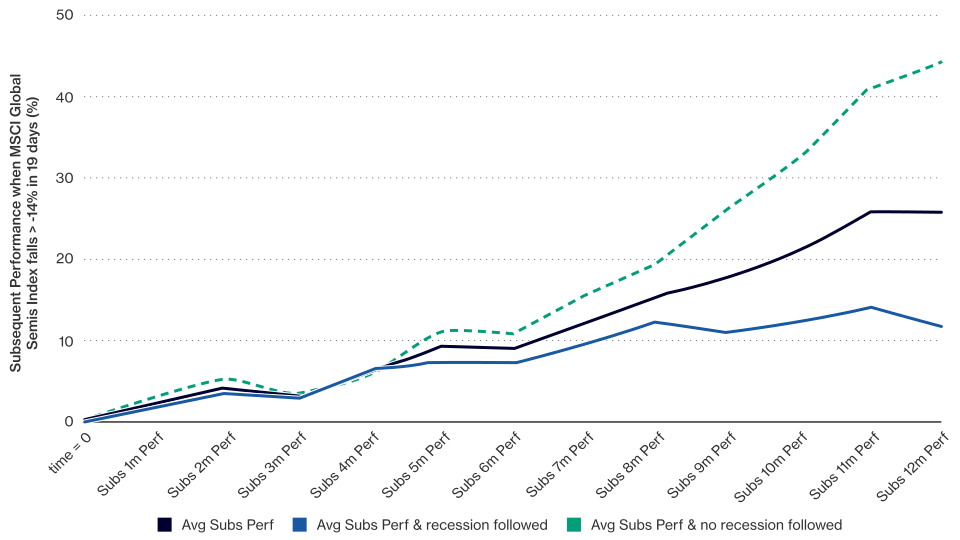
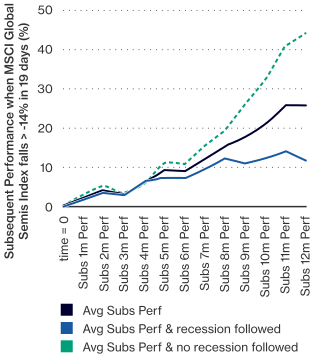
Source: BofA Global Quantitative Strategy, MSCI, Factset, Bloomberg. Data as of 6/30/2026. Chart reflects the historical performance of the MSCI Global Semiconductors Index following declines of the magnitude described, and is shown for illustrative purposes only. Past performance is no guarantee of future results. Index performance is not representative of fund performance. It is not possible to invest directly in an index.
Investment Ideas:
- VanEck Semiconductor ETF (SMH): Broad semiconductor exposure anchored by Nvidia and the full semiconductor value chain.
- VanEck Fabless Semiconductor ETF (SMHX): Targets only asset-light, R&D-heavy fabless companies.
- VanEck China Semiconductor ETF (SMHC): Provides exposure to Chinese open-source AI and semiconductor development as a potential complement or hedge, with zero overlap with SMH.
Invest in the AI Buildout with Old World Assets
Natural resources and power generation are the primary bottleneck of the AI infrastructure buildout, making real assets both a diversifier and a growth story. Global electricity demand is expected to double by 2050. The U.S. power grid was not built to handle current AI demands, making investment in infrastructure upgrades increasingly necessary.
Investment Ideas:
- VanEck Real Assets ETF (RAAX): Actively allocates across three pillars: growth-oriented holdings such as commodities, resource equities and infrastructure; income-producing assets, including Master Limited Partnerships (MLPs), pipelines, Real Estate Investment Trusts (REITs); and capital preservation via gold.
- VanEck Data Center Supply Chain ETF (RACK): Targeted exposure to the companies building the physical infrastructure behind AI, including semiconductors, data center solutions, power, bridge infrastructure, and nuclear energy.
Private Credit's Sentiment Overhang
Retail redemption requests have pushed publicly listed business development companies (BDCs) to meaningful discounts to NAV. But the underlying thesis is intact: nonaccrual rates remain well below historical averages, interest coverage is solid, and net leverage is manageable. This is a flow-driven pricing dislocation, not a credit problem.
Investment Idea:
- VanEck BDC Income ETF (BIZD): Diversified, market-cap-weighted exposure to the largest publicly listed BDCs in a liquid ETF wrapper.
Recommended subscription
Listed Alternative Asset Managers: Structural Growth at Cyclical Prices
Publicly listed alternative asset managers — like Blue Owl and Ares — have been caught in the same retail-driven sentiment downdraft as BDCs, pushing valuations toward multi-year lows even as fee-related earnings and assets under management at leading firms have compounded. The structural case for alternatives is unchanged. Allocations have continued to grow, driven by demographics, regulatory unlocks, and companies staying private longer.
Investment Idea:
- VanEck Alternative Asset Manager ETF (GPZ): Market-cap-weighted exposure to the largest and most liquid publicly traded alternative asset managers across private equity, private credit, infrastructure, and real estate.
Gold Encounters Pause Within a Structural Bull Market
Gold’s recent consolidation is a normal correction within a structural bull market, not a trend reversal. The case for gold remains grounded in durable macro forces: central banks are net buyers, fiscal deficits are widening, inflation has been persistently above target, and the incoming Federal Reserve leadership creates additional policy uncertainty.
Investment Ideas:
- VanEck Gold Miners ETF (GDX): Equity exposure to gold mining companies, providing leveraged participation in gold price moves.
- VanEck Merk Gold ETF (OUNZ): Spot gold exposure with the distinctive option to take physical delivery of the underlying gold.
Where are we in the Bitcoin Cycle?
Bitcoin entered a cyclical bear phase around Q4 2024, a pattern historically tied to the four-year halving cycle, in which mining rewards are cut in half, supply contracts, and a bear period may follow. The current cycle has seen bitcoin decline from a peak of approximately $125,000 to the low $60,000s. That context matters. These cycles are features, not structural breaks.
VanEck's GEO (Global Liquidity, Ecosystem Leverage, On-Chain Activity) framework shows two of three signals being neutral, with ecosystem leverage constructive. These are signs of near-bottoming that we believe may warrant beginning to scale in.
Investment Ideas:
- VanEck Bitcoin ETF (HODL): Low-cost spot bitcoin exposure that tracks the spot price directly.
- VanEck Onchain Economy ETF (NODE): Active exposure to companies meaningfully tied to the onchain economy, with bitcoin cycle indicators incorporated to inform risk exposure.
Putting It All Together
The central message from VanEck's Q3 Outlook is straightforward: concentration has given way to dispersion, and dispersion creates opportunity. Staying invested in structural themes while redeploying into areas of cyclical weakness is how we think allocators should be positioning portfolios for the remainder of 2026.
To receive more Investment Outlook insights, sign up in our subscription center.

IMPORTANT DISCLOSURES
1 Source: LPL Research, Bloomberg. Data as of 4/30/2026.
2 Source: Factset. Data as of 6/30/2026.
Bitcoin (BTC) is a decentralized digital currency without a central bank or single administrator. It can be sent from user to user on the peer-to-peer Bitcoin network without intermediaries.
References to Bitcoin market cycles are based on historical data. Historical market-cycle patterns may not recur and should not be interpreted as a prediction of future performance, a market-timing signal, or an assurance of future results.
This is not an offer to buy or sell, or a recommendation to buy or sell any of the securities, financial instruments or digital assets mentioned herein. The information presented does not involve the rendering of personalized investment, financial, legal, tax advice, or any call to action. Certain statements contained herein may constitute projections, forecasts and other forward-looking statements, which do not reflect actual results, are for illustrative purposes only, are valid as of the date of this communication, and are subject to change without notice. Actual future performance of any assets or industries mentioned are unknown. Information provided by third party sources are believed to be reliable and have not been independently verified for accuracy or completeness and cannot be guaranteed. VanEck does not guarantee the accuracy of third party data. The information herein represents the opinion of the author(s), but not necessarily those of VanEck or its other employees.
Fund holdings will vary and are subject to change. For a complete list of fund holdings, please visit vaneck.com.
VanEck Merk Gold ETF (“OUNZ”) and VanEck Bitcoin ETF (“HODL”) Disclosures
VanEck Bitcoin ETF (“HODL”) and VanEck Merk Gold ETF (“OUNZ”) (collectively, the “Trusts”): This material must be preceded or accompanied by a prospectus: (HODL: Prospectus, OUNZ: Prospectus). An investment in the Trusts involves significant risk and may not be suitable for all investors. Loss of principal is possible. Before investing, you should carefully consider the Trusts’ investment objectives, risks, charges and expenses. Please read the prospectuses carefully before you invest.
The Trusts are not investment companies registered under the Investment Company Act of 1940 (“1940 Act”) or commodity pools for the purposes of the Commodity Exchange Act (“CEA”). Shares of the Trusts are not subject to the same regulatory requirements as mutual funds. As a result, shareholders of the Trusts do not have the protections associated with ownership of shares in an investment company registered under the 1940 Act or the protections afforded by the CEA.
The Sponsor for HODL is VanEck Digital Assets, LLC. The Sponsor for OUNZ is Merk Investments, LLC. The Marketing Agent for HODL and OUNZ is Van Eck Securities Corporation. VanEck Digital Assets, LLC., and Van Eck Securities Corporation are wholly-owned subsidiaries of Van Eck Associates Corporation.
General VanEck ETF Risks
The principal risks of investing in VanEck ETFs include sector, industry and thematic concentration, market, economic, political, foreign currency, foreign securities, emerging market issuer, depositary receipt, world event, index tracking, passive management, active management, derivatives, commodities, gold and precious metals, blockchain and digital asset, and non-diversification risks, as well as fluctuations in net asset value and the risks associated with investing in less developed capital markets. As exchange-traded funds, the Funds are also subject to authorized participant concentration, absence of an active trading market, trading, premium/discount and liquidity of fund shares risks; recently organized Funds are also subject to new fund risk. ETFs with technology, semiconductor, energy, utilities, power generation or natural resources exposure are further subject to rapid product obsolescence, intellectual property, supply chain, cyclical demand, commodity price volatility, regulatory and environmental risks; ETFs with Chinese issuer exposure are further subject to A-Shares, Stock Connect, variable interest entity (VIE), People's Republic of China (PRC) tax, currency devaluation, government intervention, expropriation and trade limitation risks; ETFs that invest in business development companies (BDCs) are additionally subject to BDC, acquired fund fees and expenses, leverage, discount to net asset value, illiquid and privately held securities, valuation, credit, interest rate, below-investment-grade securities and financial services sector risks; ETFs that invest in master limited partnerships (MLPs), real estate investment trusts (REITs) or allocate to other exchange-traded products are additionally subject to MLP, MLP tax, real estate, fund of funds, subsidiary investment, commodity regulatory, subsidiary tax, interest rate, credit, high portfolio turnover and gap risks. ETFs that invest in companies with small and medium capitalizations are subject to elevated risks, which include, among others, greater volatility, lower trading volume and less liquidity than larger companies. Please see the prospectus of each Fund for more complete information regarding each Fund’s specific risks.
Digital asset investments are subject to significant risk and may not be suitable for all investors. Digital asset prices are highly volatile, and the value of digital assets, can rise or fall dramatically and quickly. If their value goes down, there’s no guarantee that it will rise again. As a result, there is a significant risk of loss of your entire principal investment.
Investing involves substantial risk and high volatility, including possible loss of principal. An investor should consider the investment objective, risks, charges and expenses of a Fund carefully before investing. To obtain a prospectus and summary prospectus, which contain this and other information, call 800.826.2333 or visit vaneck.com. Please read the prospectus and summary prospectus carefully before investing.
© Van Eck Securities Corporation, Distributor, a wholly owned subsidiary of Van Eck Associates Corporation.
IMPORTANT DISCLOSURES
1 Source: LPL Research, Bloomberg. Data as of 4/30/2026.
2 Source: Factset. Data as of 6/30/2026.
Bitcoin (BTC) is a decentralized digital currency without a central bank or single administrator. It can be sent from user to user on the peer-to-peer Bitcoin network without intermediaries.
References to Bitcoin market cycles are based on historical data. Historical market-cycle patterns may not recur and should not be interpreted as a prediction of future performance, a market-timing signal, or an assurance of future results.
This is not an offer to buy or sell, or a recommendation to buy or sell any of the securities, financial instruments or digital assets mentioned herein. The information presented does not involve the rendering of personalized investment, financial, legal, tax advice, or any call to action. Certain statements contained herein may constitute projections, forecasts and other forward-looking statements, which do not reflect actual results, are for illustrative purposes only, are valid as of the date of this communication, and are subject to change without notice. Actual future performance of any assets or industries mentioned are unknown. Information provided by third party sources are believed to be reliable and have not been independently verified for accuracy or completeness and cannot be guaranteed. VanEck does not guarantee the accuracy of third party data. The information herein represents the opinion of the author(s), but not necessarily those of VanEck or its other employees.
Fund holdings will vary and are subject to change. For a complete list of fund holdings, please visit vaneck.com.
VanEck Merk Gold ETF (“OUNZ”) and VanEck Bitcoin ETF (“HODL”) Disclosures
VanEck Bitcoin ETF (“HODL”) and VanEck Merk Gold ETF (“OUNZ”) (collectively, the “Trusts”): This material must be preceded or accompanied by a prospectus: (HODL: Prospectus, OUNZ: Prospectus). An investment in the Trusts involves significant risk and may not be suitable for all investors. Loss of principal is possible. Before investing, you should carefully consider the Trusts’ investment objectives, risks, charges and expenses. Please read the prospectuses carefully before you invest.
The Trusts are not investment companies registered under the Investment Company Act of 1940 (“1940 Act”) or commodity pools for the purposes of the Commodity Exchange Act (“CEA”). Shares of the Trusts are not subject to the same regulatory requirements as mutual funds. As a result, shareholders of the Trusts do not have the protections associated with ownership of shares in an investment company registered under the 1940 Act or the protections afforded by the CEA.
The Sponsor for HODL is VanEck Digital Assets, LLC. The Sponsor for OUNZ is Merk Investments, LLC. The Marketing Agent for HODL and OUNZ is Van Eck Securities Corporation. VanEck Digital Assets, LLC., and Van Eck Securities Corporation are wholly-owned subsidiaries of Van Eck Associates Corporation.
General VanEck ETF Risks
The principal risks of investing in VanEck ETFs include sector, industry and thematic concentration, market, economic, political, foreign currency, foreign securities, emerging market issuer, depositary receipt, world event, index tracking, passive management, active management, derivatives, commodities, gold and precious metals, blockchain and digital asset, and non-diversification risks, as well as fluctuations in net asset value and the risks associated with investing in less developed capital markets. As exchange-traded funds, the Funds are also subject to authorized participant concentration, absence of an active trading market, trading, premium/discount and liquidity of fund shares risks; recently organized Funds are also subject to new fund risk. ETFs with technology, semiconductor, energy, utilities, power generation or natural resources exposure are further subject to rapid product obsolescence, intellectual property, supply chain, cyclical demand, commodity price volatility, regulatory and environmental risks; ETFs with Chinese issuer exposure are further subject to A-Shares, Stock Connect, variable interest entity (VIE), People's Republic of China (PRC) tax, currency devaluation, government intervention, expropriation and trade limitation risks; ETFs that invest in business development companies (BDCs) are additionally subject to BDC, acquired fund fees and expenses, leverage, discount to net asset value, illiquid and privately held securities, valuation, credit, interest rate, below-investment-grade securities and financial services sector risks; ETFs that invest in master limited partnerships (MLPs), real estate investment trusts (REITs) or allocate to other exchange-traded products are additionally subject to MLP, MLP tax, real estate, fund of funds, subsidiary investment, commodity regulatory, subsidiary tax, interest rate, credit, high portfolio turnover and gap risks. ETFs that invest in companies with small and medium capitalizations are subject to elevated risks, which include, among others, greater volatility, lower trading volume and less liquidity than larger companies. Please see the prospectus of each Fund for more complete information regarding each Fund’s specific risks.
Digital asset investments are subject to significant risk and may not be suitable for all investors. Digital asset prices are highly volatile, and the value of digital assets, can rise or fall dramatically and quickly. If their value goes down, there’s no guarantee that it will rise again. As a result, there is a significant risk of loss of your entire principal investment.
Investing involves substantial risk and high volatility, including possible loss of principal. An investor should consider the investment objective, risks, charges and expenses of a Fund carefully before investing. To obtain a prospectus and summary prospectus, which contain this and other information, call 800.826.2333 or visit vaneck.com. Please read the prospectus and summary prospectus carefully before investing.
© Van Eck Securities Corporation, Distributor, a wholly owned subsidiary of Van Eck Associates Corporation.