A Guide to Inflation Linked Bonds
November 02, 2026
Read Time 6 MIN
Key Takeaways
- Inflation linked bonds (“ILBs”) adjust their principal with inflation, resulting in higher coupons and preservation of purchasing power.
- The real yield on an ILB is fixed at purchase, offering inflation-adjusted return certainty that nominal bonds do not.
- ILBs offer distinct inflation exposure and income potential, complementing other assets in a real return focused portfolio.
When inflationary pressures persist, bond investors face a problem: coupons lose purchasing power over time. ILBs can address this problem and provide attractive inflation-adjusted income.
What Is an Inflation Linked Bond?
ILBs are fixed income instruments designed to preserve purchasing power in an inflationary environment. ILBs pay a specified real coupon, applied to an inflation-adjusted principal rather than the original face value. The principal tracks a measure of local inflation, such as the Consumer Price Index (CPI) in the U.S. As a result, the bond's par value moves in line with the prevailing price level. Major sovereign issuers often issue ILBs alongside nominal government bonds, making them a well-established, liquid and accessible asset class.
ILB Mechanics
Because an ILB’s principal adjusts upwards as inflation rises, coupons received by the investor increase in nominal terms but remain the same in real terms. As a result, investors lock in a real return. At maturity, the investor receives the full inflation-adjusted principal, preserving the inflation adjusted value of the initial investment. This is in contrast to a nominal bond, which pays a fixed coupon and redeems at the original principal at maturity, regardless of inflation.
The table below illustrates this concept, showing how the principal and coupon payments of a $1,000 ILB with a 6% real coupon evolve, versus a nominal bond with a 10% coupon.
Yearly Inflation Adjustment
| Year | Inflation | End of Period Principal ($) | Annual Coupon ($) | Cumulative Total Return ($) | |||
| Inflation Linked | Nominal | Inflation Linked | Nominal | Inflation Linked | Nominal | ||
| Year 1 | 3.20% | 1,032.00 | 1,000.00 | 61.9 (6.2%) | 100.0 (10.0%) | 1,093.9 (9.4%) | 1,100.0 (10.0%) |
| Year 2 | 8.30% | 1,117.70 | 1,000.00 | 67.1 (6.7%) | 100.0 (10.0%) | 1,246.7 (24.7%) | 1,200.0 (20.0%) |
| Year 3 | 9.30% | 1,221.60 | 1,000.00 | 73.3 (7.3%) | 100.0 (10.0%) | 1,423.9 (42.4%) | 1,300.0 (30.0%) |
| Year 4 | 4.60% | 1,277.80 | 1,000.00 | 76.7 (7.7%) | 100.0 (10.0%) | 1,556.8 (55.7%) | 1,400.0 (40.0%) |
| Year 5 | 4.40% | 1,334.00 | 1,000.00 | 80.0 (8.0%) | 100.0 (10.0%) | 1,693.0 (69.3%) | 1,500.0 (50.0%) |
| Total | 33.40% | 1,334.00 | 1,000.00 | 359.0 (35.9%) | 500.0 (50.0%) | 1,693.0 (69.3%) | 1,500.0 (50.0%) |
*Assumes a $1,000 investment at the start of Year 1 in a nominal bond with a 10% coupon and an ILB with a 6% real coupon; principal adjusted annually for realized inflation. Coupons assumed to be based on end of period principal amount. Total inflation over period is compounded. For illustrative purposes only. Cumulative annual total return represents inflation-adjusted principal accruals and coupon income; assumes no market price movements. The example does not represent any actual investment and does not reflect fees, expenses or taxes. Not indicative of future results.
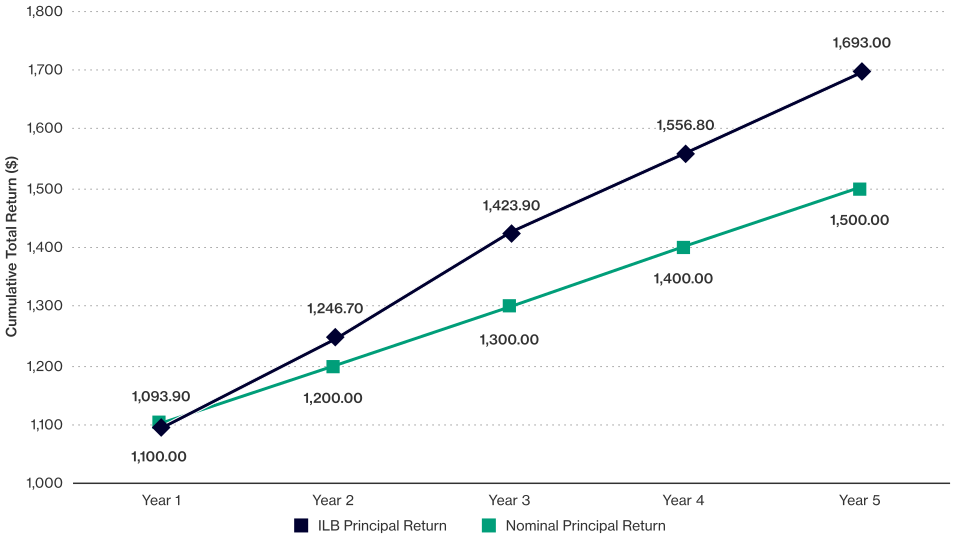
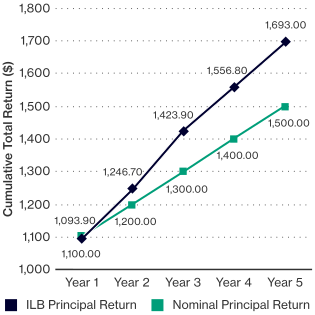
*For illustrative purposes only. Total return represents inflation adjusted principal accruals and coupon income; assumes no market price movements. The example does not represent any actual investment and does not reflect fees, expenses or taxes. Not indicative of future results.
Recommended subscription
Nominal Yield, Real Yield and the Breakeven Rate
Understanding ILBs comes down to three key components: the nominal yield, the real yield, and the breakeven rate.
The nominal yield is the return on a conventional bond assuming the bond is held until maturity, unadjusted for inflation. It is known at the time of purchase. Although inflation erodes the purchasing power of the bond’s fixed payments, nominal yields incorporate market expectations of future inflation. If realized inflation exceeds market expectations at the time of purchase, investors may be left with a return that may look attractive on paper but delivers less in practice over the life of the investment. If realized inflation is lower than expected at the time of purchase, nominal bonds can outperform ILBs.
The real yield is what investors earn above inflation. It is the yield quoted on ILBs and what nominal bond investors earn after inflation. ILBs lock in this yield upfront at the time of purchase. It is a more precise measure of return for investors thinking in real terms.
The breakeven rate is the approximate difference between the yield on a nominal bond versus an ILB with the same maturity. It can be interpreted as the market’s expectation of average future inflation over a specified time period, at a given point in time. It also represents the level of inflation at which an ILB and a nominal bond of the same maturity produce an identical return. ILBs can outperform if realized inflation is higher than the initial breakeven rate. Investors use the breakeven rate as a reference point for their inflation outlook.
In the example above, the initial breakeven rate of 4% was exceeded by average annual inflation over the life of the bond, and the ILB provided a higher total return. As shown below, the real return remains constant regardless of realized inflation, while nominal bond returns are directly impacted.
ILBs Offer Real Yields Regardless of Inflation Regime
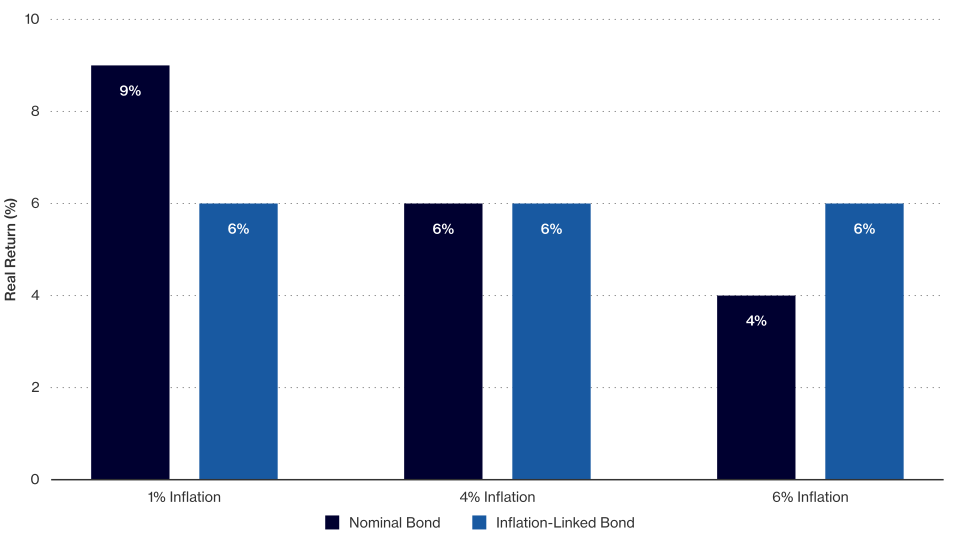
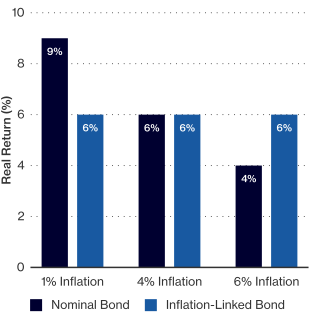
*Assumes a nominal bond with 10% coupon and an ILB with a 6% real coupon.
Interest Rates and Inflation Scenarios
ILB returns are driven primarily by two variables: real yield and realized inflation.
Real yields are driven by growth expectations and monetary policy. Slowing growth or easier monetary policy tends to push yields lower, while stronger growth and tighter policy elevate them. When real yields fall, ILB prices rise, and vice versa. As a result, ILBs remain duration-sensitive, but this price sensitivity is to real yields. Because real yields are a component of nominal yields the two can move together, so ILB prices can correlate with nominal bonds when interest rates move. A broad rise in rates typically means lower prices, even when inflation is elevated. However, ILBs may be less impacted by rising nominal rates if real rates remain steady or rise less than nominal yields.
When the market prices in higher expected future inflation, the breakeven inflation rate typically widens and is reflected in higher nominal bond yields. Nominal bonds are fully exposed to that change and experience a price decline. If the increase in nominal yield due to higher expected inflation is not accompanied by an increase in real yields, ILB prices will not be impacted. The value of an ILB will be impacted by realized inflation, which results in an adjustment to the bond’s principal and subsequently, the notional value of the coupons.
ILBs vs. Other Inflation Hedges
When evaluated alongside other asset classes commonly used as inflation hedges, ILBs stand apart. Commodities have historically correlated with rising prices, but they generate no income and are subject to supply-demand dynamics that can diverge sharply from broad consumer price inflation. Equities may struggle during periods of high sustained inflation, as rising prices can compress valuations and weigh on real returns, despite their long-run growth potential.
ILBs, by contrast, are mechanically tied to an inflation index itself. These characteristics have historically made the asset class an effective complement to diversified portfolios, offering a degree of inflation sensitivity that other instruments may not replicate with the same precision while also generating regular income. While TIPS (Treasury Inflation-Protected Securities) offer a similar structure through inflation-adjusted principal, investors seeking higher real returns have consistently found higher real yields in emerging markets (EM). This makes EM ILBs a particularly compelling option for investors that are seeking both inflation protection and stronger real returns, and are comfortable with emerging markets and foreign currency risk.
The Case for Inflation Linked Bonds
ILBs are designed to preserve purchasing power by adjusting their principal in line with inflation, which results in higher notional coupons. They have historically offered a real return certainty that nominal bonds are unable to provide. The case for the asset class is a direct result of how ILBs are built: principal values tied to local inflation and a real yield locked in at purchase. This can drive ILB outperformance versus nominal bonds in periods of high unexpected inflation.

Important Disclosures
Please note that VanEck may offer investments products that invest in the asset class(es) or industries included herein.
This is not an offer to buy or sell, or a recommendation to buy or sell any of the securities, financial instruments or digital assets mentioned herein. The information presented does not involve the rendering of personalized investment, financial, legal, tax advice, or any call to action. Certain statements contained herein may constitute projections, forecasts and other forward-looking statements, which do not reflect actual results, are for illustrative purposes only, are valid as of the date of this communication, and are subject to change without notice. Actual future performance of any assets or industries mentioned is unknown. Information provided by third party sources are believed to be reliable and have not been independently verified for accuracy or completeness and cannot be guaranteed. VanEck does not guarantee the accuracy of third-party data. The information herein represents the opinion of the author(s), but not necessarily those of VanEck or its other employees.
Emerging Market securities are subject to greater risks than U.S. domestic investments. These additional risks may include exchange rate fluctuations and exchange controls; less publicly available information; more volatile or less liquid securities markets; and the possibility of arbitrary action by foreign governments, or political, economic or social instability.
Investments in emerging markets bonds may be substantially more volatile, and substantially less liquid, than the bonds of governments, government agencies, and government-owned corporations located in more developed foreign markets. Emerging markets bonds can have greater custodial and operational risks, and less developed legal and accounting systems than developed markets.
For other important disclosures please read more.
All investing is subject to risk, including the possible loss of the money you invest. As with any investment strategy, there is no guarantee that investment objectives will be met and investors may lose money. Diversification does not ensure a profit or protect against a loss in a declining market. Past performance is no guarantee of future results.
Important Disclosures
Please note that VanEck may offer investments products that invest in the asset class(es) or industries included herein.
This is not an offer to buy or sell, or a recommendation to buy or sell any of the securities, financial instruments or digital assets mentioned herein. The information presented does not involve the rendering of personalized investment, financial, legal, tax advice, or any call to action. Certain statements contained herein may constitute projections, forecasts and other forward-looking statements, which do not reflect actual results, are for illustrative purposes only, are valid as of the date of this communication, and are subject to change without notice. Actual future performance of any assets or industries mentioned is unknown. Information provided by third party sources are believed to be reliable and have not been independently verified for accuracy or completeness and cannot be guaranteed. VanEck does not guarantee the accuracy of third-party data. The information herein represents the opinion of the author(s), but not necessarily those of VanEck or its other employees.
Emerging Market securities are subject to greater risks than U.S. domestic investments. These additional risks may include exchange rate fluctuations and exchange controls; less publicly available information; more volatile or less liquid securities markets; and the possibility of arbitrary action by foreign governments, or political, economic or social instability.
Investments in emerging markets bonds may be substantially more volatile, and substantially less liquid, than the bonds of governments, government agencies, and government-owned corporations located in more developed foreign markets. Emerging markets bonds can have greater custodial and operational risks, and less developed legal and accounting systems than developed markets.
For other important disclosures please read more.
All investing is subject to risk, including the possible loss of the money you invest. As with any investment strategy, there is no guarantee that investment objectives will be met and investors may lose money. Diversification does not ensure a profit or protect against a loss in a declining market. Past performance is no guarantee of future results.