A New Era for Latin America? What It Could Mean for EM Bonds
January 20, 2026
Read Time 8 MIN
Key Takeaways:
- EMBX outperformed across time frames, delivering 19.04% in 2025 and 3.9% annualized over five years, materially ahead of its benchmark and developed-market fixed income alternatives.
- Easing global monetary conditions and improving EM policy credibility are creating a more supportive macro backdrop for local currency debt, enhancing income potential without extending duration risk.
- Shifting geopolitics in South America, led by Venezuela’s re-entry path, could drive regional convergence in growth, inflation, and capital access, reshaping the EM opportunity set.
In 2025, the VanEck Emerging Markets Bond ETF (EMBX) was up 19.04%, compared to 16.80% for its benchmark, the 50% J.P. Morgan Government Bond Index - Emerging Markets Global Diversified (GBI-EM) and 50% J.P. Morgan Emerging Markets Bond Index (EMBI) and 8.09% and 8.2% for the Global Agg and 10-year Treasuries, respectively. In the past five years, EMBX has returned 3.9% per year, compared to 1.5% for its benchmark, and -2.5%, and -2.4% per year for the Global Agg and 10-year Treasuries, respectively. EMBX was up 1.4% in December, compared to 1.11% for its benchmark. After pulling in our horns in December, EMBX has returned to its mean exposures of the past year, with local currency exposure up to around 55% from 40%. Carry is 6.3%, yield to worst is 7.6% and duration is 5.5, right near benchmark duration.
Average Annual Total Returns* (%) (In USD)
| Month End As of December 31, 2025 | 1 Mo | 3 Mo | YTD | 1 Yr | 3 Yrs | 5 Yrs | 10 Yrs |
| EMBX (NAV) | 1.41 | 3.15 | 19.04 | 19.04 | 10.84 | 3.87 | 5.49 |
| EMBX (Share Price) | 1.12 | 3.03 | 18.91 | 18.91 | 10.80 | 3.85 | 5.48 |
| 50% GBI-EM/50% EMBI | 1.11 | 3.32 | 16.80 | 16.80 | 10.08 | 1.50 | 4.20 |
* Returns less than one year are not annualized.
The performance data quoted represents past performance. Past performance is not a guarantee of future results. Investment return and principal value of an investment will fluctuate so that an investor's shares, when redeemed, may be worth more or less than their original cost. Performance may be lower or higher than performance data quoted. Please call 800.826.2333 or visit vaneck.com for performance current to the most recent month ended.
Prior to 10/06/2025, the Fund operated as the VanEck Emerging Markets Bond mutual fund; performance shown before that date is that fund’s NAV performance (Class I, unadjusted for today’s ETF expenses).
The "Net Asset Value" (NAV) of a Fund is determined at the close of each business day, and represents the dollar value of one share of the fund; it is calculated by taking the total assets of the fund, subtracting total liabilities, and dividing by the total number of shares outstanding. The NAV is not necessarily the same as the ETF 's intraday trading value. Investors should not expect to buy or sell shares at NAV.
EMBX Total Expense Ratio – 0.76%. Van Eck Associates Corporation (the “Adviser”) will pay all expenses of the Fund, except for the fee payment under the investment management agreement, acquired fund fees and expenses, interest expense, offering costs, trading expenses, taxes and extraordinary expenses. Notwithstanding the foregoing, the Adviser has agreed to pay the offering costs until at least May 1, 2027. “Other Expenses” have been restated to reflect current fees.
EMBX | VanEck Emerging Markets Bond ETF
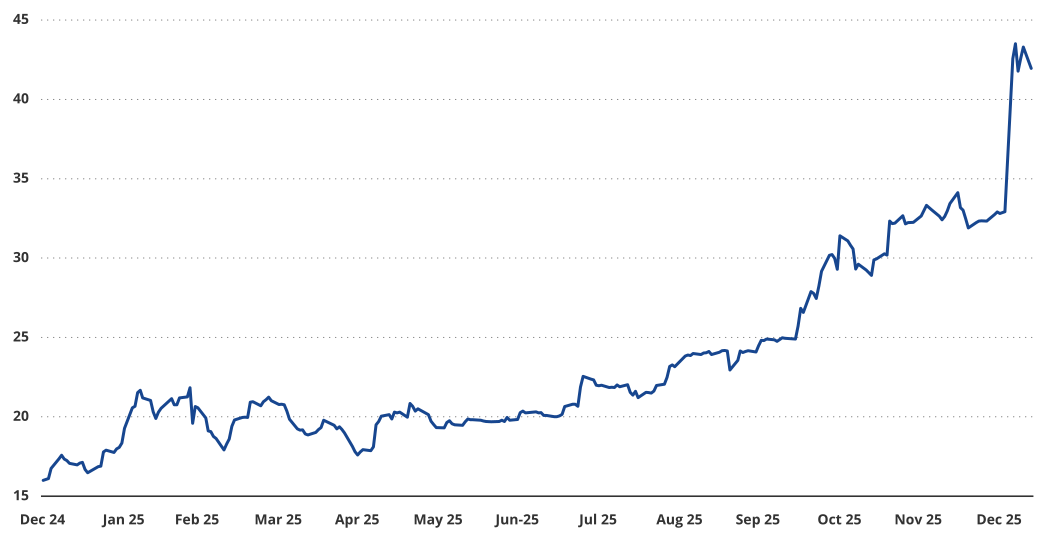
Venezuelan developments are important for Venezuelan asset prices. Venezuela went from having no path to increased production, an end to sanctions, an elected government and a debt restructuring, to having a path. The market is still adjusting to this new state-of-nature, despite a tremendous rally in Venezuela and PDVSA bonds following Maduro’s arrest. You can see the price action in Exhibit 1. Bonds in the Venezuela/PSVSA complex went up around 10 points from the high 20s to the low 40s. Let’s step back a second to focus on the bonds and the type of restructuring that could maintain. There are basically two key determinants of their present value – how long it takes to get a deal, and what the deal looks like. On how long it takes, well, that’s obviously a judgment going forward but it’s also obviously a possibility today when it wasn’t just a few days ago. On the deal we’ll get, there is great uncertainty, but fund managers can’t wait for the outcome of course. The main points to consider are as follows:
- The numbers are unknown/highly uncertain. Debt/GDP may be 160%, but there are estimates of over 200%.
- Production could increase by 250k bpd under the current transitory political scenario.
- Political stability and new elections would change the nature of the investment environment and permit far greater production increases over time.
- China could get sidelined as a bilateral creditor. The US could dominate all discussions, including over the IMF, whose involvement is not certain.
- The US, in Bolivia and Argentina, favored policies that supported a quick return to market access. We see more information here than in the Iraq precedent.
- The “exit yield” to discount restructured cash flows could be very low or very high depending on political stability, which is a necessary condition for a positive outcome.
Exhibit 1 – Venezuela Bonds I-Shaped
Recommended subscription
Source: Bloomberg. Data as of January 2026. Past performance is no guarantee of future results.
Venezuelan developments are also important for neighbors, such as Colombia. Colombia’s local market leads emerging markets (EM) so far in 2026, as markets discount new scenarios that could impact, politics and policy. Mexico and Brazil are also more in-focus. Colombia’s political environment has stronger institutions and is very divided. It also faces serious fiscal challenges that even market-friendly candidates may find difficult to successfully address. Nonetheless, US involvement next door is an unquestionable change in the mood music. And Colombia’s military is a strong institution whose closeness to the US may come to bear, depending on political scenarios. Brazil also faces presidential elections this year. The market-friendly candidate would normally be a frontrunner, but because his name might be Bolsonaro we have a bit of a soap opera. A bit more binary here, but we continue to think the risk remains of a tilt toward the right in Brazil, with only the right in the way of a victory for the right.
Venezuelan developments are important for South America, with regional “convergence” now a long-term possibility. What might “successful” US regionalism generate? A stable financial, economic, social, and inflation outcome for many countries, for one. Convergence is a real economic (and other dimension) phenomenon. We say this because for too many, the first question following Venezuelan developments was “what does this mean for Taiwan?” “What does this mean for Iran?” was another favorite – everyone thinks they’re on CNN. There are a lot of steps between Venezuela and Taiwan, and none to Colombia and few to Mexico and Brazil. One scenario we believe we’ll be hearing a lot more about is “convergence”. It’s a natural or created phenomenon but it’s real. Your author was part of the great European “convergence trade”, in which large institutions bought, for example, Polish zloty bonds as Polish inflation and growth and institutions converged to Germany’s (which used to be a good thing…now Poland just grows on its own). Anyway, our point is to have some memory (you don’t even need imagination). If politics and economics are converging, shouldn’t inflation and other variables critical to asset prices? It’s far less of a stretch than figuring out what Venezuela means for Iran. Some concrete examples of US policy forbearance in such “convergence” situations happened in our own portfolio just in 2025 – Bolivia and Argentina! We wrote about each at the time, but in both situations the US Treasury was deeply involved in managing a smooth transition. In Bolivia, emergency fuel supplies were provided right after elections, and we all know the extraordinary support lent to Argentina. Both situations led to rallies in USD bonds, and both were characterized by a wall of worry and lists of all the obstacles to progress…which happened.
Exposure Types and Significant Changes
The changes to our top positions are summarized below. Our largest positions in December were South Africa, Mexico, Poland, Thailand and Malaysia:
-
We increased our local currency exposure in Mexico, Colombia, and Brazil. Mexico’s local bonds should be able to piggyback on additional policy easing in the U.S. against the backdrop of on-going fiscal consolidation. Mexico also stands to benefit from global AI investments. In terms of our investment process, this improved the technical and policy test scores for the country. Colombia’s fiscal situation is concerning, but the central bank’s stance is credible, and local bonds can benefit from the potential return of pension funds’ money into the domestic debt market, which would improve the technical test score for the country. Brazil is on the cusp of a credible rate-cutting cycle, which should improve the policy test score for the country after the year-end period of tight liquidity is over.
-
We also increased our local currency exposure in Poland and South Korea. Poland’s lower than expected inflation leaves room for additional rate cuts, improving the policy and economic test scores for the country. The South Korean won’s strong correlation with the Japanese Yen (which is likely to be supported by the Bank of Japan) improved the technical test score for local bonds.
-
Finally, we increased our hard currency sovereign exposure in Israel and Zambia, and hard currency sub-sovereign and corporate exposure in Argentina. Compelling valuations in Zambia and Israel improved the technical test scores for both countries. Argentina’s regions and regions and companies no longer look expensive vs. the sovereign, which rallied on the back of a positive shift in the FX regime and reserves accumulation. In terms of our investment process, this improved the technical and policy test scores for the country.
-
We reduced our local currency exposure in South Africa, Thailand, and Paraguay. South Africa’s valuations look expensive (the worst valuation quartile) after a monster rally, following the adoption of the new inflation target. In terms of our investment process, this worsened the technical test score for the country. Thailand is a low yielder with less attractive valuations, which also worsened the technical test score.
-
We also reduced our hard currency sovereign exposure in Saudi Arabia and the Philippines due to our concerns about global duration, which worsened the technical test scores for both countries.
-
Finally, we reduced our hard currency corporate exposure in Nigeria and hard currency sovereign exposure in Peru and Indonesia. The key driver in Nigeria was the negative oil price dynamics, which worsened the technical test score. The worsening technical test score was also the main factor in Peru and Indonesia, where we had meaningful duration exposure. In addition, concerns about Petroperu’s rating downgrades, the company’s top management “revolving door”, and uncertain restructuring plans lowered the policy test score for the company.
To receive more Emerging Markets Bonds insights, sign up in our subscription center.

Disclosure
This is not an offer to buy or sell, or a recommendation to buy or sell any of the securities, financial instruments or digital assets mentioned herein. The information presented does not involve the rendering of personalized investment, financial, legal, tax advice, or any call to action. Certain statements contained herein may constitute projections, forecasts and other forward-looking statements, which do not reflect actual results, are for illustrative purposes only, are valid as of the date of this communication, and are subject to change without notice. Actual future performance of any assets or industries mentioned are unknown. Information provided by third party sources are believed to be reliable and have not been independently verified for accuracy or completeness and cannot be guaranteed. VanEck does not guarantee the accuracy of third party data. The information herein represents the opinion of the author(s), but not necessarily those of VanEck or its other employees.
Duration measures a bond's sensitivity to interest rate changes that reflects the change in a bond's price given a change in yield. This duration measure is appropriate for bonds with embedded options. Carry is the benefit or cost for owning an asset. Yield to worst is a measure of the lowest possible yield that can be received on a bond with an early retirement provision. Averages are market weighted. The yields presented do not represent the performance of the Fund. These statistics do not take into account fees and expenses associated with investments of the Fund.
All indices are unmanaged and include the reinvestment of all dividends, but do not reflect the payment of transaction costs, advisory fees or expenses that are associated with an investment in the Fund. Certain indices may take into account withholding taxes. An index's performance is not illustrative of the Fund's performance. Indices are not securities in which investments can be made.
The Fund's benchmark index (50% GBI-EM/50% EMBI) is a blended index consisting of 50% J.P. Morgan Government Bond Index-Emerging Markets (GBI-EM) Global Diversified and 50% J.P. Morgan Emerging Markets Bond Index (EMBI). The J.P. Morgan GBI-EM Global Diversified tracks local currency bonds issued by Emerging Markets governments. The J.P. Morgan EMBI Global Diversified tracks returns for actively traded external debt instruments in emerging markets, and is also J.P. Morgan's most liquid U.S. dollar emerging markets debt benchmark.
The Bloomberg Global Aggregate Index measures the performance of global investment grade fixed income securities.
The FTSE Treasury Benchmark 10 year measures the return of the 10 year U.S. Treasury.
Information has been obtained from sources believed to be reliable but J.P. Morgan does not warrant its completeness or accuracy. The Index is used with permission. The index may not be copied, used or distributed without J.P. Morgan's written approval. Copyright 2025, J.P. Morgan Chase & Co. All rights reserved.
An investment in the VanEck Emerging Markets Bond ETF may be subject to risks which include, among others, risks related to active management, credit, credit-linked notes, currency management strategies, derivatives, emerging market issuers, ESG investing, foreign currency, foreign securities, hedging, high portfolio turnover, high yield securities, interest rate, market, non-diversified, operational, restricted securities, investing in other funds, sovereign bond, special risk considerations of investing in African, Asian, and Latin American issuers, authorized participant concentration, no guarantee of active trading market, trading issues, fund shares trading, premium/discount and liquidity of fund shares, and cash transactions risks, all of which may adversely affect the Fund. Emerging market issuers and foreign securities may be subject to securities markets, political and economic, investment and repatriation restrictions, different rules and regulations, less publicly available financial information, foreign currency and exchange rates, operational and settlement, and corporate and securities laws risks.
Investing involves substantial risk and high volatility, including possible loss of principal. An investor should consider the investment objective, risks, charges and expenses of a Fund carefully before investing. To obtain a prospectus and summary prospectus, which contain this and other information, call 800.826.2333 or visit vaneck.com. Please read the prospectus and summary prospectus carefully before investing.
© Van Eck Securities Corporation, Distributor, a wholly-owned subsidiary of Van Eck Associates Corporation.
Related Funds
Disclosure
This is not an offer to buy or sell, or a recommendation to buy or sell any of the securities, financial instruments or digital assets mentioned herein. The information presented does not involve the rendering of personalized investment, financial, legal, tax advice, or any call to action. Certain statements contained herein may constitute projections, forecasts and other forward-looking statements, which do not reflect actual results, are for illustrative purposes only, are valid as of the date of this communication, and are subject to change without notice. Actual future performance of any assets or industries mentioned are unknown. Information provided by third party sources are believed to be reliable and have not been independently verified for accuracy or completeness and cannot be guaranteed. VanEck does not guarantee the accuracy of third party data. The information herein represents the opinion of the author(s), but not necessarily those of VanEck or its other employees.
Duration measures a bond's sensitivity to interest rate changes that reflects the change in a bond's price given a change in yield. This duration measure is appropriate for bonds with embedded options. Carry is the benefit or cost for owning an asset. Yield to worst is a measure of the lowest possible yield that can be received on a bond with an early retirement provision. Averages are market weighted. The yields presented do not represent the performance of the Fund. These statistics do not take into account fees and expenses associated with investments of the Fund.
All indices are unmanaged and include the reinvestment of all dividends, but do not reflect the payment of transaction costs, advisory fees or expenses that are associated with an investment in the Fund. Certain indices may take into account withholding taxes. An index's performance is not illustrative of the Fund's performance. Indices are not securities in which investments can be made.
The Fund's benchmark index (50% GBI-EM/50% EMBI) is a blended index consisting of 50% J.P. Morgan Government Bond Index-Emerging Markets (GBI-EM) Global Diversified and 50% J.P. Morgan Emerging Markets Bond Index (EMBI). The J.P. Morgan GBI-EM Global Diversified tracks local currency bonds issued by Emerging Markets governments. The J.P. Morgan EMBI Global Diversified tracks returns for actively traded external debt instruments in emerging markets, and is also J.P. Morgan's most liquid U.S. dollar emerging markets debt benchmark.
The Bloomberg Global Aggregate Index measures the performance of global investment grade fixed income securities.
The FTSE Treasury Benchmark 10 year measures the return of the 10 year U.S. Treasury.
Information has been obtained from sources believed to be reliable but J.P. Morgan does not warrant its completeness or accuracy. The Index is used with permission. The index may not be copied, used or distributed without J.P. Morgan's written approval. Copyright 2025, J.P. Morgan Chase & Co. All rights reserved.
An investment in the VanEck Emerging Markets Bond ETF may be subject to risks which include, among others, risks related to active management, credit, credit-linked notes, currency management strategies, derivatives, emerging market issuers, ESG investing, foreign currency, foreign securities, hedging, high portfolio turnover, high yield securities, interest rate, market, non-diversified, operational, restricted securities, investing in other funds, sovereign bond, special risk considerations of investing in African, Asian, and Latin American issuers, authorized participant concentration, no guarantee of active trading market, trading issues, fund shares trading, premium/discount and liquidity of fund shares, and cash transactions risks, all of which may adversely affect the Fund. Emerging market issuers and foreign securities may be subject to securities markets, political and economic, investment and repatriation restrictions, different rules and regulations, less publicly available financial information, foreign currency and exchange rates, operational and settlement, and corporate and securities laws risks.
Investing involves substantial risk and high volatility, including possible loss of principal. An investor should consider the investment objective, risks, charges and expenses of a Fund carefully before investing. To obtain a prospectus and summary prospectus, which contain this and other information, call 800.826.2333 or visit vaneck.com. Please read the prospectus and summary prospectus carefully before investing.
© Van Eck Securities Corporation, Distributor, a wholly-owned subsidiary of Van Eck Associates Corporation.