China - Growth Slump Is Over?
November 30, 2021
Read Time 2 MIN
China’s activity gauges signal that the near-term growth outlook remains problematic. The government has plenty of fiscal space to address the issue – will it use it or ideology will dictate otherwise?
China’s headline activity gauges (PMIs1) moved back to expansion territory in November, adding weight to an argument that the growth momentum is stabilizing after being hit by a rather long list of adverse factors, including tighter regulations, the real estate crunch, energy rationing, supply chain disruptions, higher commodity prices, and the zero-COVID approach. Targeted policies helped for sure. First, authorities rolled back some real estate restrictions, called on property developers to honor their debt obligations, and urged banks to maintain a “stable and orderly” flow of credit to the sector. Second, there was a concerted effort to ease commodity price pressures and power rationing. Third, the government extended support for small and medium-size companies, cutting some taxes and fees, assisting with cloud/digital services, lowering power tariffs (via local governments), and asking for more funding from banks.
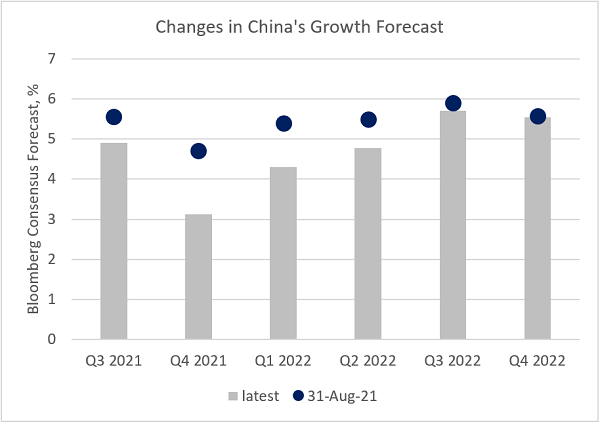
Even though the headline PMIs beat expectations, weaknesses are abound. The manufacturing PMI was barely above the expansion/contraction threshold (50.1). The services PMI was a touch lower than a month ago (52.3). Gauges for services that are sensitive to the movement restrictions (and COVID outbreaks) moved deeper into contraction zone. The new orders sub-index remained in contraction territory, as did the small companies PMI. China’s growth outlook for the next several quarters is now noticeably weaker than was expected just a few months ago (see chart below), and today’s release signals that the risks are still to the downside – especially with such formidable headwinds as the omicron outbreak and the cooling real estate sector.
Would this justify stepping up policy support? Until now, the central bank kept its “bazooka” locked in a safe, with key rates and reserve requirements for banks unchanged. However, the latest communications contained a reference to “quasi-stagflation”, while the monetary policy report no longer mentioned the need to control “the valve on money supply”. The next batch of money and credit aggregates (in about 10 days) will show whether this is indeed the case. So, stay tuned!
Chart at a Glance: Consensus Sees China’s Growth Slump Lasting Until Q322
Source: Bloomberg LP
